Vietnam urged to balance long-term trade interest amid China’s CPTPP application: Expert
Vietnam should further diversify its import markets to reduce trade risks in the future.
Economist Nguyen Tri Hieu told The Hanoi Times that Vietnam should stay cautious about ensuring long-term trade interest in case China succeeds in joining the Comprehensive and Progressive Agreement for Trans-Pacific Partnership (CPTPP).
What is your view on China’s application to join the CPTPP on September 16?
From my view, China is looking to expand both its economic and political presence in the region, while the accession into the CPTPP would provide the country with an opportunity to further strengthen its leading economic influence in the Asia-Pacific.
| Economist Nguyen Tri Hieu. Photo: Anh Ngoc |
.jpeg)
Assuming all 11 CPTPP members agree to China’s request, how would this change Vietnam’s trade relations with other countries?
There is no doubt that Vietnam’s goods and products would gain more advantage in penetrating China’s market. But in return, this would mean growing competition in the domestic market from Chinese imports.
The matter is of significance as Vietnam is suffering a trade deficit with China, so the situation would continue to remain favorable for the latter in the future.
Vietnam, therefore, should stay cautious before giving a “green light” for China to join the CPTPP and only do so when benefits are greater than the growing trade deficit that Vietnam would face.
Meanwhile, the Covid-19 pandemic has revealed the dependence of Vietnam and also the global economy on China.
While the Chinese economy was struggling with the Covid-19 impacts, Vietnam also felt the heat with the supply chains at risk of disruption, causing severe impacts on economic and trade activities. Higher dependence on input materials from a certain country would only heighten the trading risks for Vietnam.
In this context, the country should ensure long-term trade interests by diversifying its import markets. Reducing imports from China by turning to other countries would be the right direction for Vietnam. This task is difficult but viable, as Vietnam also has a trade deal with the EU, the EU-Vietnam Free Trade Agreement (EVFTA), so the country may push for higher trade turnover with this market.
Meanwhile, China joining the CPTPP means greater competitiveness for Vietnam’s goods, so local enterprises should focus on enhancing their product quality and get a bigger share in one of the world’s largest markets.
What types of goods and products should enjoy greater benefits from a CPTPP with China as a member?
Farm produce should be on top of the list, as the majority of Vietnam’s agricultural products are being shipped to China. So it is natural for Vietnam to continue pushing in this regard.
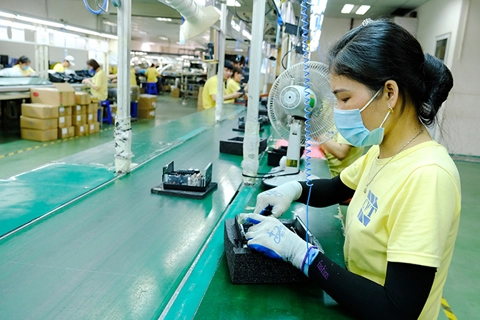
Electronics and consumer goods should be the other beneficiaries, which remain Vietnam’s main export staples.
Vietnam should also focus on the services sector once the pandemic is contained, and tourism is set to emerge as the country’s economic spearhead again, with China as a major market for Vietnam.
Thank you for your time!
| In the first eight months of 2021, China remained Vietnam’s second-largest export market, only behind the US, with a turnover of $32.7 billion, up 19.8% year on year. China, however, was Vietnam’s largest import market with $72.5 billion, surging 47.1% year on year. |