Vietnam, US move to deepen ties in science, technology and innovation
Vietnam is positioning science, technology and innovation as the driving force of its next growth phase, as Politburo member and Secretary of the Hanoi Party Committee Nguyen Duy Ngoc engaged US partners in Washington to advance cooperation in semiconductors, artificial intelligence and high-tech industries.
THE HANOI TIMES — Vietnam is stepping up cooperation with the United States in science, technology and innovation, with senior officials holding high-level meetings in Washington with leading American corporations, universities and semiconductor industry representatives.
During a February 19-20 working visit to the US as part of a high-level Vietnamese delegation led by Party General Secretary To Lam, member of the Politburo and Secretary of the Hanoi Party Committee Nguyen Duy Ngoc met with leaders of Rosen Partners, Arizona State University, Meta and the Semiconductor Industry Association (SIA).
The talks focused on expanding investment, developing Vietnam’s semiconductor ecosystem, accelerating AI deployment and strengthening high-tech education and research links.
Hanoi eyes hi-tech investment and 100-year vision
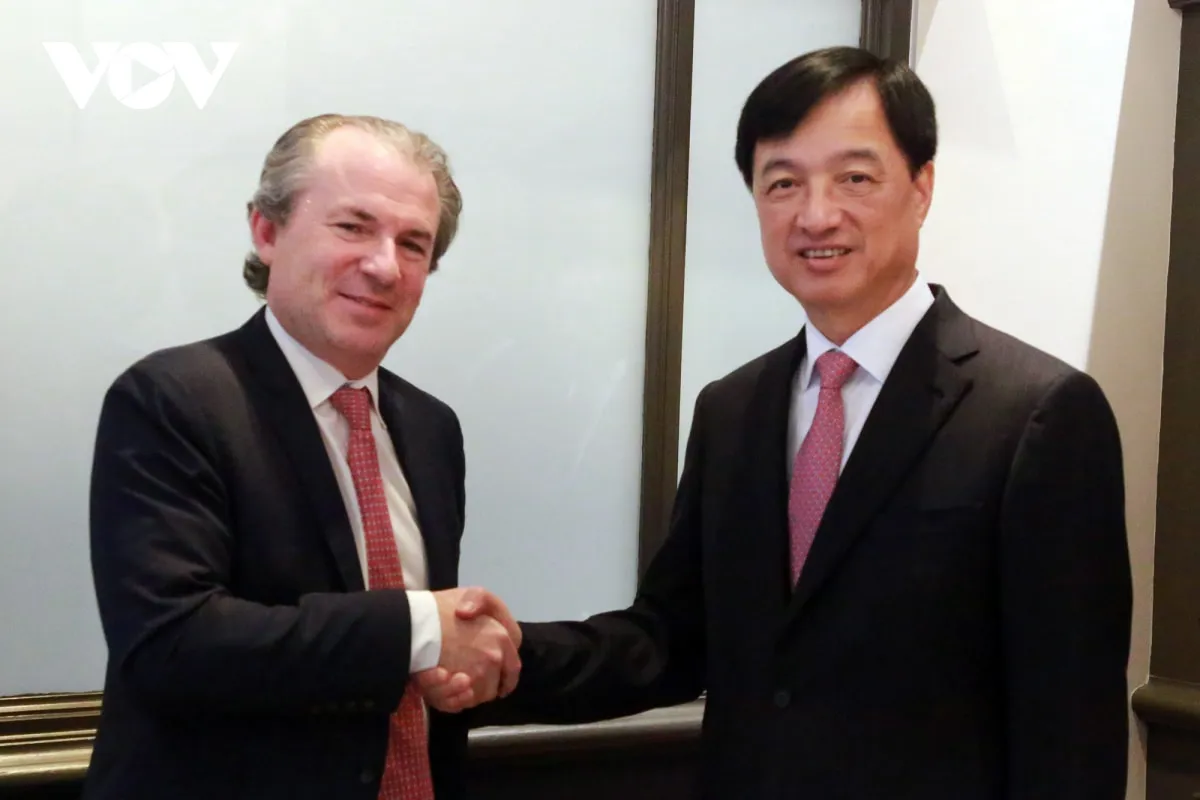
Member of the Politburo and Secretary of the Hanoi Party Committee Nguyen Duy Ngoc, right, and Chief Executive Officer of Rosen Partners, Daniel Rosen. Photos: VOV
In the meeting with Chief Executive Officer of Rosen Partners, Daniel Rosen, Ngoc welcomed Rosen Partners’ interest in investing in Hanoi, particularly in tourism and entertainment, expressing hope the projects would bring significant foreign direct investment and advanced management technologies.
He highlighted Vietnam’s new development roadmap following the 14th National Party Congress, which prioritizes double-digit economic growth and positions science, technology, innovation and digital transformation as key drivers.
Under Resolution 57-NQ/TW, Vietnam is piloting venture investment policies and prioritizing strategic technologies such as artificial intelligence and semiconductors. Hanoi, Ho Chi Minh City and surrounding provinces have established high-tech zones to host advanced technology projects.
Hanoi reported 8.16% GRDP growth in 2025, contributing roughly one-quarter of national budget revenue. The capital is targeting 11% growth from 2026 and aims to sustain double-digit expansion from 2026 to 2045 under a 100-year master plan to become a “civilized – distinctive – creative” global smart metropolis.
To support that ambition, Hanoi is inviting US companies to invest in finance, urban infrastructure, strategic technology, telecommunications, energy, healthcare, education and high-quality tourism.
Given the corporation’s strengths and the broad scope for cooperation with the capital, Ngoc encouraged it to expand beyond real estate and tourism into sectors Hanoi is prioritizing under its 100-year development vision.
Regarding research and development, he proposed that the group consider establishing research centers in Hanoi, with priority given to the Hoa Lac High-Tech Park.
“The city is finalizing breakthrough institutional reforms to ensure open market access and a competitive, transparent business environment,” said Ngoc.
He pledged streamlined procedures, “green lane” mechanisms, competitive transaction costs and ready-to-deploy land funds for major strategic partners such as Rosen Partners.
Semiconductor push: workforce, R&D and US partnerships
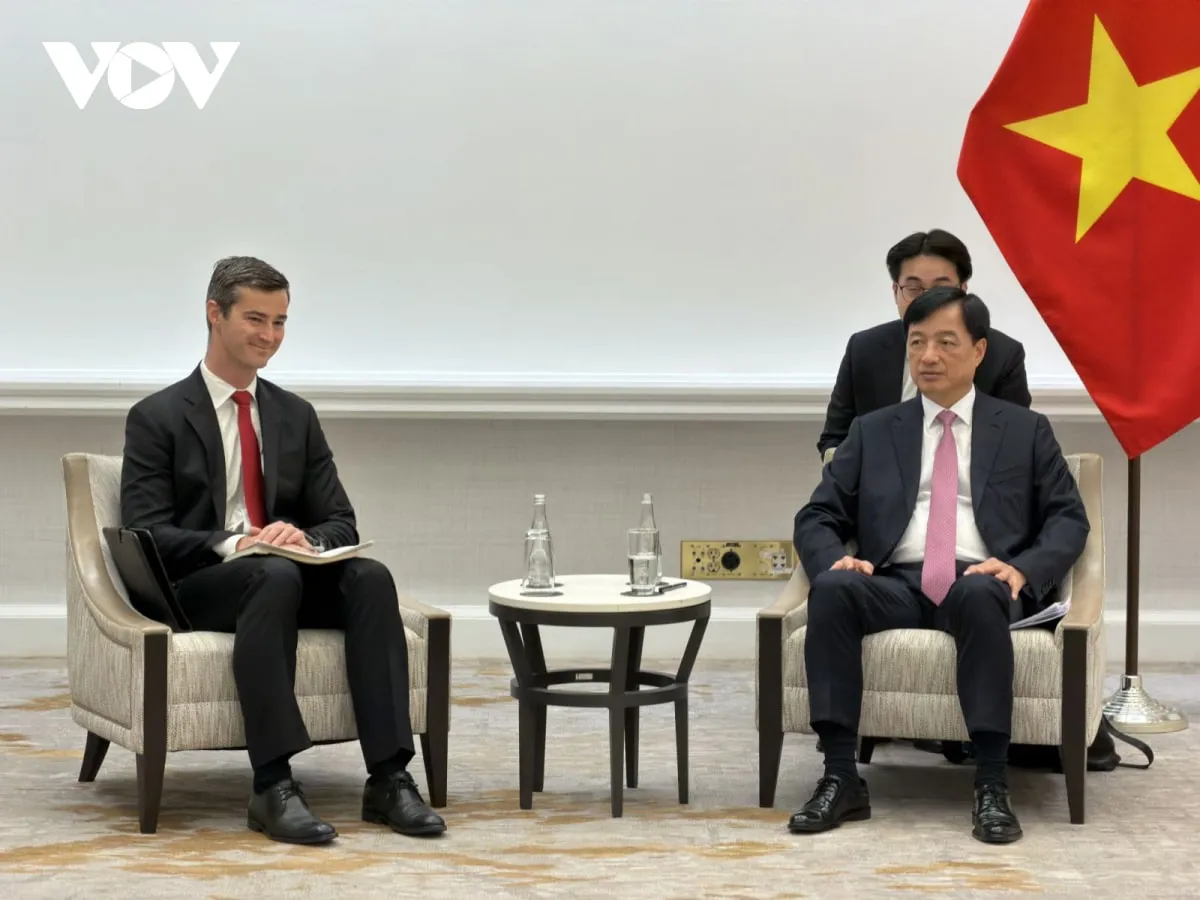
Member of the Politburo and Secretary of the Hanoi Party Committee Nguyen Duy Ngoc and Arizona State University's Vice President for Strategic Technology Initiatives Kevin McGinni.
In discussions with Vice President for Strategic Technology Initiatives Kevin McGinni and members of Arizona State University, Ngoc praised the university’s support for Vietnam in high-quality education, semiconductor research and innovation.
Hanoi proposed deeper cooperation with ASU in semiconductor workforce training, joint research, dual-degree programs and a flagship project to train 1,000 internationally qualified PhDs. The city also encouraged US semiconductor firms to invest in R&D centers for AI chips, chip design and advanced materials at Hoa Lac High-Tech Park.
Ngoc further proposed piloting a “business within university” model to foster innovation ecosystems on major university campuses in Hanoi and Ho Chi Minh City.
He pledged continued support in building an open, transparent and business-friendly investment environment, affirming that the city stands ready to apply special mechanisms and tailored policies to facilitate partners in research, training, investment and project implementation in Vietnam.
He also expressed confidence that, given their respective strengths and potential, mutually beneficial cooperation between Vietnam and US partners, including Arizona State University, will achieve new breakthroughs in the coming period.
AI, Data and digital sovereignty in talks with Meta
At meetings with Meta’s President of Global Affairs Joel Kaplan, Ngoc called for elevating cooperation to a long-term strategic technology partnership.
“Vietnam’s Resolution 57-NQ/TW promotes a shift in both mindset and implementation mechanisms, allowing pilot programs for new issues, accepting calculated risks and encouraging appropriate venture investment,” said Ngoc.
He said the resolution also aims to develop research institutes and universities into strong research hubs, closely integrating research, application and training, thereby strengthening substantive linkages among the State, businesses, research institutes and universities.
“In line with prioritizing strategic technologies, Vietnam’s official list of strategic technologies identifies semiconductor chip technology and related product groups, including specialized chips, artificial intelligence (AI) chips and Internet of Things (IoT) chips, as core priorities,” said the Hanoi Party chief.
He proposed collaboration to develop and standardize a national-scale Vietnamese language dataset to strengthen digital sovereignty while enhancing global competitiveness. The goal is to complete large-scale Vietnamese-language datasets for advanced AI models by the end of 2027.
Ngoc reaffirmed that Vietnam always welcomes and values Meta’s investment activities in the country, emphasizing that cooperation with the technology group is part of efforts to further concretize and advance the Vietnam-US Comprehensive Strategic Partnership.
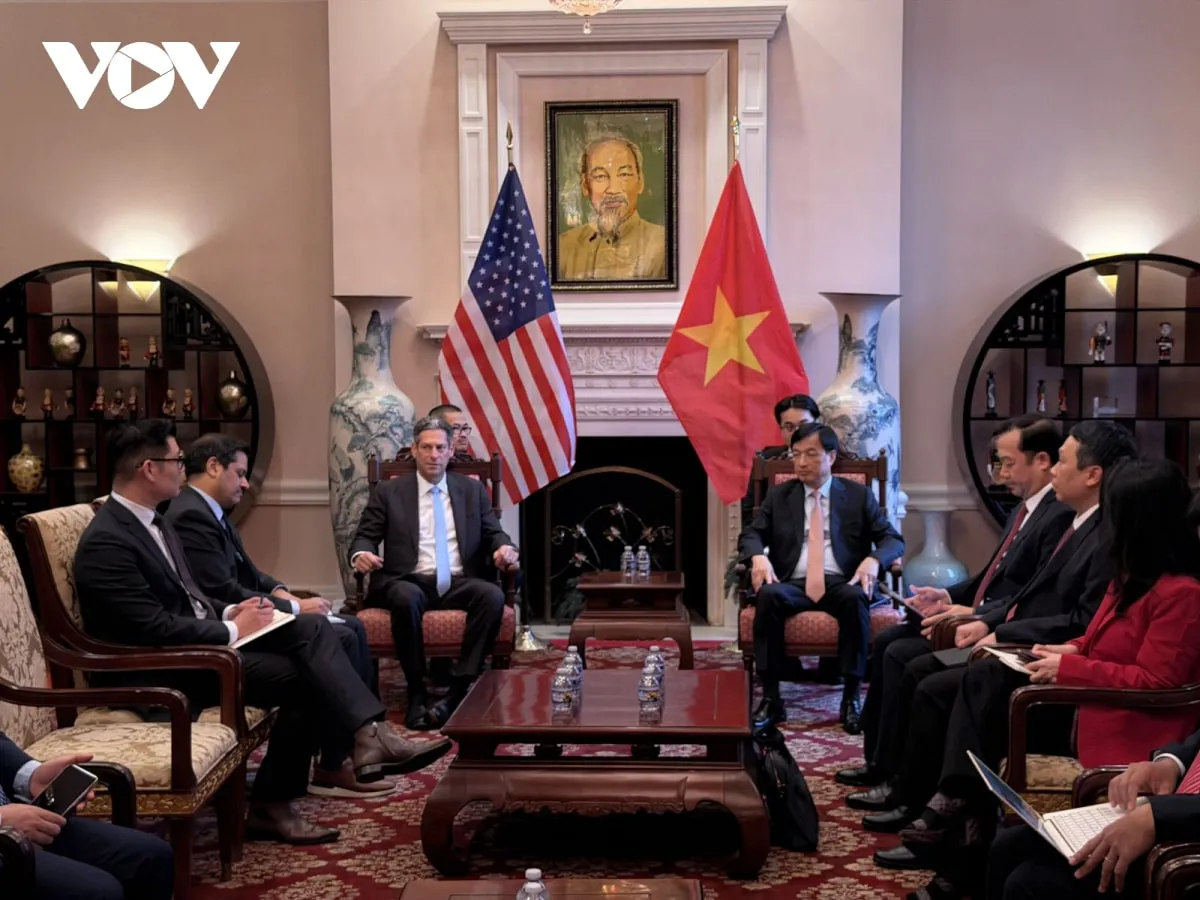
Member of the Politburo and Secretary of the Hanoi Party Committee Nguyen Duy Ngoc and Meta’s President of Global Affairs Joel Kaplan.
Strategic dialogue with US chip industry
In talks with President of the Semiconductor Industry Association (SIA) John Neuffer, Ngoc highlighted the association’s strategic influence, representing companies accounting for roughly 99 percent of US semiconductor revenue and about half of global market share.
He said the development orientation of Vietnam’s semiconductor industry has been clearly outlined in Resolution 57-NQ/TW, which identifies mastering strategic technologies as a central task.
"Semiconductor chip technology is listed among Vietnam’s strategic technologies, associated with key product groups such as specialized chips, AI chips and Internet of Things (IoT) chips," said Ngoc.
On behalf of Vietnam’s central steering committee for science and technology development, he proposed cooperation in short-term STEM certification programs in packaging, testing and chip design, potentially through US universities such as ASU; direct linkages between SIA members (including Intel, Marvell and Amkor) and leading Vietnamese universities to align graduate output with US industry demand; advisory support to refine Vietnam’s legal and policy framework for R&D investment.

Member of the Politburo and Secretary of the Hanoi Party Committee Nguyen Duy Ngoc and SIA President John Neuffer.
Ngoc acknowledged and highly appreciated the valuable recommendations and proposals for cooperation put forward by SIA President John Neuffer, expressing his support for strengthening collaboration between the association and Vietnam in the coming period.
Ngoc reaffirmed Hanoi’s commitment to transparent procedures, special policy mechanisms and long-term partnership with US technology leaders.
|
The Vietnamese government has approved a Semiconductor Industry Development Strategy to 2030, with a vision to 2050. The strategy prioritizes human resources and industrial capacity, setting major targets including: Training and developing more than 50,000 engineers and graduates to serve the semiconductor sector; Establishing design capabilities with at least 100 chip design companies; Gradually building advanced packaging and testing (ATP) capacity with at least 10 facilities; Researching and forming manufacturing capabilities, including at least one small-scale fabrication plant. |