High-tech industries to make up over 70% of Hanoi’s key industrial output
Hanoi plans to develop 30-40 key industrial products in 2026 as part of a broader push to strengthen its manufacturing base and boost export capacity.
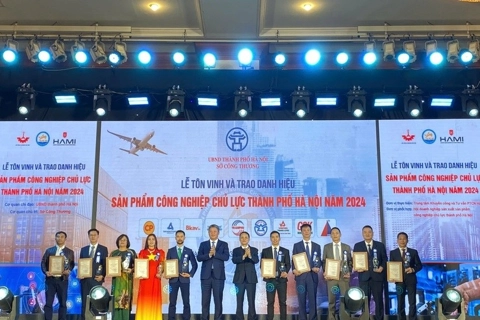
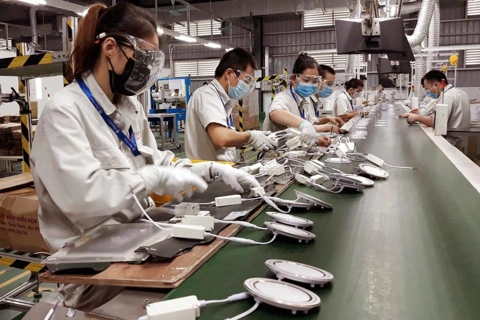
THE HANOI TIMES — High-tech, IT, mechanical and electronics products are expected to account for more than 70% of Hanoi’s key industrial output, as the capital moves to scale up its industrial base and strengthen its position in global supply chains, city officials said on January 12.
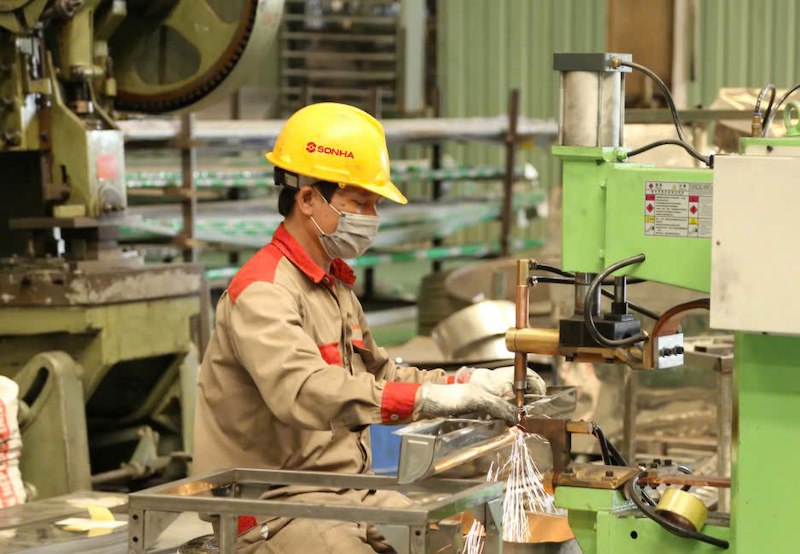
Industrial production at Son Ha Group. Photo: Khac Kien/The Hanoi Times
This strategic focus will be translated into concrete production targets, with Hanoi planning to develop 30-40 key industrial products in 2026 and 180-200 products during 2026-2030, which are projected to generate 20-25% of the city’s total export turnover.
Vo Nguyen Phong, Director of the Hanoi Department of Industry and Trade, said the city will prioritize processing and manufacturing, high-tech industries and strategic industrial products in the 2026-2030 period, identifying them as core drivers of growth.
He noted that high-tech, information technology, mechanical engineering, and electrical and electronics products are projected to make up more than 70% of all key industrial products, underscoring a shift toward higher value-added manufacturing.
“The objective is to raise value added, enhance competitiveness and reinforce Hanoi’s role in global supply chains,” Phong said in a meeting with Chairman of the Hanoi People’s Committee Vu Dai Thang on January 12.
At the same time, Hanoi plans to expand its supporting industries. The city targets more than 1,000 supporting-industry enterprises by 2026 and around 1,200 by 2030, aiming to build an integrated production ecosystem that links domestic firms with foreign-invested companies.
Accelerating investment in industrial cluster infrastructure remains a priority. Hanoi plans to fully occupy six clusters with completed infrastructure, finish infrastructure construction for 26 clusters launched during 2021–2025 and break ground on new clusters approved in 2025.
The city also intends to establish or expand five to ten additional industrial clusters in line with its master plan. All operating clusters must have centralized wastewater treatment systems that meet environmental standards, ensuring industrial expansion aligns with sustainability goals.
Based on these priorities, the Hanoi Department of Industry and Trade is finalizing a master plan for key and supporting industries through 2030, with a vision to 2045.
A separate plan for handicrafts and small-scale industries for 2026–2030 will support traditional craft villages and suburban areas.
For 2026, Hanoi targets export growth of 12% year on year, an industrial production index increase of 9.7%, and 13.1% growth in wholesale and retail trade, including vehicle repair services. Consumer price inflation is expected to be kept below 4.5% to support macroeconomic stability.
Chairman of the Hanoi People’s Committee Vu Dai Thang noted that while Hanoi has attracted many investment proposals in recent years, relatively few focus on manufacturing and processing. Most proposals target real estate, commerce, tourism and services.
This imbalance highlights weaknesses in the city’s manufacturing base, which has grown more slowly than the national average, he said.
Although Hanoi hosts the Hoa Lac Hi-tech Park and continues to draw high-tech projects, stronger policies remain necessary to advance high-tech manufacturing and supporting industries,Thang added.
The chairman said that industrial zones and clusters must align fully with the capital’s master plan and be arranged along major development corridors to create production space and jobs for local residents.
For approved industrial zones that show slow progress, the city should review, adjust where needed and push forward to ensure completion in line with the 2030 roadmap, he said.