Elon Musk’s Starlink satellite internet service approved in Vietnam
The five-year pilot, ending before January 1, 2031, aims to complement existing networks in remote areas and provide backup connectivity during natural disasters.
THE HANOI TIMES — Vietnam has officially granted SpaceX approval to operate its Starlink satellite internet service in the country, marking a significant step toward expanding digital connectivity.

Starlink by millionaire Elon Musk gets approval to operate in Vietnam.
The Ministry of Science and Technology has issued licenses for fixed and mobile satellite telecommunications services, as well as authorization to use radio frequencies and equipment. However, an official commercial launch date has not yet been announced.
Starlink Services Vietnam Co., Ltd., the local entity established by SpaceX, is authorized to deploy four gateway stations and up to 600,000 user terminals nationwide during an initial pilot phase.
The cap is expected to ensure effective management of radio frequency resources while maintaining regulatory oversight.
The approval is based on a controlled pilot framework that allows SpaceX to invest in and operate satellite telecommunications services in Vietnam, subject to national defense and security requirements.
The pilot program will last five years from the date the company receives its full telecommunications business license and must conclude before January 1, 2031.
Satellite internet services are expected to complement Vietnam’s existing terrestrial networks, particularly in remote, mountainous, border and island areas where traditional infrastructure is limited.
Local authorities also view satellite connectivity as an important backup during natural disasters, when ground-based systems may be disrupted.
Although the decision marks an important step in Vietnam’s digital development, experts said its impact on the domestic telecom market may be limited because most areas are already covered. Instead, satellite internet is viewed as a useful addition that improves network reliability and expands access where needed.
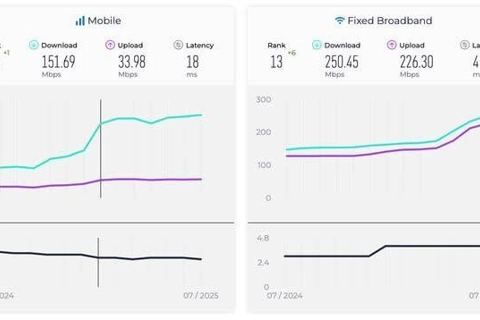
Vietnam has built one of Southeast Asia’s most dynamic internet markets, with internet penetration exceeding three-quarters of the population and mobile connectivity serving as the primary access channel for most users.
Urban areas enjoy widespread fiber-optic broadband and 4G coverage, while 5G services are being gradually expanded in major cities.
The country’s digital transformation strategy has made telecommunications infrastructure a national priority, supporting e-government, e-commerce and the broader digital economy.
Major domestic operators such as Viettel, VNPT and MobiFone dominate the market, investing heavily in fiber-to-the-home networks and nationwide mobile coverage. As a result, most populated areas have reliable internet access at competitive speeds.
However, connectivity gaps remain in remote mountainous regions, border areas and offshore islands, where deploying terrestrial infrastructure is costly and technically challenging.
Vietnam also relies on undersea fiber-optic cable systems for international bandwidth, which are occasionally disrupted by faults or maintenance, affecting connection speeds.
In this context, satellite internet services are viewed as a complementary solution to improve resilience and extend coverage to hard-to-reach areas.