Vietnamese agriculture needs proper branding strategy: business insiders
About 90% of Vietnam's agro exports are low-value-added commodities.
Effective branding is highly recommended to improve the competitiveness and popularity of Vietnamese farm produce, according to business insiders.
| High-tech farming in My Hung Commune, Thanh Oai District, Hanoi. Photo: Trong Tung/The Hanoi Times |

According to the General Statistics Office, Vietnam now has 11 export products, each of which generates revenues of more than US$1 billion. Among these, agricultural exports continue to play an important role.
In January 2024, agricultural exports surged 79% year-on-year to around $5.14 billion, reaching the most difficult markets such as the US and Australia.
However, around 90% of exports are still primary commodities. According to the Institute of Policy and Strategy for Agriculture and Rural Development, their value is lower than other countries' exports in the same category and the brands remain little known in the market.
In particular, nearly 80% of Vietnam's agricultural exports are exported under the brand name of foreign companies due to a lack of logo and brand recognition, undermining their true value in the global market.
Economist Vu Vinh Phu said that building brands for Vietnamese farm products is becoming an urgent matter.
Stable, transparent, and traceable raw material supplies and plantations are essential and require the joint efforts of all local households, he said, noting that plantations need to be well connected with farming companies to ensure efficient production, product quality, and branding.
For that reason, government agencies and enterprises need to register brands in foreign markets, study new seeds, and develop a geographical indication for each commodity. "Improved processing is also a must, which will increase the value of Vietnamese agricultural brands," Phu said.
To improve the global competitiveness of Vietnamese agricultural products, Boonlap Watcharawanitchakul, Deputy General Director of animal feed producer C.P. Vietnam Corporation, suggested that stakeholders focus on key products. Vietnam exports many agricultural products to the global market and it is important to focus on advertising them globally.
Vietnamese producers and exporters must meet international production standards and there should be a nationwide marketing strategy for products, the Thai businessman advised.
To become more competitive internationally, Vietnam needs to analyze the strengths and weaknesses of its agricultural commodities, said Tran Bao Minh, Vice Chairman of Nutifood JSC.
"Vietnamese pears and apples can't be compared to Australian ones, but we are stronger in durian and rambutan," he said. "If we don't know what we're good at, it's hard to build brands."
"Branding is not just about labeling and selling our products, we need to build an entire agricultural ecosystem that benefits all stakeholders," Minh emphasized.
Lessons from exporting rice and tea
Vietnam has long been known as one of the largest exporters of tea and rice. Today, Vietnam is the fifth largest tea exporter and the seventh largest tea producer and has secured its reputation as one of the two major rice sellers in the world.
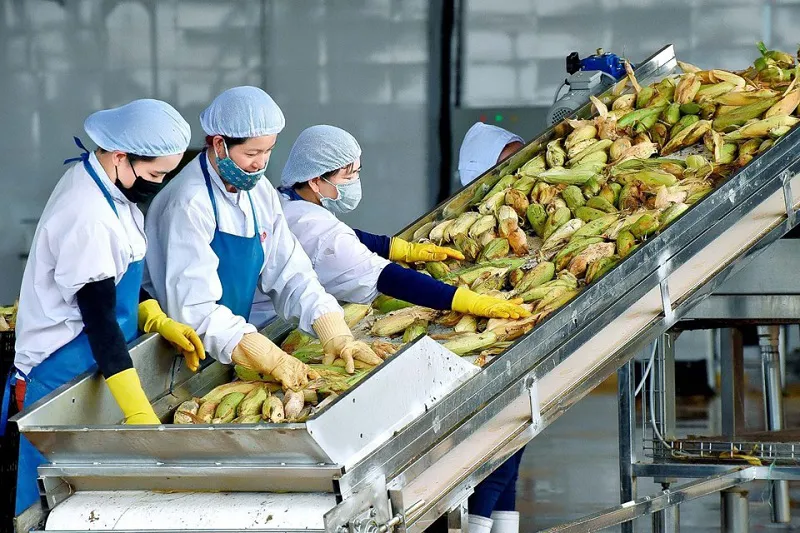
| Agricultural products undergo processing before being packaged and exported. Photo: Duc Thuy/The Hanoi Times |
However, Vietnamese rice remained little known globally until ST25 rice was announced as the world's best rice on November 31, 2023.
This has made it easier for Vietnamese trade offices around the world to export rice to international markets such as Australia, the US, and Europe.
Agronomist Vo Tong Xuan said that Vietnamese rice has made it to the most demanding markets, making Vietnam one of the top two rice exporters in the world.
Many problems need to be solved to make Vietnam the first brand that comes to mind when people think of the rice industry, the expert said.
Vietnamese exporters do not own the resources and farming areas, so they buy rice from farmers through local traders for foreign shipment. Meanwhile, small farmers prefer to do agricultural work on their own instead of cooperating to increase their production.
The recognition of ST25 is the beginning of creating brands for Vietnamese agricultural products in global markets.
"Branding requires hard work not only from farmers, businesses, and government agencies but also from scientists and engineers to increase the added value of grains," Xuan said.
Vo Thi Tam Dan, Chairwoman and General Director of Rong Vang Tea JSC, said that 90% of Vietnam's tea products are unprocessed and cheap, and very few are well-refined and branded for export.
"One kilogram of raw high-quality oolong tea sells for only $10-12, while the final product, after being processed, blended, and branded by global producers, is ten times more expensive."
Tam Dan urged domestic producers to improve production and productivity and to research new seeds to improve the quality of both raw materials and finished products.
She stressed that deep processing should be mandatory to create high-quality processed tea products that bring great economic value and facilitate the development of Vietnam's tea industry.
"We should strive to establish a close partnership between farmers and enterprises, and between plantations and the market, to ensure stable consumption and material supply," Dan noted.
![[Longform] How do Vietnamese farmers tap bioenergy for circular agriculture?](https://cdn-media.hanoitimes.vn/2023/12/20/Cover.jpg?w=480&h=320&q=100)