Vietnamese Government urged to raise base salary 6 months in advance
A higher basic wage would not only encourage public servants to improve their work performance, but also have positive effects on domestic consumption and, ultimately, on aggregate demands.
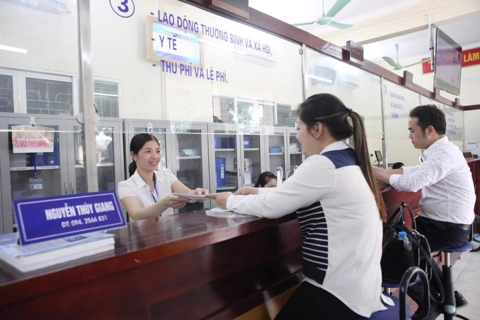
Deputies of Vietnam's National Assembly (NA) have requested the Government to increase the basic salary of civil servants as of January 1, 2023, six months ahead of schedule.
| Public staff at Hoan Kiem People's Committee. Photo: The Hanoi Times |
.jpeg)
The request was made at the ongoing NA session, following the government's latest move made on October 20, to which, Finance Minister Ho Duc Phoc presented the government's plan to allocate VND12.5 trillion (US$509 million) for wage reform, including a 20.8% increase in the base salary of civil servants from VND1.49 million ($60) to VND1.8 million ($73.3) from July 1, 2023.
During group discussions on the issue, Deputy Tran Quoc Tuan from Tra Vinh Province said the increase should take effect right in early 2023, rather than in the latter half of the year. Nguyen Huy Thai from Bac Lieu Province shared the same idea.
“For the past years, the Government has been focusing on providing support for locals and businesses to overcome Covid-19 impacts, so this is the right time for civil servants, pensioners, or those dependent on the state budget to get the much-needed support to recover from the pandemic,” Tuan said.
According to Tuan, civil servants, especially those in the healthcare sector, suffer from heavy workloads and job stress, so a higher base salary would help alleviate some of that pressure.
Moreover, the latest base wage increase took place four years ago on July 1, 2019, while the consumer price index (CPI) expanded by an annual average of 11.8% since.
Hanoi deputy Vu Tien Loc stressed the importance of the decision, saying it could be seen as an investment to improve the quality of work and discipline towards higher productivity on the one hand, and to increase spending and create positive impacts on aggregate demands on the other.
Meanwhile, Head of Prime Minister Pham Minh Chinh’s Economic Advisory Council Nguyen Duc Kien argued Vietnam’s positive economic performance is the main factor for the Government to push for higher basic wages.
“This year, Vietnam’s GDP growth is estimated at around 8%, which would create favorable conditions for the authorities to raise wages for employees in the state sector,” Kien said.
In this regard, Deputy Hoang Van Cuong from Hanoi, a member of the NA's Finance and Budget Committee, said that considering this year's estimated budget revenue of VND1,600 trillion ($68.2 billion), 14.3% higher than the annual target, it is feasible for the State budget to allocate funds for wage increases while maintaining other priorities of capital spending and the socio-economic recovery program.
Minister of Interior Pham Thanh Tra told a NA debate session that during the first half of 2022 the number of civil servants leaving their jobs was 39,500, most of them in education and healthcare.
In the past two years, such a number in the education sector was 16,400, of which those with bachelor's degrees made up 49%, and 12,190 in the healthcare sector, with over 56% holding a bachelor's degree.
According to Tra, most decided to leave their jobs around the last half of 2021 and the first six months of this year, concentrating on big cities such as Ho Chi Minh City, Hanoi, Dong Nai, Binh Duong, Ba Ria - Vung Tau, Long An, and Can Tho.
Tra said civil servants are suffering pressure from rising living costs, while their salary has not changed.
"In the post-pandemic era, there has also been a boom in the development of privately run health or education services, which has further attracted labor from the state sector to the private sector," Tra added.
Under current regulations, the basic wage in Vietnam is the reference for calculating the total wage for civil servants by multiplying it with its corresponding coefficient. The latest hike in minimum wage took place on July 1, 2019, with an increase from VND1.39 million to VND1.49 million. New graduates entering the state sector would be subject to salary level 1 with a coefficient of 2.34, equivalent to a monthly wage of VND3.48 million ($140). |