Vietnamese Gov’t approves national planning for 2021-2030
The planning would serve as the basis for Vietnam to become an upper-middle-income country by 2030.
Deputy Prime Minister Le Van Thanh has signed resolution No.138/NQ-CP approving the national planning for the 2021-2030 period, with a vision for 2050, which the National Assembly will scrutinize for final ratification.
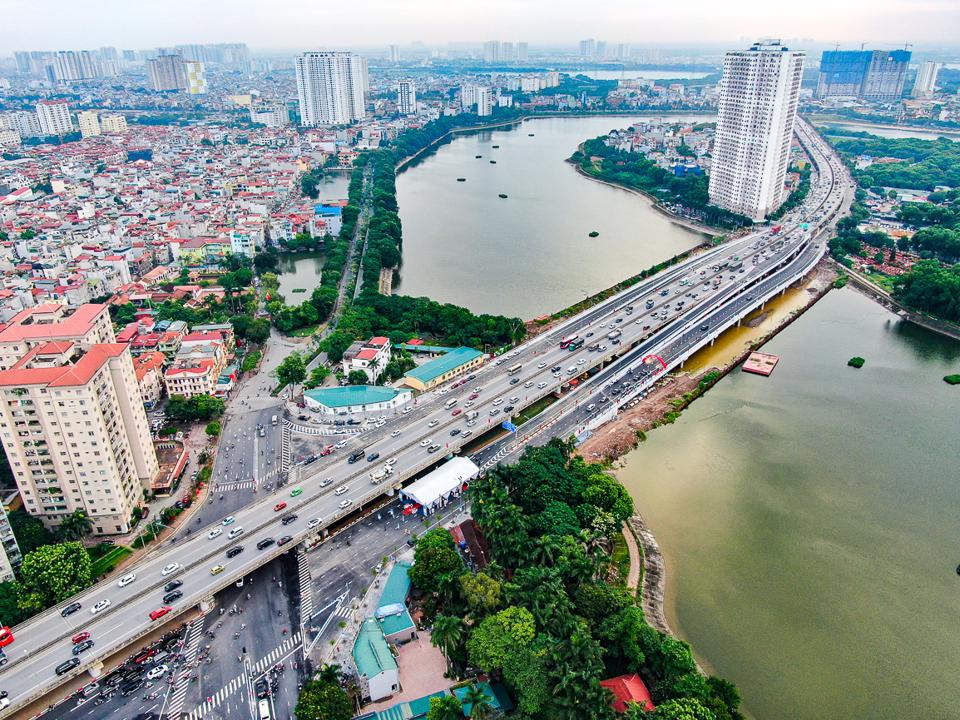
| Hanoi from above. Photo: Trung Nguyen |
Under the resolution, Vietnam targets becoming a developing country with modern industrialization and upper-middle income status by 2030.
In such a process, Vietnam would form an effective, consistent and sustainable national development space, including establishing economic and urban zones serving as driving forces for growth and a network of modern infrastructure systems. Besides maintaining essential balances of the economy for greater resilience, the city will work to ensure food, energy, and water security; promote climate resilience; and raise people’s living quality.
For the 2021-2030 period, Vietnam’s GDP growth is expected to expand by 7%, with the economic expansion rate in the Southeast and Red river delta regions would be around 8-8.5%.
By 2030, Vietnam’s GDP per capita would be around $7,500, in which the services sector would contribute over 50% of the GDP, the construction sector over 40%, and the agro-forestry-fishery below 10%.
From 2031 to 2050, the average GDP growth would be 6.5-7.5% and GDP per capita of $27,000-32,000 by 2050.
The resolution also suggested Hanoi and Ho Chi Minh City would remain the two major growth pillars for Vietnam, along with economic corridors of the North-South, Lao Cai – Hanoi – Haiphong – Quang Ninh, and Moc Bai – Ho Chi Minh City – Vung Tau.
In addition, Vietnam would form a national network of urban cities with a strong linkage between those of the national administrative level and others in rural areas. Urbanization is expected to rise by over 50%.
The resolution mentioned the goal of pushing for digitalization, in which the digital economy would make up 30% of the GDP.
Given the current population growth, the resolution expected Vietnam to have a population of 105 million by 2030, average age of 75, and the size of dwelling in urban areas would be 32 square meters per person.
The education sector would be among the top in the region, including the university system up to the best. The rate of graduate students would be 260 per 10,000, and the skilled workforce at 35-40%.
The resolution expected higher healthcare service quality comparable to regional peers, with the grassroots healthcare systems capable of meeting locals’ demand for health treatment.
In 2030, Vietnam will have an average of 35 hospital beds and 19 doctors for 10,000 people.
Key objectives for development
For Vietnam to realize these development goals, the resolution expected the country to form a national infrastructure framework, focusing on transport-, energy-, urban-, and digital infrastructure of environmentally friendly and high climate resilience.
Vietnam would continue the economic restructuring process to boost productivity, efficiency, and quality, with priorities given to fields of high potential to support growth and enhance overall economic independence.
Resources for development concentrated on regions are seen as fundamental driving forces for growth to create spillover effects on the whole region.
In this context, the Government would select specific locations and regions with a unique advantage to build special economic or administrative zones with unique mechanisms and high levels of competitiveness.
Hanoi focuses on 2021-2030 planning
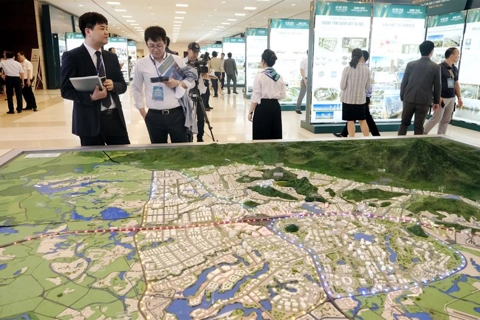
As part of the overall national planning process, the city is also focusing on its master plan for the 2021-2030 period.
In early March, Prime Minister Pham Minh Chinh approved the goal of drafting Hanoi’s planning blueprint for the 2021-2030 period, with a vision for 2050.
The Hanoi Institute for Socio-Economic Development Studies (HOSES) is scheduled to submit a report on the vision for Hanoi’s planning to the Hanoi Party Committee for review this October, serving as the basis for more detailed reporting on the planning process in subsequent steps.
The planning for Hanoi in the 2021-2030 period, with a vision to 2050 would include analyses and forecast based on the characteristics of Hanoi, the assessment of the current progress of socio-economic development, the use of land resources, a system of urban and rural structure, and the factors required for Hanoi to strengthen linkages with provinces/cities in the capital area.
Vietnam’s national development space would be divided into six zones as follow: 1/ The northern midlands and mountainous region, including 14 provinces/cities of Ha Giang, Cao Bang, Lang Son, Bac Giang, Phu Tho, Thai Nguyen, Bac Kan, Tuyen Quang, Lao Cai, Yen Bai, Lai Chau, Son La, Dien Bien, and Hoa Binh. 2/The Red river delta of 11 provinces/cities: Hanoi, Haiphong, Hai Duong, Hung Yen, Vinh Phuc, Bac Ninh, Thai Binh, Nam Dinh, Ha Nam, Ninh Binh, and Quang Ninh. 3/The North central and Coastal are central of 14 provinces/cities: Thanh Hoa, Nghe An, Ha Tinh, Quang Binh, Quang Tri, Hue, Danang, Quang Nam, Quang Ngai, Binh Dinh, Phu Yen, Khanh Hoa, Ninh Thuan, and Binh Thuan. 4/The Central Highlands of five provinces/cities: Kon Tum, Gia Lai, Dak Lak, Dak Nong, and Lam Dong. 5/The Southeast region of Ho Chi Minh City, Dong Na, Ba Ria – Vung Tau, Binh Duong, Binh Phuoc, and Tay Ninh. 6/The Mekong Delta region of Cantho, Long An, Tien Giang, Ben Tre, Tra Vinh, Vinh Long, An Giang, Dong Thap, Kien Giang, Hau Giang, Soc Trang, Bac Lieu, and Ca Mau. |