Vietnamese gov’t urged to address impact of global minimum tax
The Ministry of Planning and Investment has proposed the setting up of an Investment Support Fund, financed annually by the state budget, to provide direct cash support to eligible businesses.
The government needs urgent solutions to respond to the impact of the global minimum tax and prevent a wave of investment relocations out of Vietnam by a group of major investors who play a crucial role in the economy, a report by the Ministry of Planning and Investment (MPI) has shown.
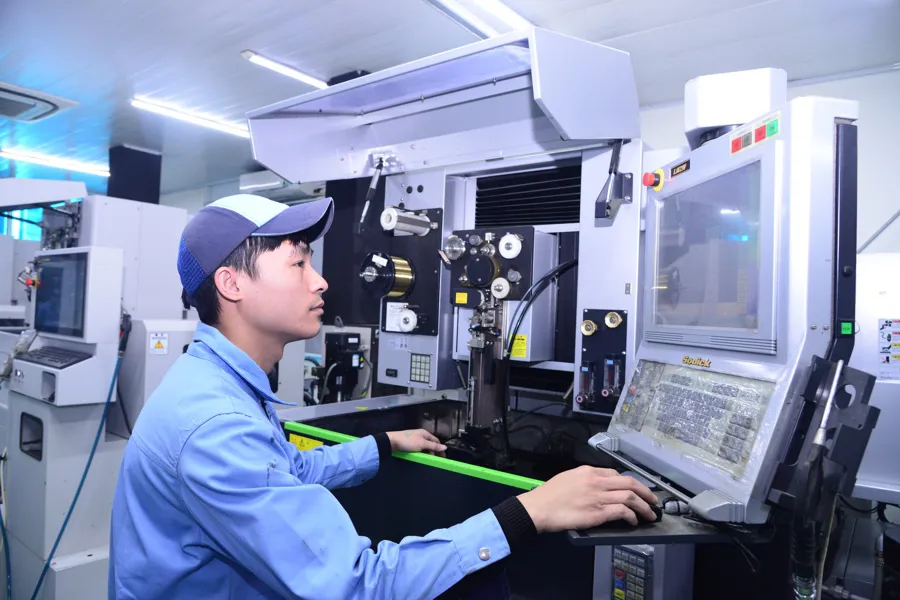
| Electronics production at JK Vietnam in Chuong My District, Hanoi. Photo: Pham Hung/The Hanoi Times |
Since the beginning of this year, Vietnam has adopted a global minimum tax rate of 15%. Many investors are concerned that this new tax will adversely affect FDI inflows, as it neutralizes all tax incentives.
According to a recent report from the MPI sent to the government, several major corporations are seeking cash subsidies to invest in projects in Vietnam.
The MPI also noted that the expansion of several large-scale high-tech projects has slowed as companies await Vietnam's policy response. Some major corporations have even officially communicated their intent to halt new investments or expansions unless appropriate support policies are introduced alongside the global minimum tax.
Projects like SMC's US$500 million to $1 billion medical equipment factory in Dong Nai and the expansion of Foxconn, Compal, and Quanta's facilities for Apple, IBM, and Cisco are also facing delays. The Ministry emphasized that without timely support measures, the decision of multinational companies to maintain or expand their operations in Vietnam would be adversely affected, leading to a decline in attracting ancillary companies.
This could also weaken the motivation of new investors planning to enter Vietnam, potentially resulting in reduced production scales and labor demand, it noted.
Furthermore, without appropriate policy measures, the implementation of the global minimum tax would reduce the effectiveness of corporate income tax incentives. Vietnam would lose its appeal in retaining or attracting new investments from multinational corporations.
The Ministry thus proposed the creation of an Investment Support Fund, financed annually by the state budget, to provide direct cash support to eligible businesses.
This fund would be sourced from additional revenues from the global minimum tax and other state budget allocations, along with external sources such as interest from deposits, revenues from appropriate public service activities, contributions, sponsorships, and annual surplus of the Fund.
In addition, the fund would directly support costs related to training, human resource development, research and development, capital investments, high-tech product manufacturing, and social infrastructure projects.
The Ministry pointed out that many countries are applying a variety of investment incentive policies, combining both income-based incentives (tax exemptions and reductions) and cost-based incentives (cash support and investment grants) to be more effective and attractive to investors. Cost-based incentives are often used to promote priority sectors.
In practice, financial support and investment subsidies are not paid immediately to businesses but are based on project implementation results (disbursement progress, revenues) and subsidize incurred costs under certain conditions.
For example, under the US CHIPS Act, the government supports 25% of the total investment in the construction of manufacturing facilities. This support is phased over 10 years and must be repaid if the company fails to implement the project or sells the subsidized assets.
"With flexible incentive policies, many countries have attracted very large-scale projects in high-tech sectors," stated the MPI.
The global minimum tax applies to multinational enterprises with total consolidated revenues of at least EUR750 million (US$800 million) in two of the immediately preceding four years. Approximately 122 foreign-invested corporations in Vietnam are subject to this tax, according to the tax authority's review.