

Vietnamese, Taiwanese universities partner to develop semiconductor talents
The National Innovation Center (NIC) and Taiwan’s National University of Science and Technology (NTUST) have joined forces to develop Vietnam’s semiconductor talent pipeline, launching a major education and research partnership under the INTENSE Scholarship Program.
THE HANOI TIMES — Vietnam’s National Innovation Center (NIC) and the National Taiwan University of Science and Technology (NTUST) have announced the launch of INTENSE Scholarship Program to promote academic and talent exchange between leading universities in the two countries.
The MoU signing ceremony took place on October 30 during the Vietnam-Taiwan Semiconductor Talent Cultivation Forum hosted by the University of Sciences, a member of the Vietnam National University – Hanoi.
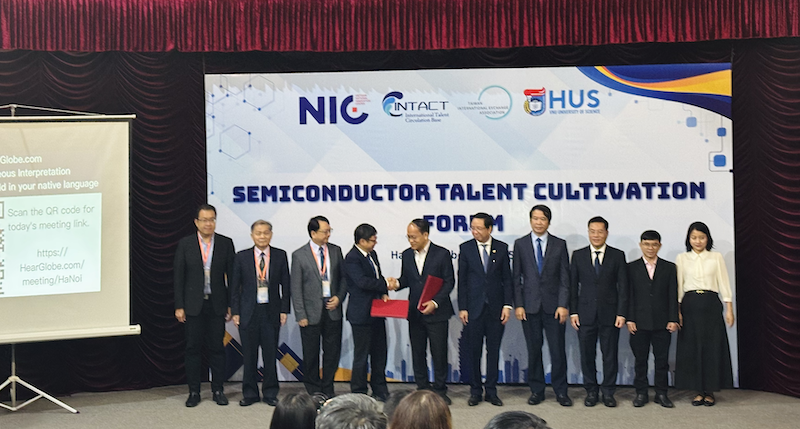
The MoU signing ceremony takes place on October 30 as part of the Vietnam-Taiwan Semiconductor Talent Cultivation Forum. Photos: Phi Nhat/The Hanoi Times
Several top universities in Vietnam, including the Hanoi University of Science and Technology, the Vietnam National University, the Electric Power University and the University of Transport and Communications joined the program.
The collaboration has established a long-term framework for training, research and exchange between Vietnam and Taiwan (China), particularly in developing high-quality human resources for the semiconductor industry.
The INTENSE Scholarship is an international program initiated by Taiwan’s Ministry of Education in 2024 to support postgraduate students in Asia pursuing studies in engineering, science, semiconductors, high technology and finance.
Starting in 2025, the program will officially expand to Vietnam, aiming to strengthen the country’s pool of highly skilled engineers and contribute to building a competitive, globally integrated semiconductor industry.
Chun-Chang Chu, Taiwan’s Administrative Deputy Minister of Education, committed to investing in talent training and deepening academic exchanges with Vietnam.
He described Vietnam as a “strategic partner” in Taiwan’s plan to develop human resources across Asia.
Strengthening university-industry linkages
During the forum, representatives from Vietnamese and Taiwanese universities discussed practical solutions to enhance training capacity, foster stronger connections between academia and industry and promote international cooperation.
The discussions focused on building a comprehensive talent network to serve the future growth of Vietnam’s semiconductor ecosystem.
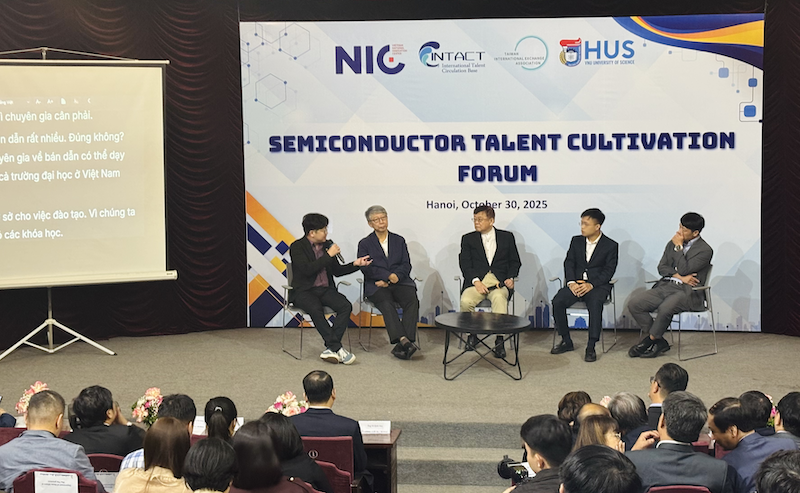
Delegates at the session of the forum
Prof. Konrad Young, former Director of R&D at TSMC and CEO of Industry-Academia Innovation College, said that it is important to enhance the link between government, academia and business in cultivating semiconductor talent.
He described the connection as a decisive factor for Vietnam to move deeper into the global value chain.
Echoing this view, Prof. Wen-Yuh Jywe, Director of the INTENSE Program and Prof. Jia-Yush Yen, President of NTUST, said that Taiwan is readiness to share expertise, transfer technology and support Vietnam in developing its next generation of semiconductor professionals.
NIC Director Vu Quoc Huy said that Taiwan remains one of Vietnam’s most trusted partners in semiconductor cooperation.
Taiwan has a comprehensive ecosystem covering research and development, design, manufacturing and talent training, he added.
“Today’s forum is a valuable opportunity for Vietnam and Taiwan to share insights on talent development, exchange experiences in training and explore joint initiatives in semiconductor education and R&D,” said Huy.
This collaboration will help Vietnam build a skilled workforce and a resilient, innovation-driven semiconductor ecosystem.”
NIC director pledged to work closely with Taiwanese partners, including the Taiwan International Exchange Association, Taipei Economic and Cultural Office (TECO), the INTENSE Program, universities and industry players, to promote education, research and the development of an innovation ecosystem.
The collaboration is considered a practical implementation of the Politburo’s Resolution No. 57, which outlines Vietnam’s development strategy for high-tech industries. It also serves as a foundation to strengthen educational, scientific and technological cooperation between Vietnam and Taiwan.
Through academic exchange, joint training and partnership agreements, the initiative opens up new opportunities for Vietnamese students in scholarships, internships, research and employment, while deepening bilateral cooperation in developing high-quality human resources for Vietnam’s semiconductor industry.
At the forum, NTUST also announced the inauguration of the INTENSE Program Office, which opened on October 29 at NIC in the Hoa Lac Hi-tech Park to bolster efforts in semiconductor talent development.
![[Vietnam – a hub of nurturing tech talent] Prospects soar for Vietnam’s tech talents](https://cdn-media.hanoitimes.vn/2023/08/23/Cover_P4_Tech_talent_HNT.png?w=480&h=320&q=100)







