Vietnam's rice exports break price records
The market will remain favorable for Vietnam's rice exports through the first quarter of 2023.
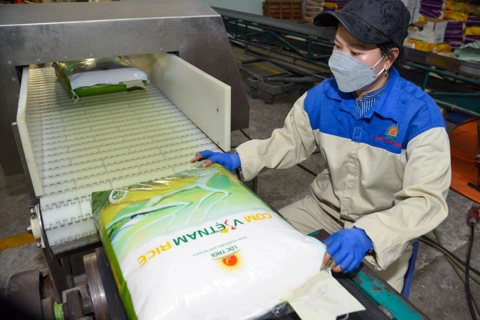
Vietnam is on track to export a record seven million tons of rice by 2022, with revenues of US$3.5 billion, made possible by the price, now the highest in the world, and a larger share in major markets.
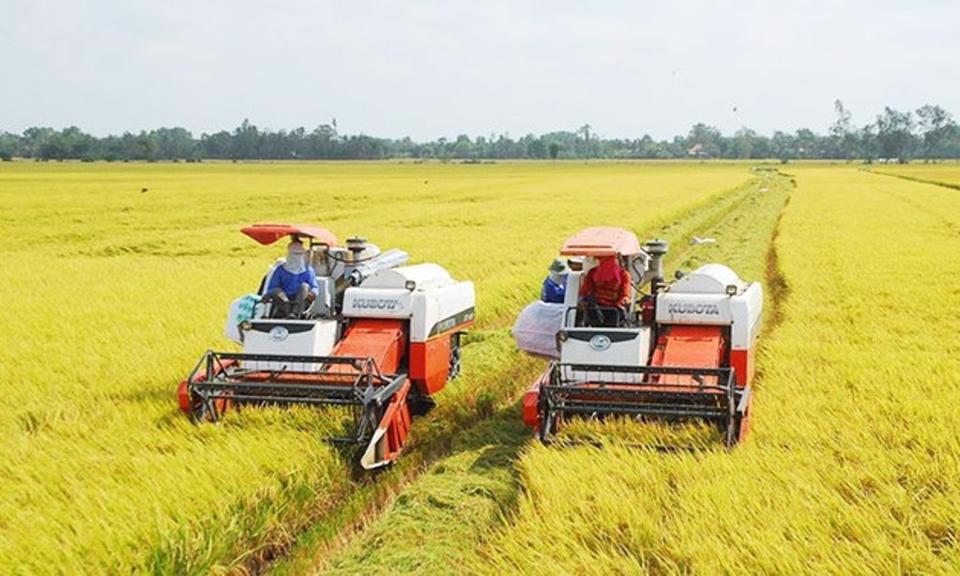
| Rice harvesting in the Mekong Delta. |
Data from the Ministry of Industry and Trade reveal that the volume of rice exports in the first eleven months was 6.7 million tons valued at US$3.24 billion, a year-on-year increase of 16.3% in quantity and 6.9% in value.
Chairman of the Vietnam Food Association (VFA) Nguyen Ngoc Nam noted that Vietnamese rice export prices have already surpassed those of Thailand to lead the market.
At present, Vietnam’s 5%-broken rice is being offered at $438 per ton, up $10 per ton, and 25%-broken rice at $418, up $10. Compared to those from Thailand, Vietnamese rice is $20 higher per ton.
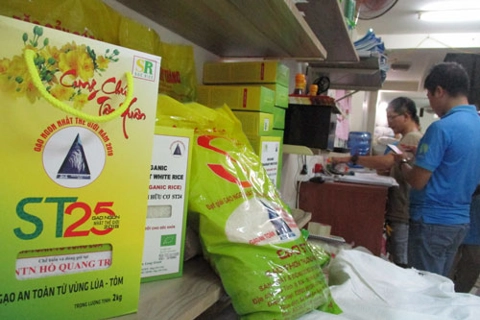
"Not only white rice, but also fragrant rice and Japonica from Vietnam are now in high demand," Nam said, referring to prices of fragrant rice for export to the Middle East and Europe at $600 a ton and Japonica at $700.
The director of the Department of Agricultural Products Processing and Market Development under the Ministry of Agriculture and Rural Development (MARD), Nguyen Quoc Toan, attributed the good performance of Vietnamese rice exports to improving product quality rather than quantity.
According to Toan, the majority of rice production areas in Vietnam have now adopted strict quality control protocol and used new rice varieties with high value.
“This has given Vietnamese rice an edge over those of the same types from Thailand. This is proven by rising orders for local rice products from Europe, the US, South Korea, and Singapore at high prices,” Toan said.
“Ongoing armed conflicts, unfavorable weather conditions, and diseases are also factor leading to rising global demand for rice,” he added.
Focus on exports
In the 11-month period, Vietnam’s rice exports to the Philippines rose by 18% to $1.39 billion for nearly three million tons, accounting for 44.9% of total volume and 42.9% of revenue. China came in second with 808,000 tons for $408.5 million, and Ivory Coast at third with 655,600 tons for $294 million.
The export volume to RCEP member countries hit 4.42 million tons worth $2.09 billion, up 17% in quantity and 9.1% in value, and those from CPTPP at 544,000 tons of $263.1 million.
According to experts, the situation will remain favorable for Vietnam’s rice exports until the first months of 2023.
China, one of the world’s largest rice exporters, has now focused on the domestic market due to the impacts of the Covid-19 pandemic, while India put a ban on the export of broken rice and restricted the sale of 5% broken white rice.
Nam from the VFA called for local rice producers to stay active in setting up new production areas and promoting new value chains to ensure consistent quality and quantity.
“Those taking part in the value chains with the application of high technologies would help optimize operational costs and ensure international standards,” he said.
Given the positive market outlook in the coming time, Nam noted a constant modernization of the production process would help Vietnamese rice brands to cement their place in the international market.
“The Government should consider favorable policies to promote hi-tech production areas and the establishment of high-quality rice production chains, at the same time facilitating trade to potential markets,” he added.
Deputy Director of the Import-Export Department under the Ministry of Industry and Trade (MoIT) Tran Thanh Hai said Vietnam’s rice development strategy until 2030 set forth the goal of raising the product quality and export revenue, instead of quantity.
“This is the right direction for the sector to speed up the ongoing rice restructuring process to better meet the demand from developed countries,” Hai added.
As part of the supporting program to facilitate rice exports, Hai said the MoIT and the MARD would maintain close cooperation to frequently update market information for local businesses.
“In line with the process of restructuring the rice production sector toward higher value, the authorities are committed to supporting companies in promoting rice brands aboard,” he said.
Hanoi aims for at least 80% of the city's rice production to be of high quality by 2025, while maintaining 80-100 production areas of high-value and japonica rice varieties for export. Hanoi's Department of Agriculture and Rural Development Vice Director Nguyen Manh Phuong said the city would also focus on the food processing and storage process to increase the added value of Hanoi's rice products. “During the five-year time, Hanoi should form at least two value chains of high-quality Japonica rice to ensure the city’s sustainable agricultural development,” he said. |