5 issues concern Vietnamese consumers most towards green living
Sustainability becomes one of the most unsettling topics for Vietnamese consumers in recent years.
Food safety, plastic waste, water pollution, insecticide/fertilizers and air pollution are among the top 5 concerns of Vietnamese people, according to market research firm Kantar Worldpanel.
Source: Kantar Worldpanel, October 2020. Screenshot: NM |
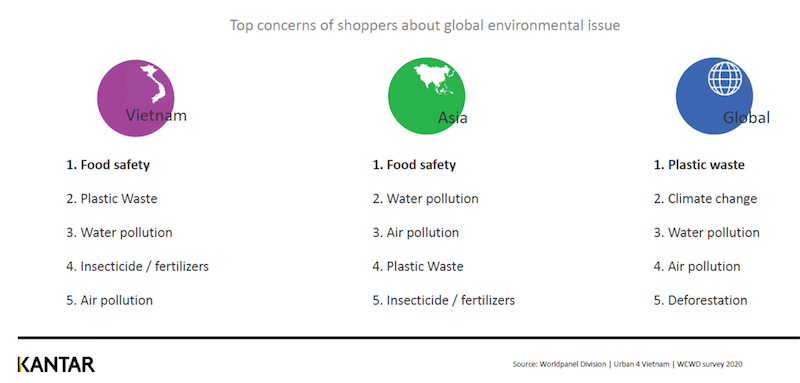
Top concerns among Vietnamese consumers
According to the latest report entitled “Kantar's Who Cares Who Does 2020,” facing increasing climate change along with escalating levels of pollution, especially in the two key cities Hanoi and Ho Chi Minh City, there is an increasing environment consciousness among a group of Vietnamese consumers (Eco-actives & Eco-considerers) who are willing to take action to improve the situation such as plastic waste reduction, recycling , and heading towards more healthy and sustainable lifestyles.
However, in comparison with the global average, these people only account for a relatively modest proportion (about 35%), which is much lower than the global number (59%).
According to this study, nearly 80% of Vietnamese consumers maintain their shopping habits without bringing their own bags, resulting in the increasing usage of plastic bags when shopping. And the three main reasons that limit Vietnamese ‘living green” are:
Firstly, it is the knowledge barriers. There are not much influential publicity and guidance for environmental protection from the local authorities and enterprises. A third of respondents are not sure what to do or what actions are beneficial for the environment.
Secondly, 40% of the population do not see the long-term environmental impact on their lives, and of those around them. They believe that the situation is not that bad. Therefore, there should be more emphasis on its alarming level as well as the importance of working together to reduce and tackle environmental issues.
Thirdly, sustainable and environmentally friendly products are difficult to access, hard to find on store shelves and their price is often higher than average. These are the factors that manufacturers and retailers need to consider.
| Source: Kantar Worldpanel, October 2020. Screenshot: NM |
In fact, one of the activities that has been promoted and encouraged recently is recycling. However, for consumers, recycling is still very vague in terms of which products can be reused, recycled and replaced, of where these products can be collected and the recycling process, how the products are recycled, and what will happen with these products after recycling. Furthermore, up to a quarter of the respondents said that recycling is inconvenient.
In such unplanned shopping occasions, it is not convenient for consumers to bring their own bag/cup/ basket for shopping, thus, increasing the need to use free plastic even though they are aware of its negative impacts on the environment. as the result, consumers show a preference towards easier and more convenient solutions such as 100% recyclable plastic packaging or biodegradable packaging instead.
But more importantly, there are different consumers’ expectations for different categories or products. Hence, it is crucial for businesses to understand these differences in order to identify and implement the right actions and offerings that will be welcome and supported by their target consumers, Kantar recommended.
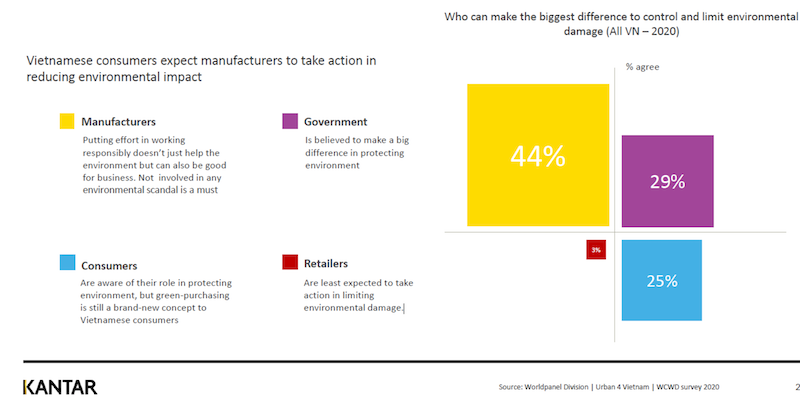
“Vietnamese consumers expect manufacturers to take the lead in reducing environmental impact, following by the local authorities while retailers are least expected to take actions in limiting environmental damage,” the report wrote.
Eco-actives, Eco-considers lead “green living”
Source: Kantar Worldpanel, October 2020. Screenshot: NM |
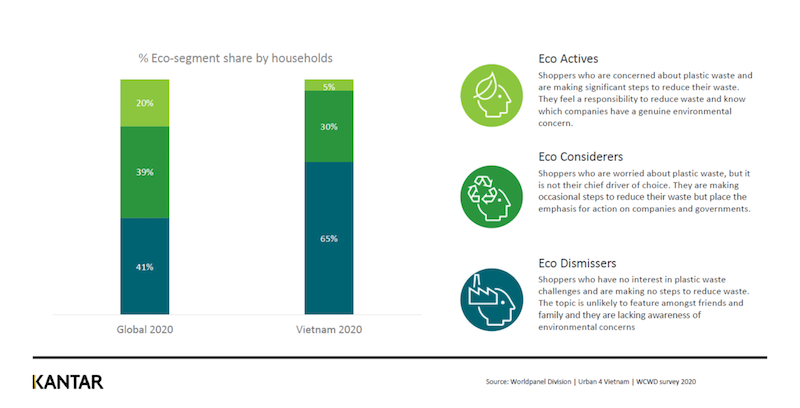
However, surprisingly, only 5% of the study participants can name which manufacturers or brands are doing good deeds for the environment, and the remaining 95% could not recall any brands. This can be because (1) only a small portion of Vietnamese pay attention to businesses that actually act for the environment (the Eco-actives) or (2) the brands do not prefer/prioritize or have not widely communicated these “green” actions. If it's the second season, it’s understandable why most Vietnamese are in the group "Eco-dismissers".
Kantar's Worldpanel data also revealed a majority of this consumer group stopped buying some products and services because of their impact on the environment or society.
Considering the fast-moving consumer goods (FMCG) industry alone, they spend 7% more on groceries per year than Dismissers, making more trips and having bigger shopping baskets, contributing to nearly 40% of FMCG sales for in-home consumption. This implies the importance of this “more active” group of consumers. By involving and engaging with them will create an increased opportunity for brands to achieve a sustainable development in the future.