ASEAN foreign ministers highlight centrality, unity in external relations
Once again the 10-member bloc emphasizes the importance of centrality and unity in the face of rising threats posed to the region.
Foreign ministers of the Association of Southeast Asian Nations (ASEAN) have stressed the importance of centrality and unity in the bloc’s external relations at the 53rd ASEAN Foreign Ministers’ Meeting (AMM).
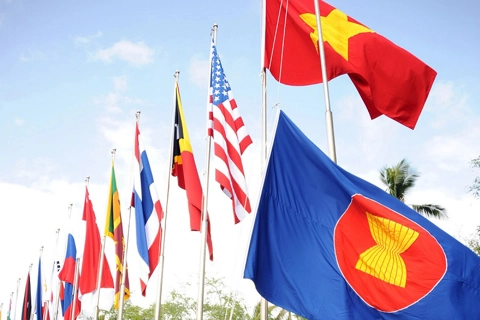
| The 53rd ASEAN Foreign Ministers’ Meeting (AMM) takes place under the chair of Vietnam. Photo: MOFA |
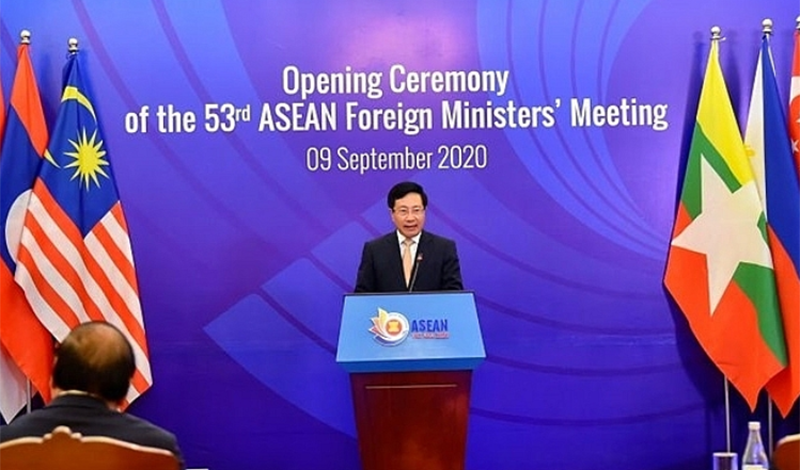
“We underscored the importance of strengthening ASEAN Centrality and unity in our engagement with ASEAN’s external partners through ASEAN-led mechanisms such as the ASEAN-Plus One, ASEAN Plus Three (APT), EAS, ARF, and ADMM-Plus, in order to build mutual trust and confidence as well as reinforce an open, transparent, inclusive, and rules-based regional architecture with ASEAN at the centre,” according to the joint statement.
“We noted with satisfaction the encouraging progress in ASEAN’s relations with our Dialogue Partners, Sectoral Dialogue Partners, and Development Partners through the existing frameworks, plans of action, and development cooperation programmes based on mutual interest and benefit. We acknowledged with appreciation the contribution of these partnerships to our ASEAN Community-building and development cooperation efforts.”
“We also welcomed the support of our partners for the priorities of ASEAN in 2020 in advancing a “Cohesive and Responsive” ASEAN. We agreed to further strengthen partnership and cooperation with our external partners, thus contributing to the continued efforts towards the realisation of the ASEAN Community Vision 2025 and our proactive response to emerging challenges.”
Importance of ASEAN Centrality
This technical term first appeared in the ASEAN Charter, the official document and the constitution of ASEAN.
In October 2010, in the Chair’s statement of the ASEAN Summit held in Hanoi, Vietnam also explicitly mentioned ASEAN centrality.
The concept of ASEAN centrality signifies that ASEAN needs to play a central role in multinational frameworks of the Asia-Pacific region.
This concept has been recognised as a ‘primary driving force’ to consolidate a framework, together with the cooperation of external partners, in evolving regional architecture and ASEAN integration, wrote Nishimura, H., M. Ambashi, and F. Iwasaki (2019), in their work titled “Strengthened ASEAN Centrality and East Asia Collective Leadership: Role of Japan-ASEAN Cooperation as Development of Heart-to-Heart Diplomacy”.
ASEAN centrality is a product of both ASEAN and external players, according to the authors.
Amid the Covid-19 pandemic, multilateral cooperation as seen within ASEAN is necessary to share best practices and provide support, Rifki Dermawan wrote for The Diplomat.
Regarding unity, regional media reported that it is clear that the Covid-19 pandemic has further enhanced ASEAN centrality and unity. As such, it is imperative for ASEAN to stick together to face the challenges posed by these external shocks.