Boosting cultural industry: Full of ups and downs
Many cultural enterprises and artists desire to join in boosting the country's cultural industries, but they face many obstacles.
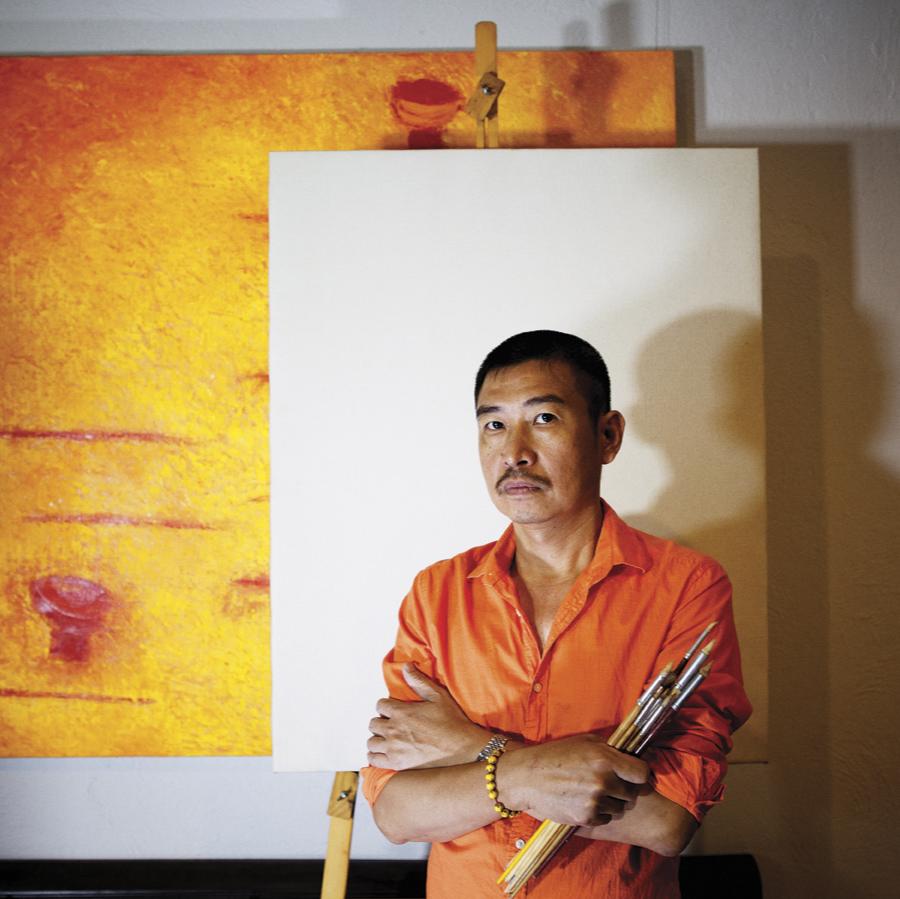
Painter Le Thiet Cuong, who embraces the ambition of advanced Vietnamese fine arts, knows that creating art in silence is not enough to realize his dream. At his home at 39A Ly Quoc Su, he founded Gallery 39, a non-profit cultural enterprise that aspires to drive young artists toward the development of extensive and sustainable art in Vietnam.
As both an artist and a business owner, painter Le Thiet Cuong suffered many bruises trying to boost the cultural industry, especially when Covid-19 severely affected the economy and the cultural sector.
When intellectual property theft is commonplace
Before his success with Zen pottery, painter Le Thiet Cuong experienced heartbreak when his "brainchild" unexpectedly became "someone else's child". But this is not unusual in the creative industry.
"I make a drawing that will be painted on a vase, and then I take it to the kiln for production. People working at the kiln find it marketable, so in addition to the product I commissioned, they make a hundred more without my authorization. It's just one of many examples of stolen creativity," Le Thiet Cuong said.
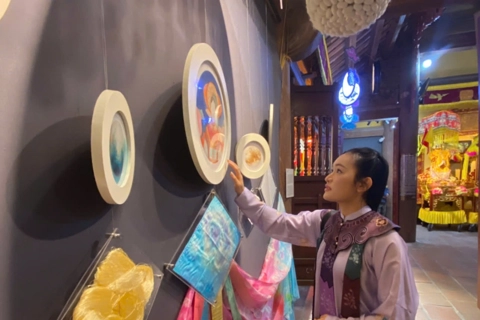
| Painter Le Thiet Cuong, a renowned artist, and owner of Gallery 39.Photo courtesy of the artist |
Sharing the same feeling, Tran Mai Khanh, project manager of QP Vietnam Company, owner of Xuong Thu Bay (The 7th atelier), a creative space in Hanoi) said creative works are valuable but easily copied.
Sometimes, both the author and the counterfeiter are unaware of the harmful effects of copyright violation on the development of the creative economy market.
Mai Khanh herself was also depressed when someone rejected her company's bid but then blatantly copied her idea in the bidding documents.
Mai Khanh said Xuong Thu Bay was born with the goal of becoming a dynamic creative space of the capital, a place to nurture the aspirations of building a strong Vietnamese creative industry. That is the ideal, but right from the start, the Xuong Thu Bay team has encountered many difficulties in terms of infrastructure, legal issues and market psychology, as well as the Covid-19 pandemic, which led to the cancellation of many projects.
OTT: The game is unequal
Mai Khanh highlighted the inequality between Vietnamese cultural enterprises and their foreign peers.
While Over-the-top (OTT) service providers in Vietnam have to deal with content censorship and pay taxes, foreign companies do not, she said.
For this reason, domestic OTT service providers such as VieOn, BHD, FPT Play, among others, still find it hard to compete with foreign OTTs that dominate the market, despite their best efforts. In addition, the market has witnessed uneven competition between private and state-owned enterprises.
| FPT Play's copyrighted programs are re-uploaded and distributed on pirated websites. Photo: FPT Play |

While independent filmmakers struggle to raise capital, rent studios, invest their own money in film promotion, and expect to recoup capital from ticket sales, State-owned film studios make films with funds from the State budget. Movie studios are built with public funds, and no one cares about revenues.
“Small and medium-sized enterprises like Xuong Thu Bay do not have the financial resources to build their own studios. In rented studios in poor condition, production requires more effort and investment capital to achieve a quality outcome," Mai Khanh said.
Another obstacle is that domestic customers always tend to pay low prices for innovative products of domestic companies, while they are willing to pay high prices for imported products.
“The inequality between domestic cultural industry enterprises and foreign ones has also somewhat limited the development opportunities of Vietnam's cultural industry,” Mai Khanh said.
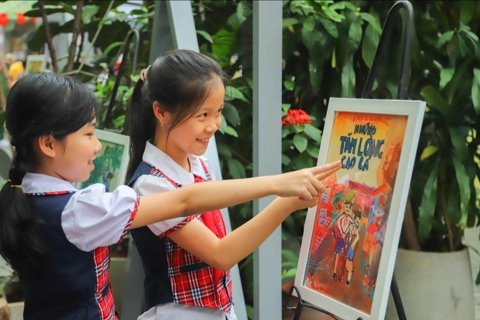
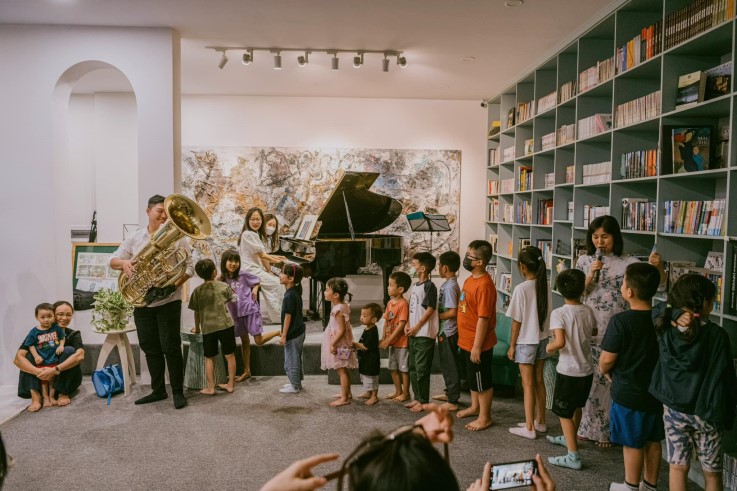
| Children learn music at The 7th Atelier creative space. Photo courtesy of The 7th Atelier |
Nguyen Thu Huong, Content Director of FPT Play, said that foreign OTT platforms such as Netflix, WeTV, iQiyi are landing massively in Vietnam. The fact that users can easily watch any movie online by paying monthly subscription fees or no fees at all implies the risk of learning false knowledge and even a violation of national sovereignty in some movies.
These platforms do not have a representative office in Vietnam, they do not pay taxes, their content is not subject to censorship, while Vietnamese companies have to comply with Vietnamese regulations that govern this business such as authentic Vietnamese language, censorship and tax obligations, all of which leads to more time and cost to create content.
In addition, Huong said they had lost heavily when content was copied without their permission in the digital space. FPT Play's copyrighted programs are uploaded and distributed on pirated websites.
"Currently, FPT Play owns the exclusive broadcasting rights of the UEFA Champion League and some other sports tournaments, so we have to assign someone on duty to scan pirated sites every night. Of course, it is our responsibility to protect our content assets, but we also hope that the State will tighten sanctions and legal regulations to support businesses like ours," she said.
Assessing the development strategy of the cultural industry in the capital, Le Thi Minh Ly, a member of the National Council of Cultural Heritage, said that Hanoi also faces some weaknesses in developing the cultural industry.
“Hanoi's cultural products are not diverse and unique despite its rich and millennial culture. The population of artisans, although large, lacks professional and management skills in the cultural industry. Awareness of the cultural value of heritage is not deep. The Hanoi government has not yet established a database and specialized information for the cultural industry," Ly said.
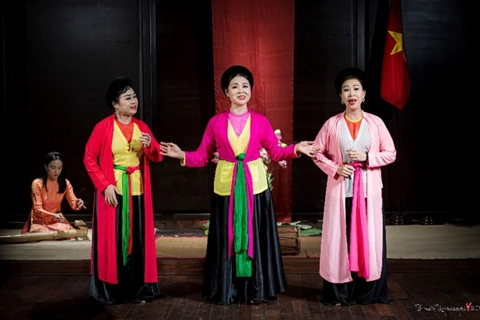
| A troupe is performing ca tru in Hanoi. Photo: Lai Tan/The Hanoi Times |

According to Le Thi Minh Ly, 1,206 festivals and 79 heritages of folk performing arts will be a sustainable basis for the development of cultural tourism in the capital. However, the cultural industry must be developed cautiously because commercialization risks heritage protection and community interests and rights.
Turn raw materials into gold
Mai Khanh of QP Vietnam Company said that to protect intellectual property for creative enterprises in the international market, the legal system on copyright and intellectual property rights needs to be refined and continuously updated, and the enforcement of the law on these rights should be ensured by relevant agencies and organizations.
"Without copyright protection, no one wants to be creative. Without creativity, there will be no cultural industry," said painter Le Thiet Cuong.
So how to quantify the value of creativity?
Painter Le Thiet Cuong once went to survey all the pottery villages around Hanoi such as Bat Trang, Huong Canh, and Phu Lang, and found that 70% of a product's retail price is material and only 30% is labor. That's how the potters do business.
"If this is the price breakdown, then it turns out we are just selling a block of soil with a shape?" he wondered.
The product's value must be determined by creativity, not materials, branding, and promotion.
He asserted that Vietnam's identity is rich enough to develop a cultural industry but needs "more fire to refine the raw material and turn it into gold".
"It is not easy for not only cultural people but even ordinary people to understand the cultural industry," he said.