Can Tho University and CT Group launch UAV-robotics center for smart farming
Can Tho University and CT Group have signed multiple projects to advance smart farming in the Mekong Delta, fostering innovation, sustainability and digital transformation in agriculture.
THE HANOI TIMES — Can Tho University and CT Group on September 9 partnered in a project that aims to foster smart farming through using unmanned aerial vehicles (UAVs) and robotics.
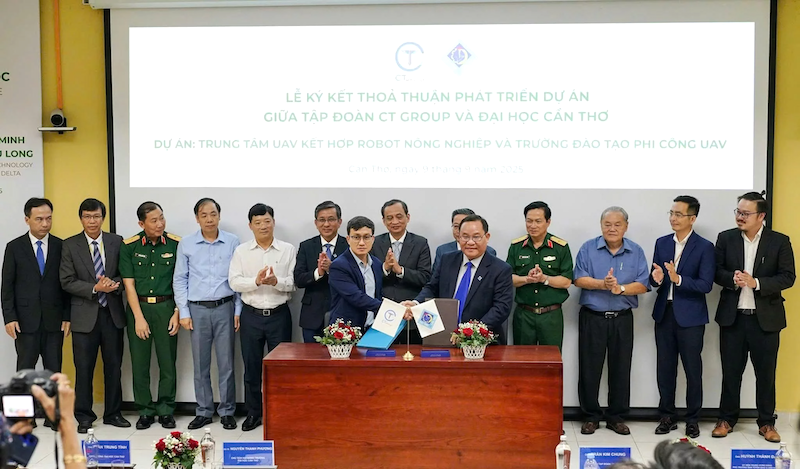
The signing ceremony for the cooperation agreement to establish the UAV-Robotics center. Photo: CT Group
Under the cooperative agreement, the two sides will together establish and operate a center for UAV and robotics development and a training school for UAV pilots and technicians.
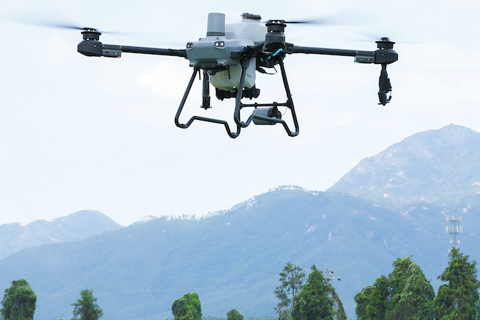
CT Group and Can Tho University will focus on applying UAVs and robotics in seeding, crop care, harvesting and carbon credit assessment.
Both sides will also organize high-quality training for UAV pilots and technicians, foster collaboration between academia, business and government, and drive innovation to support sustainable regional and national development.
Tran Trung Tinh, Rector of Can Tho University, praised the deal. He said that the project will bring economic benefits and transform the agriculture sector.
"It will facilitate the Mekong Delta region in taking the lead in smart farming, climate resilience and deeper integration into global value chains,” he said.
According to Ma Truong Thanh of Can Tho University, most smart agriculture applications in the region are still at the level of narrow AI.
The common technologies in use include sensors for water quality monitoring, IoT-based aquaculture alerts, crop disease diagnosis, rice leaf disease recognition via mobile devices and AI-powered virtual assistants, he said.
“The establishment of the UAV-robotics center will expand applications of AI and deep learning, accelerating agricultural modernization in the Mekong Delta region,” he said.
CT Group Chairman Tran Kim Chung said that the company is committed to advancing UAV and robotics technologies in Vietnam so that the country gradually becomes a global hub for smart agriculture.
The enterprise will support the development of digital infrastructures, shared platforms, data systems, cybersecurity and workforce training for agricultural digital transformation, he added.
"Applications will also extend to marine economy development, offshore fishing vessel monitoring, high-tech farming and biodiversity management," said Chung.
The group has developed a 15-layer National Digital Twin (NDT15) with 250 functions for multiple industries, according to the business executive.
In agriculture, 36 of these functions support forecasting crop seasons, pest monitoring, drought-salinity alerts, irrigation and fertilizer management, UAV and robotic harvesting, traceability, logistics and AI assistants.
This technology helps farmers reduce costs, increase yields, and mitigate risks, while providing governments with accurate data for planning and disaster response, and offering open platforms for research and innovation, he said.
"The project ultimately aims to raise farmers’ incomes, improve livelihoods, and build the brand 'Smart - Clean - Sustainable Mekong Delta Agriculture', positioning the region as a global hub for smart farming," Chung added.
Nguyen Thanh Binh, Project Director of NDT15, noted that the National Digital Twin is one of three pillars of Vietnam’s national digital transformation strategy, integrating data from land, sea and space.
Under the agreement, the two sides will also cooperate in semiconductor advanced packaging training and human resource development in science, technology, innovation and digital transformation for the Mekong Delta as well as in carbon credit projects focused on sustainable shrimp farming, rice cultivation and public lighting transition.