Changes in Me Linh District 15 years after joining the capital
Me Linh has risen strongly from a difficult suburban district after 15 years of integration into Hanoi.
Compared to 2008, Me Linh District's per capita income has increased 5.4 times, while its industrial sector has quadrupled. The district is also actively speeding up slow-moving construction projects and resolving the issue of service land for locals.
Economic development and improved living standards
According to the National Assembly Resolution No.15, Me Linh District in Vinh Phuc Province became part of Hanoi in 2008. After 15 years, the district has undergone a significant positive transformation.
Me Linh's economy has maintained a relatively high growth rate while undergoing a major structural shift toward industrialization, modernization, and the service sector.
In particular, the local industrial sector has grown by 3.98 times compared to 2008, mainly thanks to the operations of Quang Minh I and Quang Minh II industrial parks. These two contribute about VND900 billion (US$38 million) to the budget and create jobs for 38,000 workers annually.
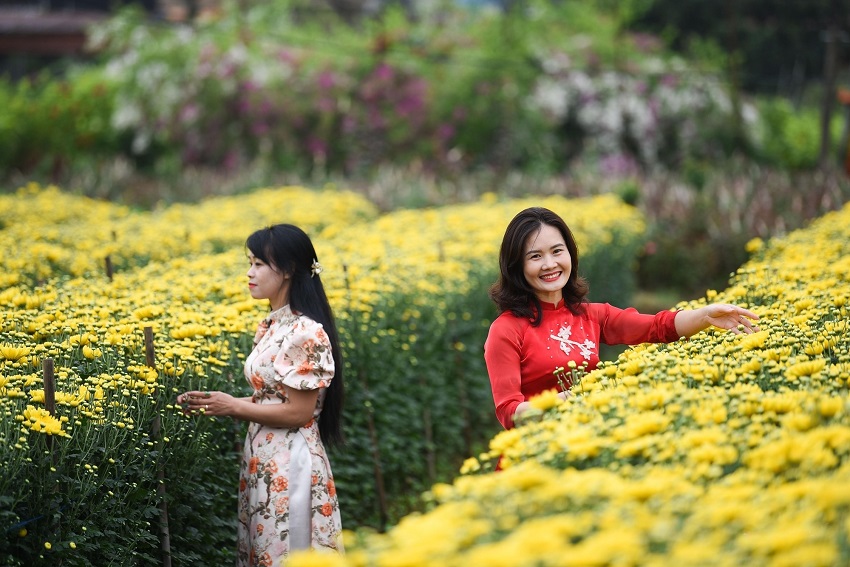
| A bustling flower field in Me Linh District, Hanoi. Photo: Giao duc Thoi dai |
Flower-growing hub of the largest capital
After 15 years, agriculture is still the highlight of Me Linh District, although it is moving towards more industrialization. The district has become the largest flower supplier in the capital.
According to Nguyen Xuan Dai, Director of the Hanoi Department of Agriculture and Rural Development, Me Linh District is the leading vegetable and flower producer in the city. Vast single-crop fields and many large producing households make the farming stand out in the overall economic picture. It's home to massive production of cut flowers and bonsais.
This district on the outskirts of Hanoi has nearly 8,100 hectares of agricultural land. A number of high-tech agricultural models with investments in modern machinery and equipment have achieved high initial economic efficiency. These include an organic Japonica rice production model in Tam Dong Commune, a high-tech Phalaenopsis orchid production model in Dai Thinh Commune, and another model that combines organic rice production with adventure tourism in Tam Dong Commune.
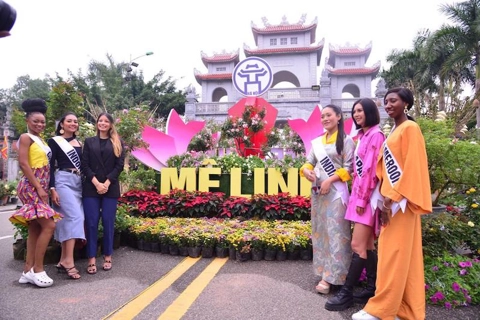
| The yearly Me Linh Flower Festival attracts thousands of visitors. Photo: VNA |
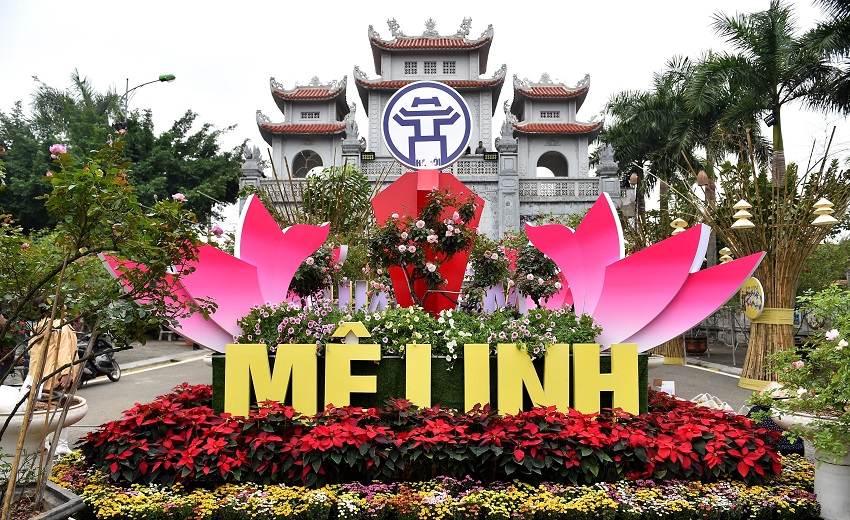
The district has 75 OCOP (One Commune, One Product) items, including 24 four-star products and 51 three-star products. In 2023, Me Linh plans to submit another 30 products for three-star or higher certification.
Thanks to these positive aspects, the average income here has improved significantly, reaching VND60 million ($2,518) in 2022 - 5.4 times higher than in 2008.
Progress in culture development and social security
With a number of historical sites, Me Linh District is committed to creating and perfecting tourism products with cultural, historical and spiritual values. Two major destinations are Hai Ba Trung Temple in Me Linh Commune and 79 Springs Hill in Thanh Lam Commune.
In 2022, the first flower festival with the theme "Me Linh's Brilliant Flowers" was successfully held, attracting a large number of tourists and promoting the Me Linh flower brand.
| Bird's eye view of Hai Ba Trung Temple in Me Linh District, Hanoi. Photo: VTC News |
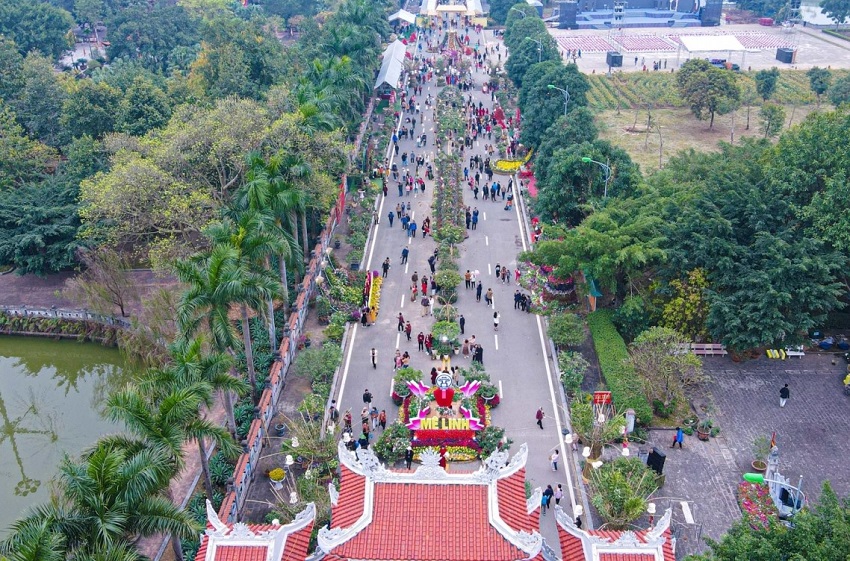
Health and welfare are also being properly addressed. In fact, Me Linh District is the first place in the country to implement universal health checks and electronic health records for 100% of its residents.
Meanwhile, social work for war veterans and support for children, women, and near-poor households have also yielded tangible results. Specifically, the current poverty rate in Me Linh is only 0.03%, down from 10.77% in 2008.
Resuming suspended projects and settling service land
Slow project progress has been a perennial problem in Me Linh District. In recent years, several projects have been resumed, including the HUD Me Linh Central project. As for six other urban projects, the formalities have basically been completed and the investors have promised to start construction in the shortest possible time.
In cases of zero or slow implementation, either deliberately or due to incompetence of investors, Me Linh District has resolutely asked the city to replace them with capable ones. In June, the Hanoi People's Committee decided to definitively stop three projects in the district after more than 15 years of suspension.
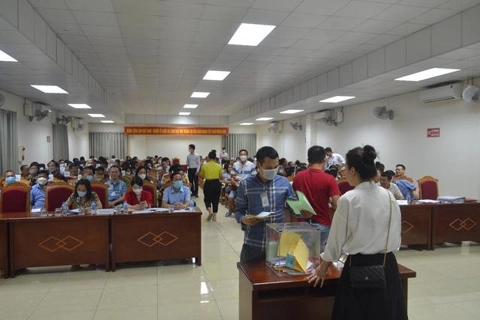
Service land is also a thorny issue for Me Linh. The solution did not come until early 2023, when the Hanoi People's Committee approved a policy to address the allocation of service land to locals. Currently, the district is focusing on developing a plan for this purpose.
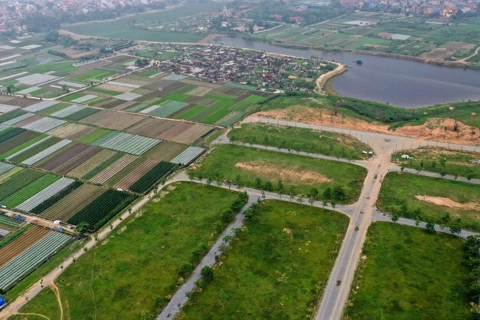
Quick and drastic site clearance for Ringroad 4
| The rendered image of Hanoi's Me Linh intersection, Ringroad 4 - Capital Region Project |
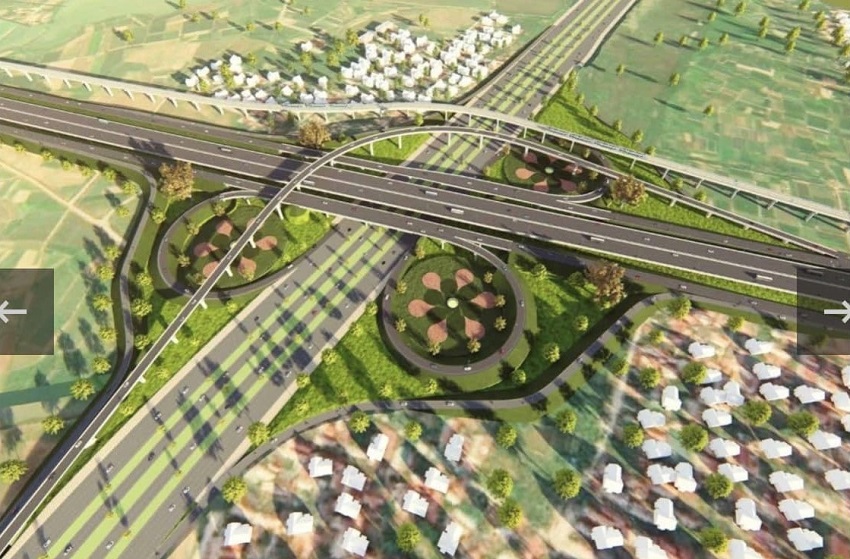
Me Linh District has mobilized the entire political system to carry out the task of clearing the land for the Ringway 4 - Capital Region project. A district-wide emulation movement was even launched to speed up the process.
As a result, by the end of June 2023, the district has handed over 121 hectares, or 99.2% of the required land for the project, which had been used for agriculture, transportation, and irrigation.