Entrepreneurs propose State ownership cut in Hanoi Innovation Center
Lowering State ownership in the innovation center will give more power to tech developers and scientists, reduce burden on the State budget, and boost creativity and accountability among stakeholders.
THE HANOI TIMES — Chairman of Vietnamese venture capital firm NextTech Nguyen Hoa Binh has suggested trimming State ownership in the Hanoi Innovation Center to below 70%.

Scientific research at Phenikaa University. Photo: Phenikaa
The State should act as a “catalyst investor” while leaving more room for private enterprises and social organizations, he told a workshop on August 29.
Cutting State ownership in innovation projects still ensures its decisive role, Binh said, citing the fact that the State holds only 51% of the capital in equitized State-owned banks.
"Venture capital funds should be the 'backbone' of innovation. Private investors should have a greater role in innovation projects to reduce the burden on the State budget," the entrepreneur said.
The NextTech chairman also suggested that the Hanoi government find ways to relocate potential capital sources from real estate, gold and stock markets to innovation projects.
"If successful, there will be a huge boost for Hanoi. Innovation needs long-term, stable finances without relying too much on the State budget."
Binh also credited Hanoi government for laying out a comprehensive, interconnected framework on the sandbox mechanism, which is “fundamental and vital” to innovation.
The sandbox should empower specialized agencies to make swift decisions within their domain, and attract foreign startups to test ideas in Hanoi, he added.
Binh's ideas were presented at the workshop on the six draft resolutions designed to concretize the 2024 Capital Law and the implementation of the Politburo’s Resolution No. 57-NQ/TW regarding national breakthroughs in science, technology, innovation, and digital transformation.
The drafts cover specific policies to advance science, technology, and innovation in Hanoi; investment and ecosystem support for startups; controlled pilot testing (sandbox); the establishment of a Hanoi technology exchange; a pilot venture capital fund; and a Hanoi Innovation Center.
According to participating delegates, the six draft resolutions form a comprehensive and interconnected framework to lay the foundation for the capital’s long-term development.
Chairman of CMC Corporation Nguyen Trung Chinh urged the government to approve and put these resolutions into practice soon.
There should be a lead agency responsible for detailing action plans with measurable goals and incentives to partner with enterprises, he said.
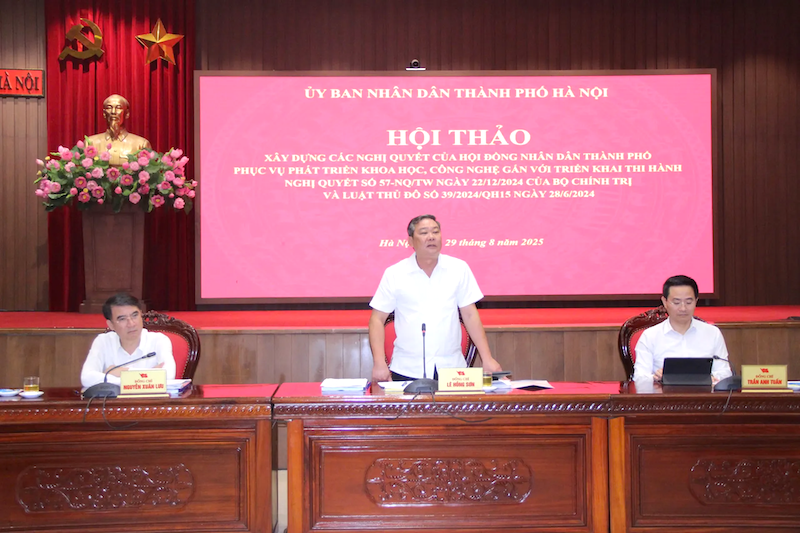
Le Hong Son, Standing Vice Chairman of the Hanoi People’s Committee, speaks at the consultation workshop on August 29 in Hanoi. Photo: Kinh te & Do thi Newspaper
Bui Thi An, Director of the Institute for Natural Resources, Environment, and Community Development, said that Hanoi must give priority to ensuring resources and practicality when the six resolutions come into effect.
"The resolutions must involve all people, businesses and scientists, and bring real benefits to the stakeholders," she added.
Le Hong Son, Standing Vice Chairman of the Hanoi People’s Committee, stressed that the resolutions must guarantee feasibility, with clear alignment to physical and digital infrastructure, funding sources, and governance capacity, and practicality.
“What matters is that once adopted, these resolutions must come to life, creating real value for Hanoi,” he said.
The six draft resolutions are expected to be reviewed by the Hanoi People’s Council at its September 2025 session.
If approved, they will not only provide a synchronized legal framework but also introduce breakthrough mechanisms to accelerate innovation-led development in the capital.