Culture
Five-fruit tray sends Tet traditional flavours
A “Mam Ngu Qua” (five-fruit tray) on the ancestral altar during Tet holiday symbolizes the admiration and gratitude of the Vietnamese to their ancestors, also demonstrates their aspiration for prosperity.
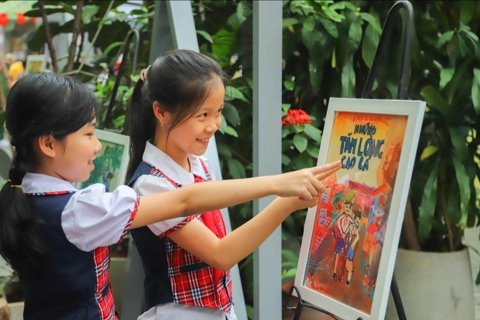
For a long time, together with horizontal lacquered boards engraved with Chinese characters, parallel sentences written on crimson paper, ornamental kumquat and peach trees, and popular Hang Trong and Dong Ho pictures, the five‑fruit tray prepared for Tet has transcended its material value to become a spiritual symbol, an original national product in the spiritual life of the Vietnamese.
Tet Nguyen Dan, more commonly known by its shortened name Tet, is the most important and popular holiday in Vietnam. It is a relaxing and special occasion for everyone to think about the achievements of the past year and plan for the New Year. During these New Year days, in addition to such national dishes and products as "Fat pork, salted onions, parallel sentences written on red paper. Long bamboo poles planted upright, strings of fireworks, and square glutinous rice cakes", it is indispensable for each Vietnamese family to display a five‑fruit tray on the ancestral altar for Tet.
Tet Nguyen Dan, more commonly known by its shortened name Tet, is the most important and popular holiday in Vietnam. It is a relaxing and special occasion for everyone to think about the achievements of the past year and plan for the New Year. During these New Year days, in addition to such national dishes and products as "Fat pork, salted onions, parallel sentences written on red paper. Long bamboo poles planted upright, strings of fireworks, and square glutinous rice cakes", it is indispensable for each Vietnamese family to display a five‑fruit tray on the ancestral altar for Tet.

The custom of displaying the five‑fruit tray as votive offerings at the holy place of the house has been reflected in many popular legends and tales. It has originated from ancient popular beliefs observed from one generation to another in their worship towards their forefathers. To this day, the Vietnamese still observe a long‑standing custom of placing the first ripe fruits harvested from the home garden on the altar and burning incense sticks in memory of their ancestors.
No matter whether rich or poor, on New Year’s Eve, it is also very important for the Vietnamese to select the best five-fruit tray. The fruits are placed on a red-lacquered wooden tray and arranged in a balanced cone and in harmonious colours. Fruits that may be laid out on the tray include bananas, finger citrons, watermelons, oranges, kumquats, coconuts, apples, persimmons or tomatoes, and chilis. Each kind of fruit has its own indication. A hand of green bananas or a finger citron, for example, symbolises one's wish for the protection of supernatural powers and ancestors, pomelos and watermelons indicate fertility, and kumquats or persimmons connote wealth and prosperity.
The custom of displaying the five‑fruit tray as votive offerings at the holy place of the house has been reflected in many popular legends and tales. It has originated from ancient popular beliefs observed from one generation to another in their worship towards their forefathers. To this day, the Vietnamese still observe a long‑standing custom of placing the first ripe fruits harvested from the home garden on the altar and burning incense sticks in memory of their ancestors.
Like other popular rituals, the preparation of a five‑fruit tray for Tet has become an established convention. Although it is called a five‑fruit tray, it does not necessarily contain exactly five kinds of fruit. Arranging fruits on the crimson, hourglass‑shaped wooden tray is really an art. One has to combine the colours and shapes of the different fruits in arranging them on the tray to make it look like a still life picture.
To ensure balance on the tray, one usually places the hand of bananas in the middle with the bananas pointing upright and the pomelo on the concave surface of the hand of bananas. Then one puts the oranges, sapodilla plums, apples, etc. in the gaps between the bananas and the pomelo. The last little gaps are filled in with little kumquats to create a full, compact tray of fruits. In colours, the fruit‑tray presents a harmonious combination of the different colours of fruits: dark green of banana, light yellow of pomelo, deep red of persimmon, reddish‑yellow of orange and kumquat, light green of apple, and dark brown of sapodilla plum. To complete the picture, the fruit‑tray will be covered here and there with some small, fresh leaves of kumquat.
The “Mam Ngu Qua” in Tet festival represent the quintessence that Heaven and Earth bless humans. This is one of the general perceptions of life of the Vietnamese, which is “Ăn quả nhớ kẻ trồng cây” ("When taking fruit, you should think of the grower").
No matter whether rich or poor, on New Year’s Eve, it is also very important for the Vietnamese to select the best five-fruit tray. The fruits are placed on a red-lacquered wooden tray and arranged in a balanced cone and in harmonious colours. Fruits that may be laid out on the tray include bananas, finger citrons, watermelons, oranges, kumquats, coconuts, apples, persimmons or tomatoes, and chilis. Each kind of fruit has its own indication. A hand of green bananas or a finger citron, for example, symbolises one's wish for the protection of supernatural powers and ancestors, pomelos and watermelons indicate fertility, and kumquats or persimmons connote wealth and prosperity.
The custom of displaying the five‑fruit tray as votive offerings at the holy place of the house has been reflected in many popular legends and tales. It has originated from ancient popular beliefs observed from one generation to another in their worship towards their forefathers. To this day, the Vietnamese still observe a long‑standing custom of placing the first ripe fruits harvested from the home garden on the altar and burning incense sticks in memory of their ancestors.
Like other popular rituals, the preparation of a five‑fruit tray for Tet has become an established convention. Although it is called a five‑fruit tray, it does not necessarily contain exactly five kinds of fruit. Arranging fruits on the crimson, hourglass‑shaped wooden tray is really an art. One has to combine the colours and shapes of the different fruits in arranging them on the tray to make it look like a still life picture.
To ensure balance on the tray, one usually places the hand of bananas in the middle with the bananas pointing upright and the pomelo on the concave surface of the hand of bananas. Then one puts the oranges, sapodilla plums, apples, etc. in the gaps between the bananas and the pomelo. The last little gaps are filled in with little kumquats to create a full, compact tray of fruits. In colours, the fruit‑tray presents a harmonious combination of the different colours of fruits: dark green of banana, light yellow of pomelo, deep red of persimmon, reddish‑yellow of orange and kumquat, light green of apple, and dark brown of sapodilla plum. To complete the picture, the fruit‑tray will be covered here and there with some small, fresh leaves of kumquat.
The “Mam Ngu Qua” in Tet festival represent the quintessence that Heaven and Earth bless humans. This is one of the general perceptions of life of the Vietnamese, which is “Ăn quả nhớ kẻ trồng cây” ("When taking fruit, you should think of the grower").