Foreign competition the smallest concern for Vietnam’s logistics firms in CPTPP
Direct impacts from the CPTPP agreement would not be significant, but means a more stable and predictable environment for logistics firms in Vietnam, according to an expert.
Foreign competition is the smallest concern for Vietnamese logistics firms when the Comprehensive and Progressive Trans – Pacific Partnership (CPTPP) comes into play, according to Nguyen Thi Thu Trang, director of the WTO Center and Integration under the Vietnam Chamber of Commerce and Industry (VCCI).
| Overview of the conference. Source: Ngoc Thuy. |
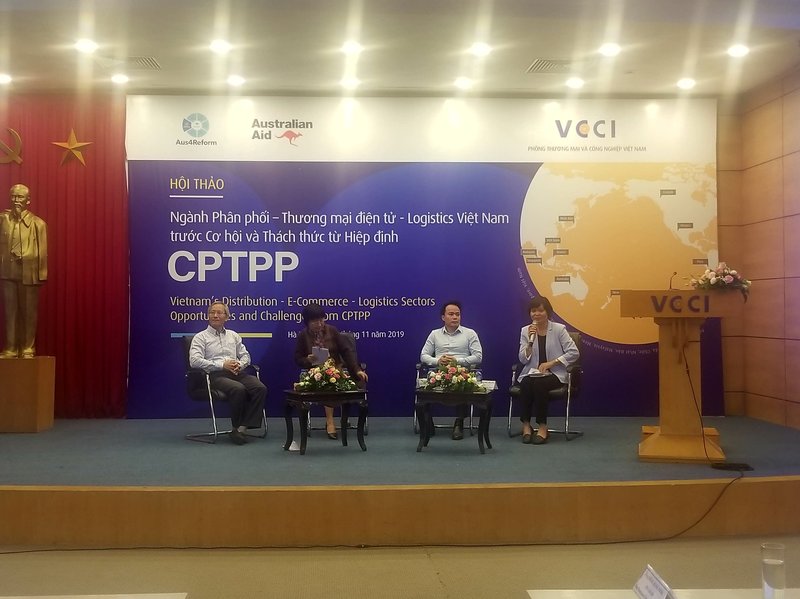
“The major concerns would be weak state management capabilities, deficiencies of logistics infrastructure, unfavorable business environment and unofficial costs,” said Trang at a conference under the program “Australia supports Vietnam’s economic reform” (Aus4Reform) on November 25, discussing the country’s challenges and opportunities from the CPTPP.
Trang argued the domestic logistics market has basically opened to foreign companies since Vietnam’s participation in the World Trade Organization (WTO) in 2007, therefore, “direct impacts from the trade deal would not be significant, but rather a more stable and predictable environment for logistics firms.”
Similarly, there would be no major changes in the landscape of Vietnam’s distribution and e-commerce sectors.
“Indirect impacts are much anticipated,” said Trang, adding the CPTPP’s pressure to reform would force Vietnam to have a more transparent and attractive market for all businesses involved.
“Commitments to eliminate tariff and non-tariff barriers will create conditions to increase the supply of goods for distribution – e-commerce sectors, and increase the demand for logistics services,” said Trang.
Meanwhile, commitments in custom – trade facilitation are presenting opportunities to reduce business costs, she stated.
Ngo Chung Khanh, deputy director of the Multilateral Trade Policy Department under the Ministry of Industry and Trade (MoIT), said the CPTPP’s market-opening principle, namely the “Select to exclude” (some services are selected to exclude), provides higher commitment compared to “select to include”, and means huge opportunities to attract investment into Vietnam’s business sectors.
Khanh also noted the “ratchet” provisions under the CPTPP encourage the privatization of public services. Under these provisions, anything that is public can be made private. However, once a service is privatized it cannot be brought back into public hands.
“Such clause would help maintain a predictable legal environment for Vietnam,” said Khanh.
CPTPP to boost logistics services
Vietnam’s logistics sector recorded growth rate of 12 – 14% annually over the last few years, reaching an annual revenue of US$40 – 42 billion and contributing 4 – 5% of the GDP, said a VCCI’s report.
Statistics showed Vietnam currently has 30,000 logistics companies, an increase from 23,000 in 2016, including 4,000 operating in cargo transportation domestically and internationally.
Local logistics firms, mostly small and medium sized, are holding 23 – 30% of the market share, while the remaining share belongs to around 30 multinational peers.
In 2018, Vietnam ranked 39th out of 160 countries and territories in the World Bank’s Logistics Performance Index (LPI), up 25 places from 2017, and only behind Singapore and Thailand in ASEAN.
The World Bank estimated by 2030, the CPTPP would help boost Vietnam’s GDP growth by 1.1 – 3.5 percentage points, resulting in an increase of 4.2 – 6.9% in exports and 5.3 – 7.6% in imports.
“This would present opportunities for the logistics sector, particularly international logistics services,” said VCCI.
Vietnam’s logistics and warehousing market is expected to register a positive compound annual growth rate (CAGR) of 13.3% in the 2018-2022 period, reaching revenues of US$86.7 billion by 2022, according to Ken Research – a market research and consulting company based in India and the US.
In addition to Vietnam, country members of the CPTPP include Australia, Brunei, Canada, Chile, Japan, Malaysia, Mexico, Singapore, New Zealand and Peru. President Donald Trump withdrew the US from the pact in January 2017 days after his inauguration.
The 11-nation deal economies represent around 13% of global economic output, including third largest economy Japan, and 500 million people. It includes cuts to tariff and non-tariff barriers among its members and is designed around high standards on human rights, labor practices, and environmental standards.