FPT opens advanced chip testing plant, deepening Vietnam’s role in global semiconductor chains
FPT has announced the establishment of an advanced semiconductor testing and packaging plant in the northern province of Bac Ninh, expected to begin operations this year, marking a significant step toward completing Vietnam’s semiconductor value chain.
THE HANOI TIMES — Vietnamese technology group FPT on January 28 unveiled an advanced semiconductor testing and packaging plant to drive Vietnam deeper into the global chip supply chain and gain greater control over core technologies.
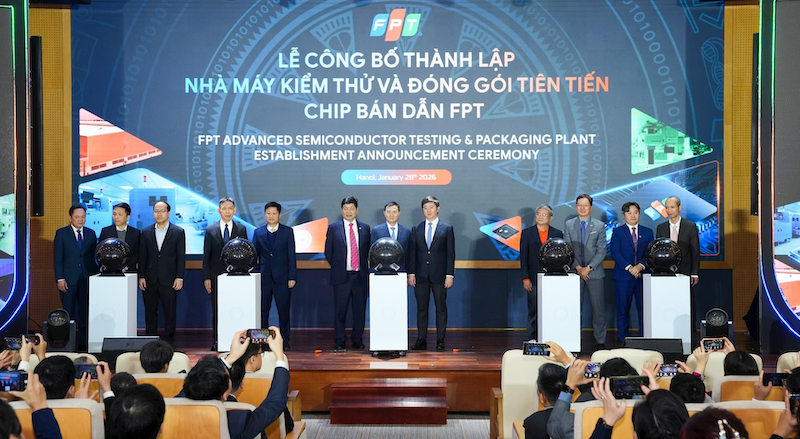
The announcement ceremony for FPT Advanced semiconductor testing and packaging plant. Photo courtesy of the group
FPT Chairman Truong Gia Binh said the facility reflects Vietnam’s national strategy to develop sovereign technologies, strengthen technological autonomy and expand its presence in high-value segments of the semiconductor industry.
Semiconductor production typically involves three stages: design, fabrication and testing and packaging. Vietnam has built a strong base in chip design, while domestic fabrication capacity has begun to advance following the recent groundbreaking of Viettel’s chip manufacturing facility.
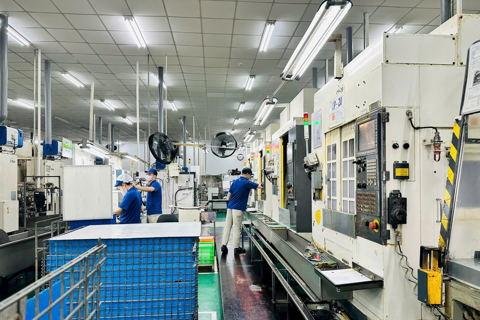
According to Binh, Vietnamese engineers and specialists will fully operate and master the new plant. The facility spans 1,600 square meters at Yen Phong II-C Industrial Park in Bac Ninh Province.
In its first phase, scheduled for 2026-2027, the plant will run six functional testing lines equipped with automated test equipment (ATE) testers and handlers. A dedicated area will support reliability testing, burn-in processes and failure analysis.
All equipment and processes will meet international quality management standards to ensure stable and reliable performance throughout the product lifecycle.
The plant can handle both high-volume testing and specialized requirements, allowing customers to optimize costs without dividing quality assurance across multiple sites.
A key advantage lies in FPT’s “Make in Vietnam” testing software, which engineers can tailor to each product. This flexibility improves efficiency and supports higher-value services for global clients.
FPT expects to complete the initial six testing lines and reliability areas in time for Vietnam’s Reunification Day on April 30, enabling the facility to begin operations.
The company plans a major second-phase expansion from 2028 to 2030. The plant will grow to 6,000 square meters, add 18 testing lines, introduce three more reliability and durability testing areas and deploy additional packaging technologies.
Once fully operational, the facility is expected to reach annual output in the billions of products.
FPT also aims to expand testing capabilities for high-end chips used in Internet of Things applications, automotive electronics and edge-based artificial intelligence system-on-chip solutions. This focus seeks to complete Vietnam’s semiconductor value chain and move the country into more technologically demanding markets.
Deputy Minister of Science and Technology Bui Hoang Phuong said testing and packaging, especially advanced packaging, has become a core technology as chip performance approaches physical limits.
He urged FPT to take a leading role in connecting and supporting other Vietnamese firms entering the semiconductor value chain.
“The plant should become a research and training hub linked with domestic educational and research institutions,” he said.
Phuong added that the ministry will continue refining the legal framework to support sector development.
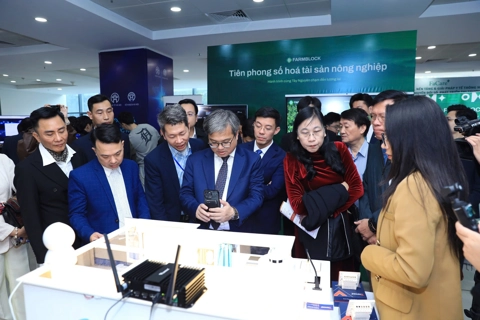
At the launch event, FPT signed several cooperation agreements with domestic and international technology partners.
The group entered a comprehensive partnership with military-owned technology firm Viettel to strengthen Vietnam’s semiconductor autonomy through closer integration across the value chain.
FPT also announced plans to research and develop edge AI system-on-chip products, aiming to gain full control of a smart device ecosystem that includes cameras, drones and unmanned aerial vehicles.
As of August 2025, Vietnam had nearly 60 semiconductor-related enterprises, including about 50 chip design firms and seven testing and packaging companies, alongside global players such as Intel, Amkor and Hana Micron.
In April 2025, another Vietnamese company, CT Group, also began building a chip testing and packaging plant in Ho Chi Minh City.