FTA Index facilitates Vietnam's 8% GDP target in 2025: Prime Minister
The FTA Index aims to provide transparent, objective data for central and local authorities to steer and monitor integration efforts
THE HANOI TIMES — The implementation of the FTA Index serves as a key metric and foundation to inform development strategies, supporting Vietnam's goal of 8% growth in 2025.
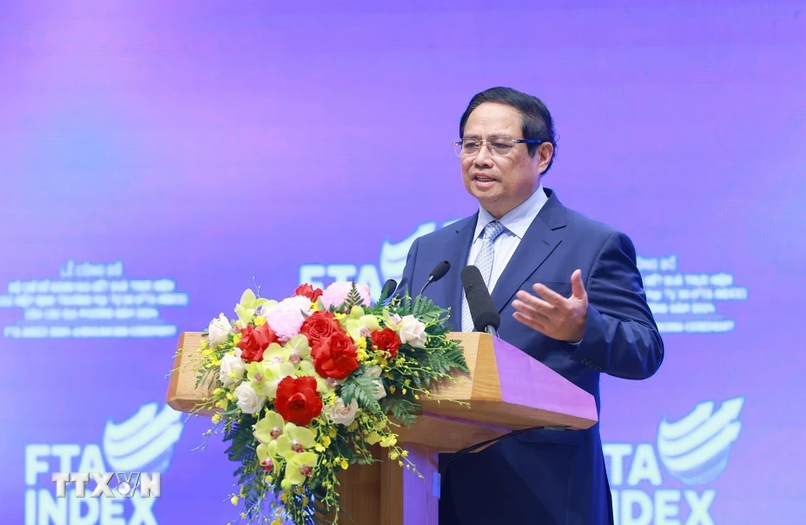
Prime Minister Pham Minh Chinh at the launch of the FTA Index. Photo: VNA
"The index helps build momentum and capacity and position of the country to become a high-income nation," said Prime Minister Pham Minh Chinh at the launch ceremony of the FTA Index of Provinces/Cities in 2024 held today [April 8].
Since 2022, the Ministry of Industry and Trade (MoIT), under the leadership of the government, has started to develop the FTA Index, a set of indicators to assess the implementation of free trade agreements (FTAs).
This is the first time such a systematic and data-driven tool has been introduced in Vietnam, based on surveys of businesses in all 63 provinces and cities.
The FTA Index composite score is based on a 40-point scale, incorporating four indicators, each scored out of 10. These indicators assess access to FTA-related information for businesses, compliance with national legal obligations, the effectiveness of FTA-support policies, and local implementation of sustainable development commitments. The highest-scoring province achieved 34.90 points, while the lowest scored 14.49 points.
The average score was 26.20, with a median of 20.40. At the launch event, Prime Minister Pham Minh Chinh described FTAs as a dominant force in global trade, playing a key role in boosting trade between countries amid deepening globalization and economic integration.
"Vietnam has actively embraced this process, and FTAs in particular have brought significant economic benefits, including export growth, market expansion, and increased foreign investment," said Chinh.
The leader also noted that FTAs have helped improve the production capacity and competitiveness of Vietnamese enterprises. Institutional reforms and transparency commitments under FTAs have created momentum to improve the domestic business environment.
However, implementation challenges remain. In response, the government tasked MoIT with developing the FTA Index to assess results and guide further progress.
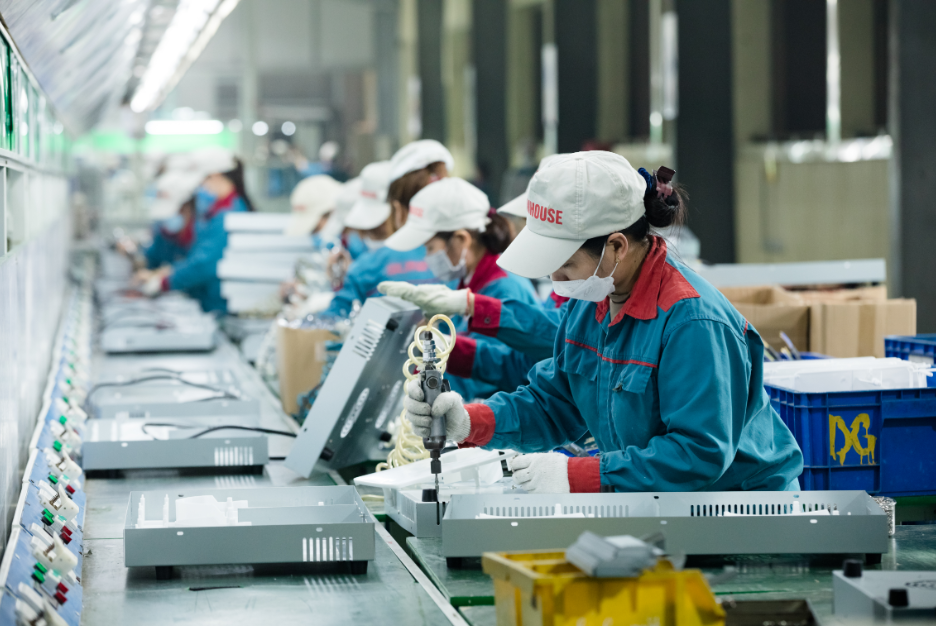
Electronics production at Sun House Group's manufacturing plant. Photo: Khac Kien/The Hanoi Times
The FTA Index aims to provide transparent, objective data for central and local authorities to steer and monitor integration efforts. It is also a tool for localities to assess their performance against action plans and design policies tailored to their specific conditions and potential.
According to Minister of Industry and Trade Nguyen Hong Dien, the FTA Index provides a quantitative, comprehensive, and objective assessment of FTA implementation in Vietnam's 63 provinces and cities.
He said that in the current global trade environment, where US President Donald Trump has imposed reciprocal tariffs of 10-49% on imports from all countries, FTAs serve as "major highways" to promote cross-border trade.
Dien said that the effective implementation of FTAs has helped Vietnam diversify markets, supply chains, and export products, and integrate more deeply into global production networks. However, he acknowledged that the ability to leverage FTAs varies widely across regions and enterprises.
The FTA Index is expected to serve as an important reference for designing more practical and effective import-export policies. "This index is not just for comparison, but a driving force to encourage localities and businesses to better implement FTAs and optimize their benefits," Dien said.
Promoting efficiency in FTA implementation as key
The survey results show that only 12.4% of the businesses "frequently" or "very frequently" participated in FTA information dissemination events. Another 35.3% reported participating occasionally, 16.6% said they rarely attended, and 35.6% never participated.
There is also a notable gap in how effectively different types of firms use FTAs. Nearly 35% of foreign-invested enterprises (FDIs) rated the results of FTAs as effective, and 6.13% as very effective. State-owned enterprises reported an effectiveness rate of 37.5%, but none rated the outcomes as very effective.
Some 79% of the firms surveyed said that FTA support was "very necessary" or "necessary." Among them, state-owned enterprises expressed the greatest need for assistance in exploiting FTAs and managing trade activities. Private firms sought assistance in overcoming internal barriers, while FDI firms emphasized the importance of strategic, targeted programs.
Among the provinces, Ninh Binh scored the highest (8.3) on the component index measuring access to FTA information. Khanh Hoa led in legal implementation with 8.69 points. Thanh Hoa topped the policy support index with 7.33 points, while Bac Lieu led in sustainable development with 8.35 points. In the overall FTA index ranking, Ca Mau topped the list with a score of 34.90, and Quang Tri came in last with 14.49.