Government taps private sector in new national wealth creation strategy
The government will continue to facilitate, rather than control, the development of the private sector.
THE HANOI TIMES — The government is gearing up to launch a nationwide movement to encourage wealth creation, with the private sector set to play a major role in driving economic growth.
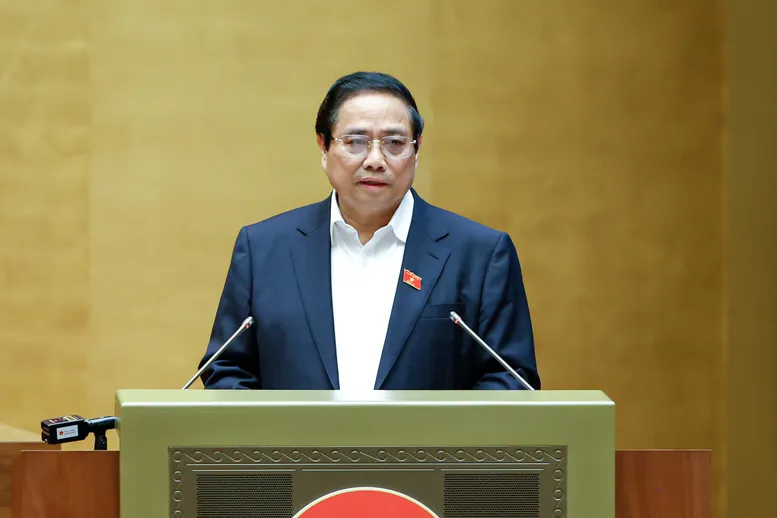
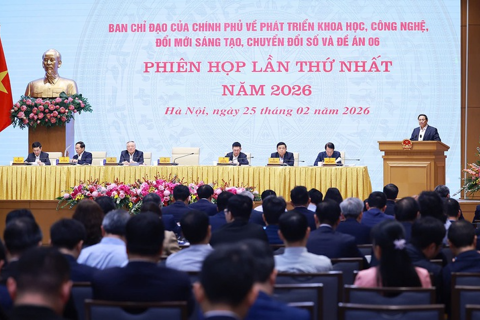
Prime Minister Pham Minh Chinh at the conference on internalizing Politbureau's Resolution 68. Photos: VGP
Prime Minister Pham Minh Chinh kickstarted the movement at a national conference on Resolutions 66 and 68, which address legal reform and the promotion of private sector development, respectively. Held on May 18, the conference was attended by Party and State leaders, as well as representatives from ministries and local authorities, and was broadcast to 37,000 institutions and units across the country.
Resolution 66, issued by the Politburo, aims to improve legal frameworks for successfully implementing the strategic directions and goals for private sector development outlined in Resolution 68. These two resolutions are closely intertwined and reinforce each other in advancing the country's development in the new era.
At the conference, Prime Minister Chinh urged policymakers to view the marketplace as a battlefield and entrepreneurs as frontline soldiers. He called for an end to the entrenched "ask-give" mindset and discrimination against private businesses.
"Only by doing so can we ensure a level playing field for the private sector, particularly with regard to access to resources," said the Prime Minister.

Country leaders at the event.
Full support for private sector
He called for the dismantling of regulatory barriers and emphasized the State's evolving role as a facilitator rather than a controller. He said that tailored policies are needed to prioritize key sectors, such as electric vehicles, wind power, and solar power, especially in areas like energy access and technology transfer.
"In order to prioritize a specific industry, we must have policies tailored to it," he said, citing electric vehicles, wind power, and solar power as examples of sectors requiring targeted incentives for energy access and technology transfer.
Vu Van Tien, Chairman of the Geleximco Group, welcomed the resolutions, but called for a dedicated monitoring body to ensure effective implementation and to collect feedback from the private sector.
"For years, restrictive mechanisms have tied our hands," said Tien. “These new policies are promising, but proper execution is essential.”
In response, Prime Minister Pham Minh Chinh said that the government had issued a resolution containing a detailed action plan for implementing Resolution 68. This plan specifically assigns responsibilities to the relevant ministries and agencies. He called on regulators and enterprises to demonstrate a strong commitment: "Words must be translated into actions, and those actions must yield tangible results."
Vuong Quoc Toan, the chairman of the Lan Hung Real Estate Group, which specializes in social housing development, highlighted the land access challenges faced by millions of small- and medium-sized enterprises (SMEs), especially sole proprietors. He pointed out that all industrial parks lease only one-hectare plots or larger, which come with high rental costs that are unaffordable for SMEs.
The Prime Minister acknowledged these concerns and noted that Resolution 68 includes provisions to provide SMEs with land access and capital. He added that the government will issue a decree to implement land access policies and that the State Bank of Vietnam will issue guidelines for accessing financing.
"The policies are straightforward, and businesspeople can rest assured. There will be detailed and appropriate implementation guidance,” he said.
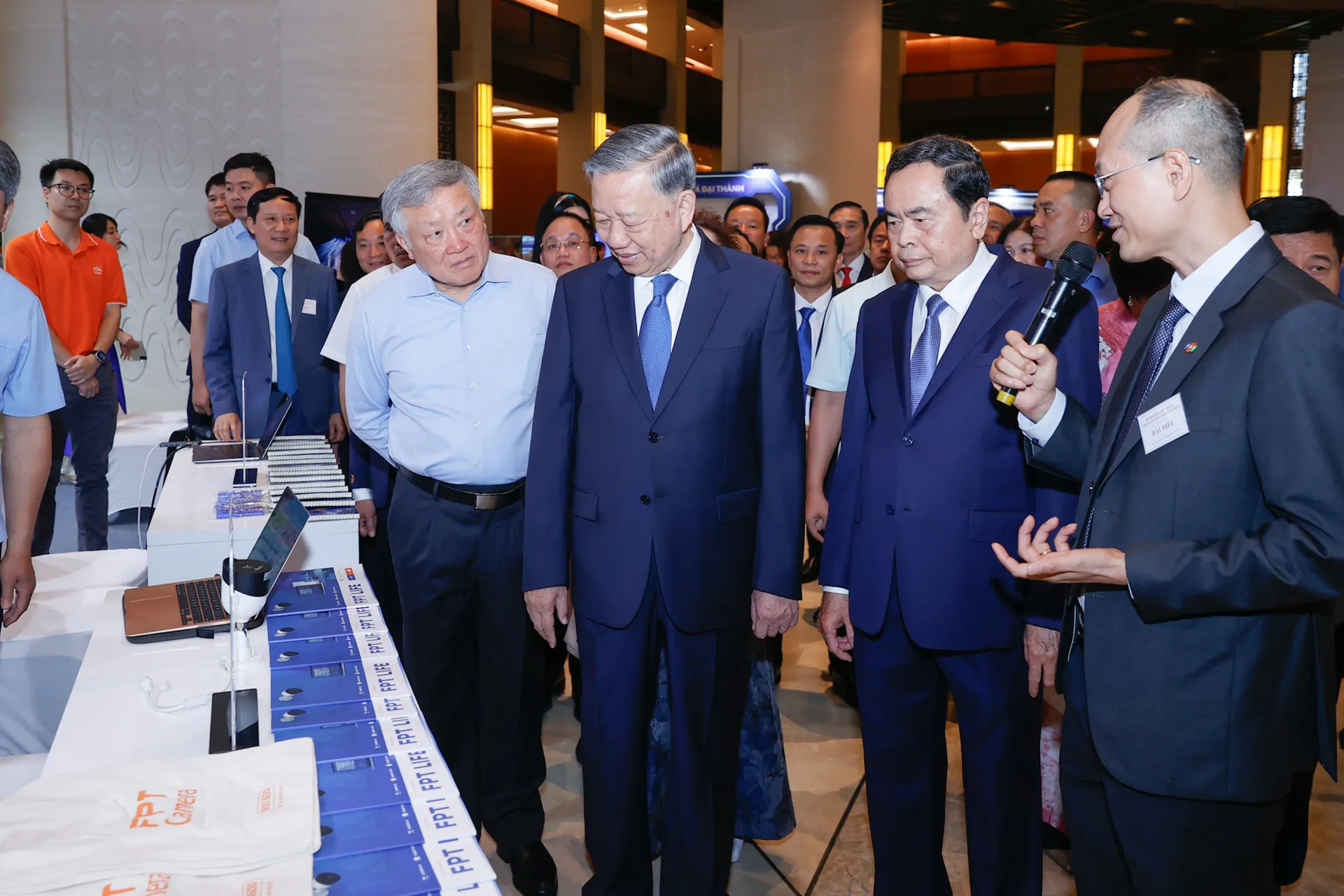
General Secretary To Lam, National Assembly Chairman Tran Thanh Man, and Deputy Prime Minister Nguyen Hoa Binh visit exhibition booths showcasing products from private enterprises.
Promoting pro-business mindset
Currently, the private sector contributes 50% of GDP and over 30% of the state budget. The number of private enterprises has grown from just around 5,000 in 1990 to nearly one million by the end of 2024.
The Prime Minister noted that the private sector continues to grow and assert itself as a vital engine of the economy. Many major domestic corporations are expanding in Asia and globally. He added that Resolution 68 has sparked enthusiasm and accelerated the startup movement nationwide.
He revealed that the government has tasked the Ministry of Home Affairs with developing a plan for a nationwide wealth creation movement, which will be rolled out once private sector-related resolutions are fully in place.
However, the Prime Minister acknowledged that there are still several challenges preventing the private sector from reaching its full potential and contributing to the national economy as it should.
For instance, the target of having 1.5 million enterprises contribute 55% of the GDP by 2025 has not been achieved. Approximately 98% of private enterprises are small or medium-sized, and 70% are micro-sized. These enterprises face limitations in competitiveness, efficiency, and governance.
Some private businesses still fail to comply with the law, lacking strategic vision, ethical standards, and a strong business culture. Some have even been involved in smuggling, selling counterfeit goods, evading taxes, and manipulating the market.
Regarding the regulatory body, the prime minister noted that governance is inconsistent, awareness of the private sector's role is limited, and policies and mechanisms are often ineffective or slow to execute. He emphasized that legal frameworks are the "bottleneck of all bottlenecks," hindering private sector development.
In 2023, Vietnam’s business environment index ranked 70th out of 190 countries, which is lower than several regional peers, including Thailand, Malaysia, and Singapore. He noted that some unnecessary and unfeasible business conditions have yet to be amended and that administrative procedures in several areas remain complex and nontransparent.
Additionally, it remains difficult to implement certain support policies for private enterprises, such as incentives for research and development (R&D) investment, tax breaks, and encouraging household businesses to transition into formal enterprises. Drawing from real-world experiences in private sector development, the Prime Minister emphasized the importance of treating private enterprises fairly and equally, especially those in strategic sectors.
He emphasized the importance of branding, pointing out that garments made from the same material could be sold at vastly different prices based solely on their brand. "We must support private businesses in entering global markets and developing international brands," he said.
The Prime Minister emphasized the importance of science and technology, creating an open and transparent business environment, and maintaining regional and global competitiveness. He called for a stronger spirit of entrepreneurship, legal wealth creation, and national contribution.
To illustrate, he highlighted FPT as a pioneer in technological and telecommunications innovation, especially in artificial intelligence (AI). The company has been developing AI since 2013 to serve national interests and foster private-sector and national development.
He concluded by affirming the need to strengthen the leadership of the Party, the State's facilitating role, and the centrality of businesses.
"We must honor and support a strong entrepreneurial class. This will unleash patriotism, national pride, and the desire to contribute," he concluded.