Greening agriculture - opportunity for Vietnam’s growth
Vietnam can become a logistics center for agriculture and food in the Asia-Pacific region.
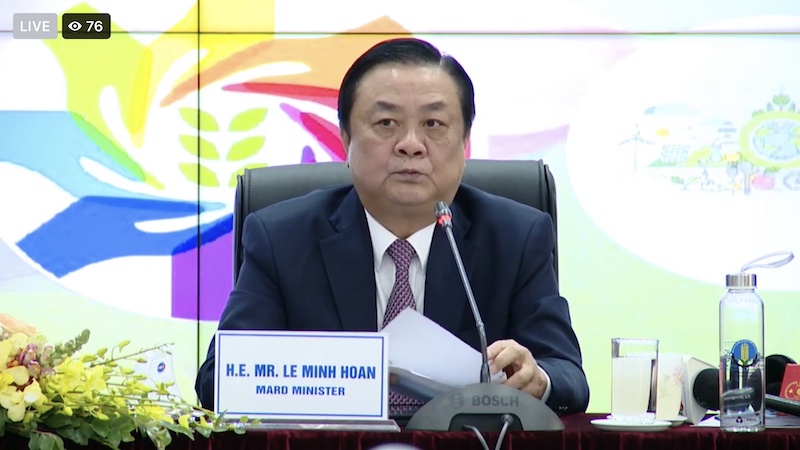
The greening of agriculture is not a burden but a need and an opportunity that Vietnam should determine to grasp. This is also a responsibility for tens of millions of farmer households, Minister of Agriculture and Rural Development Le Minh Hoan said.
The minister said the Ministry of Agriculture and Rural Development (MARD) will assign the Vietnam National University of Agriculture to coordinate with the ministry’s agencies to implement each step of the agriculture greening scheme.
“The Departments of Crop Production, Livestock Husbandry and Fisheries, those which are related to green agriculture need to take specific steps to start implementing it from today,” Hoan said.
| Minister of Agriculture and Rural Development Le Minh Hoan. Photos: Phi Nhat |
According to the minister, Vietnam is realizing an initiative of the World Economic Forum in a production chain of commodities including coffee, rice, tea, vegetables, seafood, pepper, livestock, and agrochemicals. The initiative, "New Vision for Agriculture”, is aimed at sustainable and responsible agricultural development.
Over the past 10 years, the country has been considered to have demonstrated a significant commitment to promoting a more sustainable growth path and efforts in both climate change adaptation and mitigation. This is reflected in a large number of strategies, plans, resolutions, and revised documents.
Under the National Green Growth Strategy for the 2021-2030 period, with a vision to 2050, approved by the Government on October 1 2021, the ministry will develop and implement sustainable, low-emission agriculture towards a circular economy, cleverly adapt to climate change and improve competitiveness for green agricultural products.
Building and developing new rural areas based on green and sustainable models such as eco-villages and smart villagesthat adapt to the climate is also a direction to take.
Restructuring the agricultural sector is designed around three pillars: ecological agriculture, modern urban areas, and smart farmers in line with the strategic orientations of the country.
Minister Hoan believed with geo-economic strengths, Vietnam can completely become a logistics center for agriculture and food in the Asia-Pacific region, a processing center for agro-forestry-fishery products for Southeast Asia.
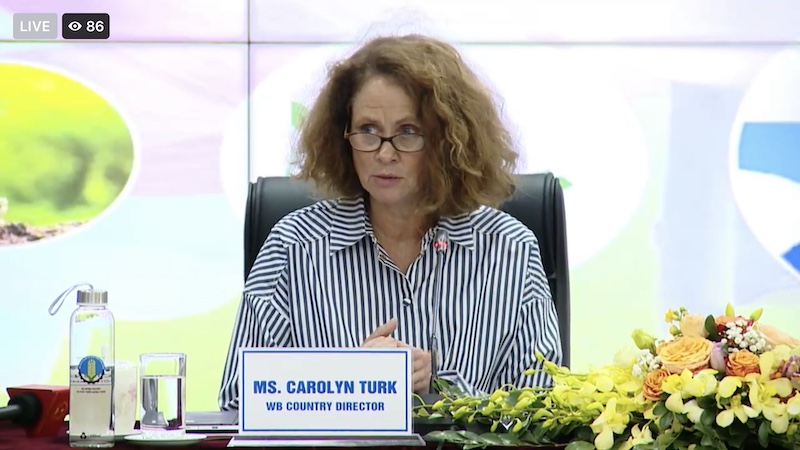
Speaking at a high-level policy forum on November 30, Carolyn Turk, World Bank (WB) Country Director for Vietnam said agriculture is one of the main drivers of climate change as greenhouse gas emissions from this sector account for 18% of total emissions. Emissions are expected to generate 120 million tons of CO2 by 2030, of which up to half will come from the rice industry.
Vietnam is also facing negative impacts of climate change such as sea-level rise, saltwater intrusion, extreme rainfall, and drought.
| Carolyn Turk, World Bank Country Director for Vietnam |
In addition, Vietnam is also facing internal challenges such as reduced productivity in the industry, pressures from increasing output, and requirements for the quality of agricultural products.
“We believe Vietnam urgently needs to maintain its desired position as one of the strong agricultural producing countries in the world,” she underlined.
The WB will continue to cooperate, provide technical support, expand investment activities together with the Vietnamese Ministry of Agriculture and Rural Development to identify and look forward to a bright future for Vietnam's agriculture industry, according to the WB country director.
Vietnam has made a strong commitment at COP26 to reach net-zero emissions by 2050, cut methane emissions by 30% by 2030 and this is a challenge for the rice industry.
Turk said: “The future of Vietnam’s agriculture will be based more on knowledge while resource-intensive practices and carbon footprint need to be reduced. Vietnam also needs to be more sensitive to global needs to produce products that are safer for the environment.”
The WB strongly encourages the Vietnamese government to move towards public investment in a green food system and emission reduction. In fact, the WB, the Ministry of Agriculture and Rural Development along with many provinces and cities are developing a project to support the development of agricultural value chains to reduce emissions in the future.
Experts from the WB expected a strong partnership with the private sector, a close partnership to enhance skills and drive investment where the private sector can contribute to high-value agricultural transformation more productive, and lower emissions.
Vietnam needs a technical platform and technologies to promote farmers’ participation in sustainable agricultural development, according to Steven Jaffee, a WB senior economist.
Being of the same mind, Jikun Huang, Director of the Center for Chinese Agricultural Policy of the Chinese Academy of Sciences said a mechanism to encourage farmers’ incentives is extremely important as this is a key indicator to ensure the promotion of participation and adoption of innovation, he said.
“Drawing on the lessons learned from China’s experience, in order to increase farmers’ incomes, improve food security and develop sustainable agriculture, Vietnam urgently needs political commitments in institutional reform, support policies, and investment in agriculture,” Huang emphasized.