Hanoi builds more processing plants to balance supply and demand
The Hanoi People's Committee set a target for 2030 to develop the processing industry with medium and advanced technology and create highly competitive products that meet the requirements of domestic and export markets.
Hanoi will invest in upgrading and building new slaughterhouses, and preliminary and deep processing plants in order to improve food quality and step by step meet consumer demand for processed agricultural products.
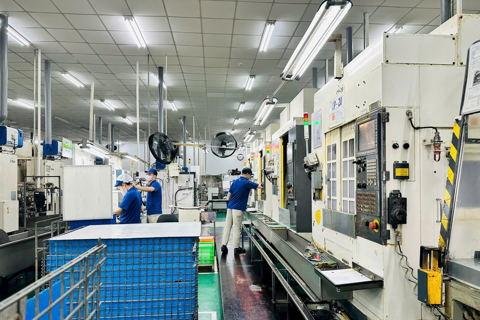
| C.P Food Processing plant at Phu Nghia Industrial Park, Chuong My District. Photo: Viet Linh / The Hanoi Times |
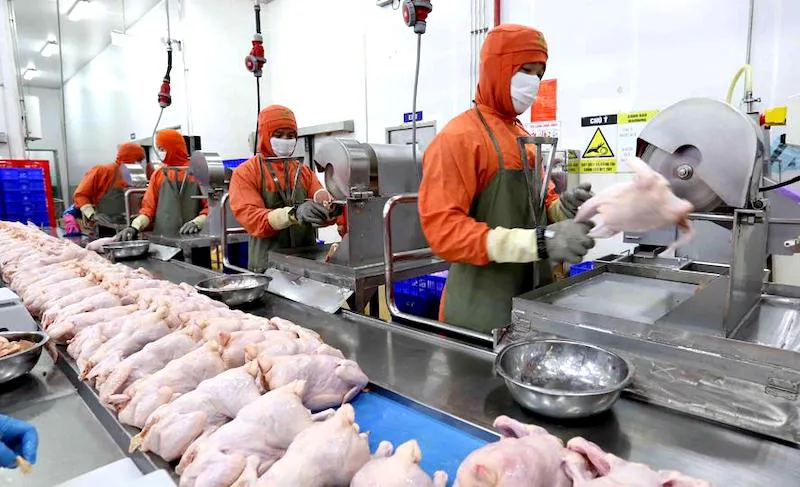
Under a proposal of the Hanoi Department of Agriculture and Rural Development, the Hanoi People's Committee will call for and facilitate investment by large companies in building high-tech agricultural infrastructure and services to ensure a long-term supply of processed food.
Hanoi Agriculture and Rural Development Department Deputy Director Nguyen Ngoc Son said that the department would continue to coordinate closely with provinces and cities to develop regional linkage programs, connecting suppliers with businesses to sell processed products in the capital city.
As one of the largest farm producers in the Northern region, Hanoi is still unable to meet the local demand for processed food.
Statistics from the Hanoi Department of Agriculture and Rural Development showed that the city has more than 1,900 agricultural processing establishments, 98% of which are currently small and medium-sized.
The city has more than 250 enterprises processing farm produce, along with thousands of cooperatives and households operating in pre-processing and preservation, whose machinery is mainly semi-automatic (accounting for 76.6% of the total number of establishments), automatic (14.7%) or manual (8.7%).
Meanwhile, the city has 113 cold storage warehouses, and there are only seven warehouses with a scale of nearly 30,000m2. The remaining 106 warehouses are small, with an area of over 5,300m2. The output of farm produce and processed foods in Hanoi is about 1,000 tons per month, while the consumption demand amounts to almost 5,200 tons. It means that every month, the processed food supply only meets nearly 20% of Hanoi's market.
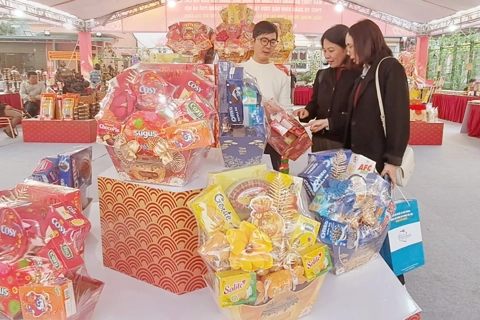
Therefore, the city has connected with neighboring localities to produce, consume, and commercialize processed food to satisfy consumers' needs.
Strengthening trade connections
| Hanoi has connected with neighboring provinces and cities in the production, consumption, and commercial promotion of processed food. Photo: Lam Nguyen/ The Hanoi Times |
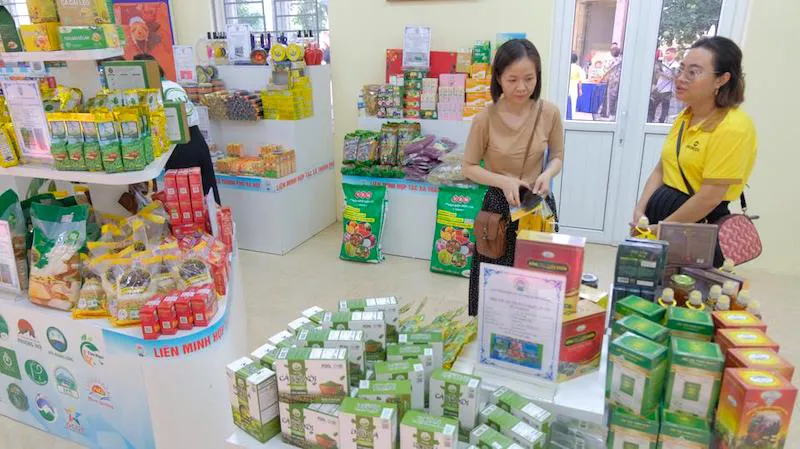
The Hanoi People's Committee and the Ministry of Agriculture and Rural Development signed a cooperation program to ensure food safety, improve the quality of agricultural, forestry, and fishery products, and trade between Hanoi and other provinces and cities in the 2021-2025 period.
Under the agreement, the municipal Department of Agriculture and Rural Development has actively exchanged and cooperated with the departments of Agriculture and Rural Development of 43 provinces and cities across the country according to the strengths of each locality’s farm produce.
Since this year's beginning, tens of thousands of tons of processed food from localities have been sold in Hanoi’s market. In addition to bringing processed food from localities to consumption in the capital city, Hanoi's relevant departments and agencies have strictly controlled the quality of goods. From the beginning of 2022 up to now, the Hanoi Agro-Forestry-Fisheries Quality Assurance Sub-Department has taken 63 samples of processed food.
“The authorities have required localities to conduct traceability, determine the cause of the violating samples, and then take measures to ensure food safety for Hanoi’s consumers,” Deputy Director of the Hanoi Agro-Forestry-Fisheries Quality Assurance Sub-Department Ngo Dinh Loat said.
This year, the city and localities will hold some festivals promoting farm produce and products ranked by the One Commune One Product (OCOP) program associated with Hanoi’s tourism in Chuong My, My Duc, Phu Xuyen, and Ba Vi districts, and the Fruit Festival 2022.