

Hanoi debuts 43 new schools, ready for new school year
By expanding schools and upgrading facilities, Hanoi strengthens learning opportunities for millions of students and prepares for future educational demands.
THE HANOI TIMES — As more than 2.3 million students return to class this week, Hanoi authorities have unveiled 43 new schools, a bold move marking the city's readiness for the new academic year 2025-2026.
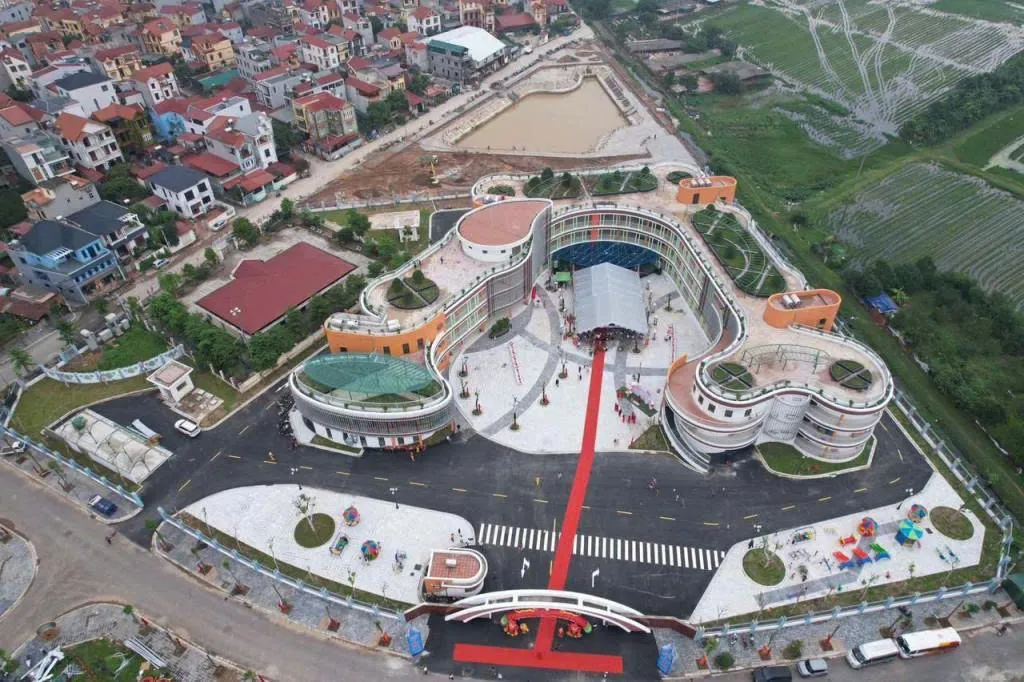
The overview of Van Khe A Kindergarten in Me Linh Commune, Hanoi. Photo: Tuoi Tre Thu Do Newspaper
In Kien Hung Ward, this is the first school year for teachers and children at Hoang Cong Kindergarten, which was established in mid-June.
For the past two months, teachers and staff at the preschool have been decorating classrooms and preparing the playground, art and creative spaces.
At the Khe Ngoai 3 resettlement area of Me Linh Commune, Van Khe A Kindergarten opened in late June 2025.
The school development project represents an investment of VND134 billion (US$5 million) and spans 12,000 square meters, serving families affected by the construction of Ring Road No. 4 in Van Khe Commune.
The two new schools, along with 41 others, are proof of Hanoi's commitment to providing classrooms and facilities for the new academic year. It is estimated that the city will welcome 60,000 first graders in the 2025-2026 school year.
In total, Hanoi will have more than 2.3 million students across all three levels of education: primary, lower secondary, and upper secondary.
According to the Hanoi Department of Education and Training, of the 43 new schools, 27 are public and 16 are private institutions. By education level, there are 17 preschools, 14 primary schools, nine lower secondary schools, and three upper secondary schools.
Other schools across the capital are in the final stages of renovation projects to be ready for the new school year.
Bui Thuy Linh, Principal of Thach Ban High School in Long Bien Ward, said that the VND60 billion (US$2.3 million) renovation and upgrading project is now near completion.
Once completed, the school will meet the level-2 national standard and create a better environment for both teachers and students, she said.
In Viet Hung Ward, Ly Thuong Kiet High School expects to add more classrooms and functional rooms this school year under a renovation project worth VND100 billion (US$3.8 million).
The school will welcome 675 freshmen in 2025-2026, an increase of 36% compared to the previous year.
Luu Le Thuy, a mother in Hoang Mai Ward, said her family struggled to find a suitable kindergarten for their child last year due to soaring demand.
She was relieved that there were more options this year. "The battle for enrollment is less intense," said Thuy.
Duong Trong Tan, a resident of Cau Giay Ward, has a child entering first grade this year.
New primary schools in the ward, where enrollment is highly competitive, are welcome news, he said.
Nguyen Phuong Mai has been preparing for her child to enter grade 10 in Ha Dong Ward.
"Other children in the area used to travel long distances to school, and their parents worried a lot about them," she said.
"Now we have a high school nearby. It's easier to commute, and my children have more time to spare after class."
“My child was admitted to a new public high school with modern facilities. I can clearly see the city’s efforts to create better learning conditions for students,” said Nguyen Thi Thu Ha, a parent from Hong Van Commune.
According to Tran The Cuong, Director of the Hanoi Department of Education and Training, the city will have more than 2,950 schools with some 68,900 classrooms.
The completion of school construction and renovation will also ease pressure on parents seeking facilities that fit their needs, he said at a recent meeting on the education sector.
In addition to general schools, Hanoi has 29 centers for vocational and continuing education, serving around 57,000 learners.
Laying the foundation for sustainable education
Hanoi has set a goal to invest in facilities and equipment that are permanent, modern, up to national standards, and internationally integrated.

Candidates sit for the 10th-grade entrance exam in Hanoi. Photo: Pham Hung/The Hanoi Times
The city plans to build 30 to 35 new high schools by 2030 to ensure equal access for students across the city. By 2025, 80-85% of public schools are expected to meet national standards, rising to 85-90% by 2030.
These efforts align with Prime Minister Pham Minh Chinh's remarks at a meeting last week on preparations for the 2025-2026 school year.
"Teachers and administrators must make a swift shift in their mindset, moving from delivering knowledge to developing comprehensive learning competencies for students," he said.
"All citizens must have equal, fair access to education. No student should be left without schools, classes, teachers, food, or clothing."
Regarding this orientation, Nguyen Van Phong, Permanent Vice Secretary of the Hanoi Party Committee, said school planning must be linked to the two-tier government model.
The model will ensure accurate population forecasts and protect students’ rights and quality of education, rather than striving for achievements for the sake of "good profiles," he said.
Vice Chairwoman of the Hanoi People’s Committee Vu Thu Ha said the city is fully prepared for the new school year.
According to the Hanoi Department of Education and Training, the construction of new schools will ease public concerns and improve the quality of teaching and learning.
City authorities will continue to refine existing policies and mobilize social resources to develop a sustainable education sector.
This will help provide schools with better conditions and raise the quality of teaching and learning activities, meeting the expectations of both parents and society.







