Hanoi determined to ensure effective enforcement of amended Capital Law
Hanoi faces a heavy workload in enforcing the amended Capital Law, to take effect on January 1, 2025.
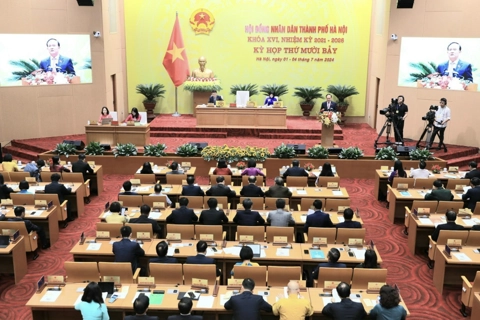
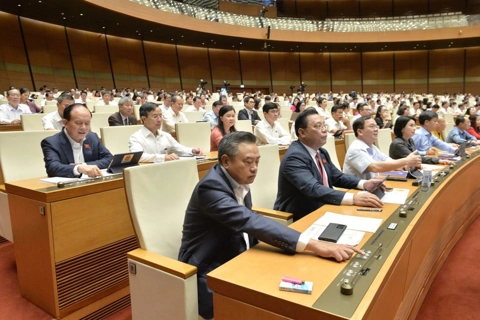
With the amended Capital Law set to bring significant legal breakthroughs for Hanoi's development, the key issue will be to ensure its effective operationalization when it takes effect in early 2025, Vice Secretary of the Hanoi Party Committee Nguyen Thi Tuyen said during a group discussion at a session of the 17th Hanoi People’s Council on July 1.
| Vice Secretary of the Hanoi Party Committee Nguyen Thi Tuyen during the session. Photos: Thanh Hai/The Hanoi Times |

According to Tuyen, a significant highlight for the city in the first six months of the year was the progress made on several major legal initiatives. In particular, the amended Capital Law passed by the National Assembly and two master plans, which provide a legal framework and long-term strategic direction for Hanoi's development, are currently undergoing public consultation.
Regarding the 83 tasks within the city's authority related to six draft Government decrees to put the Capital Law into effect, Deputy Secretary Tuyen noted that this substantial workload requires immediate action.
On this issue, Gia Lam District Party Secretary Nguyen Viet Ha stressed that the amended Capital Law remains vital for Hanoi’s development process and needs to be implemented without delay. Ha suggested that during the organization and implementation process, mechanisms need to be established and enacted to concretize the Capital Law under the authority of both the municipal People's Council and the People’s Committee.
| Deputy Nguyen Ngoc Viet from My Duc District. |

“With only six months to go, if immediate action is not taken, and specific responsibilities are not assigned to each advisory body, it will be challenging to meet the law's enforcement timeline starting from January 1, 2025,” said Ha.
Deputy Nguyen Ngoc Viet from My Duc District echoed these sentiments, emphasizing that although the amended Capital Law will come into on January 1, 2025, the city must now draw up a comprehensive plan and leverage resources in terms of mechanisms and policies so that they can be implemented immediately once they come into effect.
Deputy Director of the Hanoi Department of Justice Nguyen Cong Anh stated that the Capital Law delegates the issuance of many mechanisms to the People's Council and the People's Committee for execution from January 1, 2025.
So far, the City People's Council has been assigned 35 tasks, and the concretization of these responsibilities is a heavy burden. The Department of Justice has drafted a plan, but guidance is needed from the Party Committee, the People's Council, the People's Committee, the Fatherland Front, and other organizations, along with clear responsibilities for various departments and sectors to execute the tasks, said Anh.
| Deputy Director of the Hanoi Department of Justice Nguyen Cong Anh. |

Deputy Nguyen Minh Duc from Hoang Mai District noted that following the passage of the amended Capital Law, officials, party members, and citizens are enthusiastic and highly appreciative of Hanoi's initiatives in drafting of the law.
“With strong decentralization provisions, this legal foundation will enable Hanoi to efficiently perform its duties,” said Duc.
Deputy Nguyen Dinh Hung from Me Linh District said that the amended Capital Law will create significant development opportunities for the capital. However, he also pointed out that with these opportunities come substantial challenges. He stressed the need for robust communication efforts on the law so that the residents of the capital understand it and support the authorities in its implementation.
The amended Capital Law consists of 7 chapters and 54 articles, compared to only 4 chapters and 27 articles in the 2012 version. This underlines the importance of this legislative project for the development of the capital and the country as a whole. While the current version mainly serves as a framework, the latest version addresses particular aspects related to decentralization and delegation of powers.
Notably, the new law contains several new provisions, such as those on urban government organization; construction, development, management, and protection of the capital; finance, budgeting, and mobilization of resources for capital development; regional linkage and development; and supervision, inspection, audit, and responsibilities for the development, management, and protection of the capital.