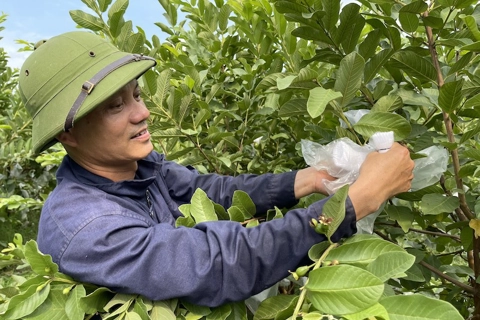
Hanoi expands VietGAP aquaculture models
The adoption of VietGAP aquaculture standards has been instrumental in raising public awareness of water environment management.
Hanoi's agricultural sector has supported fish farmers to develop and expand aquaculture models in line with VietGAP standards. This has resulted in high economic efficiency, clean and safe products, and reduced environmental pollution and production costs.
Effective model
| Hanoi continues to apply science and technology to improve the productivity of aquaculture. Photo: Hanoimoi |
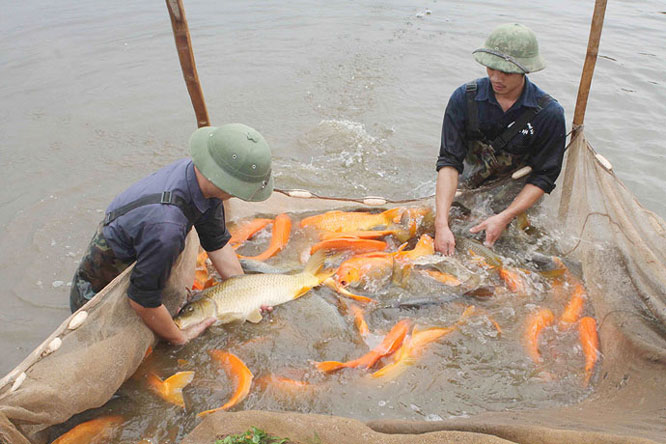
After earning a low income from traditional fish farming, Le Van Phuong's family in Trung Tu Commune (Ung Hoa District) switched to VietGAP aquaculture on their 2.7-hectare farm with the help of local agricultural extension officers. Phuong has found that VietGAP fish are healthier and require less feed than before. He has also been able to stop using antibiotics to treat and prevent fish diseases.
A one-hectare VietGAP aquaculture model was also established on Do Thi Thu Ha's farm in Dai Ang Commune (Thanh Tri District) with the support of the Hanoi Agricultural Extension Center.
The family received 50% support for fingerlings, and agricultural staff regularly monitored the farming process and provided technical advice on pond management and maintenance.
The family learned methods of water treatment, how to use rapid tests to monitor water quality indicators, and how to identify and prevent common freshwater fish diseases.
Vu Thi Huong, director of the Hanoi Agricultural Extension Center, said that from the beginning of 2024 until now, the center has worked with various districts to implement VietGAP-compliant aquaculture models on 25 hectares in Phuc Tho, Ung Hoa, Ba Vi, My Duc, Thanh Tri, and Phu Xuyen districts.
She added that these models have shown great effectiveness - the fish have shown strong growth, with a survival rate of 81.5% and a yield of over 12 tons per hectare. Profitability has exceeded VND95 million (US$3,713) per hectare, an increase of 10-15% compared to traditional methods.
"Farmers practicing the VietGap model have received training and technical guidance from local officials, including water quality monitoring, testing, and farm record keeping," she said.
Huong underlined that farming households have shown a strong commitment to food safety, aquatic animal health, environmental protection, and ensuring the production of high-quality, standards-compliant products.
“The adoption of VietGAP standards in aquaculture has been instrumental in raising public awareness about water environment management, the use of biological products for disease prevention and treatment, and minimizing environmental pollution," she stressed. "This, in turn, has resulted in the production of clean, safe products while increasing the overall value of local aquaculture."
Supporting infrastructure and value chain development
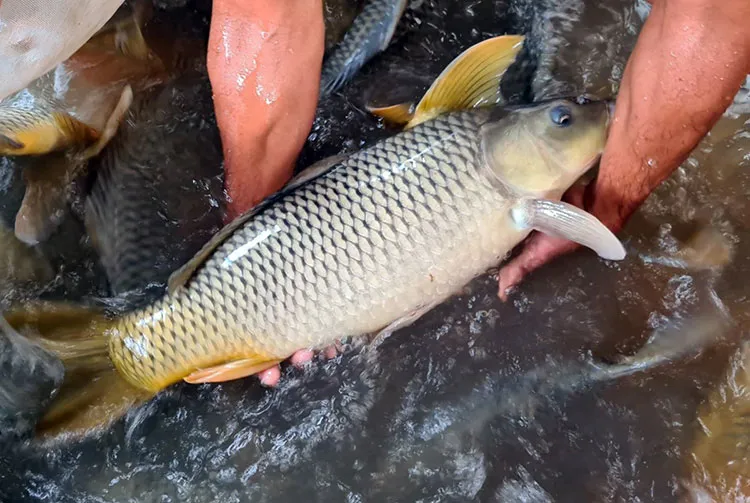
| The VietGAP aquaculture model is being expanded across the city. Photo: thuysanvietnam.com.vn |
According to the Hanoi Agricultural Extension Center, the expansion of VietGAP-compliant aquaculture plots still faces challenges in many districts. While water sources, feed, fingerlings, and the use of medicines and chemicals require meticulous record-keeping, many farmers still practice fish farming based solely on experience, making them less patient in sticking to the VietGAP model.
The VietGAP model requires higher initial investment costs, and the market for the products is unstable. In addition, VietGAP products are often still perceived by consumers as being the same as traditionally grown products, which discourages many households from adopting the VietGAP approach, the center said.
Ta Van Tuong, Deputy Director of the Hanoi Department of Agriculture and Rural Development, said that to address these challenges, the department will work with local authorities to expand VietGAP aquaculture models, adapting them to market demands and regional advantages. The aim is to encourage farmers and cooperatives to apply scientific, technological, and engineering advances in post-harvest processing and preservation.
"We will closely inspect and control the production and trade of aquaculture fingerlings, feed, biological products, and environmental treatment facilities to ensure the supply of quality fingerlings and feed," he said.
He suggested that local authorities need to allocate funds for infrastructure development to help farmers implement VietGAP-compliant aquaculture models.
According to Nguyen Trong Vinh, Deputy Chairman of the Phu Xuyen People's Committee, the district will continue to work with the city's Department of Agriculture and Rural Development in the coming period to hold training courses on the application of VietGAP production standards for local farmers.
In addition, the district called on communes to further develop VietGAP aquaculture production areas with the district's support in infrastructure development, branding, and establishing product-consumer value chains to increase the price of these products.