Hanoi hospital downplays HIV test strip scandal
The director of Saint Paul Hospital denied the fraud and said it was only an experiment by the Department of Microbiology.
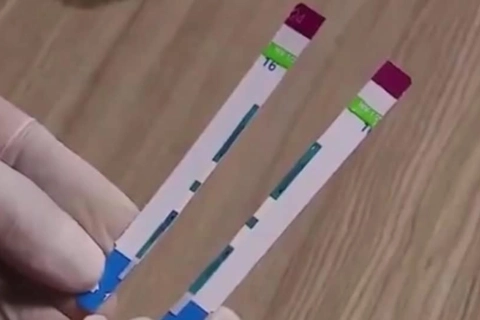
Only 40 HIV test strips have been cut into two halves by diagnostic staff at Saint Paul Hospital over the past three months, Director of the hospital Nguyen Dinh Hung said on December 10 and denied the information on blood mixing during the test.
Earlier, a report by national broadcaster VTV showed that some staffers of the hospital's Department of Microbiology cut HIV and hepatitis B test strips into halves so that one single-use test strip could be used twice. This fraudulent act could lead to misdiagnosis and does not follow directions for use given by its manufacturer.
| A test strip cut in half by diagnostic staff at the Saint Paul Hospital. Photo: VTV24 |
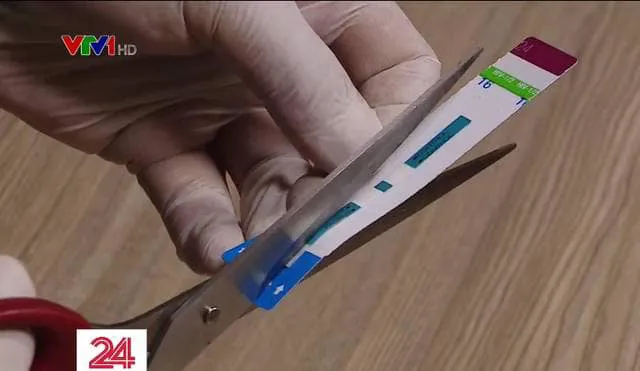
Hung denied the act was fraudulent and said it was only an experiment by the Department of Microbiology. However, the experiment was not reported to the hospital's managerial board.
The hospital’s director said the strips were provided free to the hospital by Luc Tinh Company, a private medical equipment supplier, and the hospital has not used them on patients.
"The tests were not aimed at defrauding health insurance," Hung affirmed.
Through the review, the hospital did not detect the similar act of spliting rapid test strips for hepatitis B. Hung denied the report on mixing four patients' samples in a test tube while performing the ELISA (Enzyme-Linked ImmunoSorbent Assay).
Currently, the hospital suspended from work three of its staff members who are a deputy head of Microbiology Department, the head of the technician team and a technician.
Deputy Director of the Hanoi Department of Health Tran Thi Nhi Ha said that cutting the strips into two halves is not permitted, even as an experiment.
"The unused half of the cut strip will definitely not guarantee an accurate result," Ha said. "This behavior is completely against the procedures for medical examination and testing."
Other microbiologists said that the cutting of strips was unacceptable because it could compromise the accuracy of the test, adding that it was a serious because an HIV-positive person could be wrongly tested negative.
The municipal Department of Health has also asked Saint Paul Hospital to review the hospital's chemical inventory books and records of trial tests to identify the procedure violations.
An HIV test kit with 100 test strips costs VND3 million (US$129). Saint Paul Hospital is the largest hospital under management of the Hanoi Department of Health.