Hanoi needs preferential policies for underground parking development
Subsurface and surface planning are equally important and must be considered together for balanced development.
Suitable policies are needed for Hanoi to attract investors to build underground parking lots, said Nguyen Xuan Luu, Director of the city's Department of Finance.
He suggested that besides land policies, the Hanoi People's Committee needs other favorable policies to lure investment, such as a supportive interest rate when investors ask for a loan.
"At present, Hanoi lacks a specific legal framework for urban underground construction. To establish a legal basis, amendments to the Land Law are needed to address various aspects related to land use planning, including the issuance of land use right certificates for underground construction projects," Luu said.
The director said the cost of building underground parking is much higher than above-ground parking, and there is a cap on parking fees, all of which are barriers to underground parking construction.
A parking cellar on Le Van Luong Street, Hanoi's Cau Giay District. Photo: Pham Hung/The Hanoi Times |
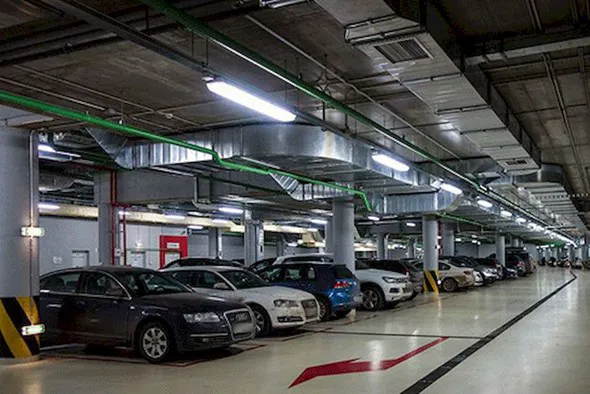
Statistics show that the fees set by the Hanoi People's Committee for surface parking allow investors to make reasonable profits but are not enticing for investment in the construction of underground parking. Investment in underground parking is one of the least attractive businesses in Hanoi.
Duong Duc Tuan, Deputy Chairman of the Hanoi People's Committee, shed further light on the issue, stressing the need for the amended land law to provide more specific guidelines.
"To facilitate the development of underground parking, it is essential to prioritize the rapid improvement of legal frameworks and policies. This includes formulating laws on the use and development of underground spaces and ensuring their synchronization with the existing legal framework on land, construction, and planning," Tuan said.
He said it is also necessary to issue documents that define the powers and responsibilities of relevant organizations and individuals involved in the planning, construction, exploitation, and use of underground spaces.
Resolution No.07/2019/NQ-HDND, issued in 2019 by which the Hanoi People's Council encouraged investment in the construction and operation of bus stations and parking lots, is not attractive enough for investment in the construction of underground parking lots.
"Therefore, in the coming period, the Hanoi People's Committee will report to the city People's Council to review and amend Resolution 07. It is expected to be completed in the second quarter of 2024," Tuan added.
Architect Dao Ngoc Nghiem, Vice Chairman of the Vietnam Association for Urban Planning and Development, told The Hanoi Times that since the 2000s, Hanoi has implemented various solutions for underground infrastructure, including pedestrian underpasses, underground parking lots, and basements in hotels and commercial centers.
Underground parking at Time City Commercial Center in Hanoi's Hai Ba Trung District. Photo: Trung Kien |
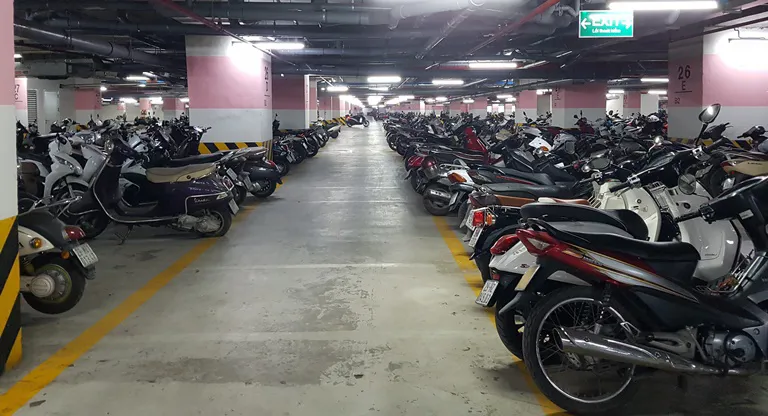
He added that in March 2022, the city's general plan for underground urban construction up to 2030 approved underground parking facilities with up to five levels in the central areas of Hoan Kiem, Ba Dinh, Dong Da, and Tay Ho. "However, no project in this area has been implemented," Nghiem pointed out.
Architect Tran Huy Anh of the Hanoi Association of Architects said that Hanoi has planned 78 underground parking lots covering a total area of 104 hectares, mainly in the four core districts of Ba Dinh, Hai Ba Trung, Dong Da and Hoan Kieam. This is a key part of the city's underground space planning and a network of underground transportation systems, including six metro lines and 81 underground stations.
"Planning the underground space would help improve the efficiency of using urban land resources, preserving the cultural and historical landscape, developing green spaces and the urban ecosystem towards modernity and sustainability," Anh told The Hanoi Times.
Underground planning is as important as surface planning. "In Hanoi, without proper underground planning, future construction will face many challenges. When addressing traffic congestion issues, it is imperative to consider not only the surface but also the subsurface of the city's infrastructure," Anh said.