Hanoi pushes planning flexibility and administrative reform to accelerate hi-tech investment
Upgrading facilities and infrastructure in hi-tech parks and industrial zones in Hanoi remains a key concern for enterprises aiming to expand production and improve operational efficiency.
THE HANOI TIMES — Hanoi authorities need to provide clearer guidance that allows businesses to adjust and increase construction density within industrial land plots, said Ho Minh, Deputy General Director of Thang Long Industrial Park Co Ltd.
Greater flexibility would create more favorable conditions for investment expansion and future production growth, he told a conference hosted by the Hanoi Hi-Tech and Industrial Park Management Board on December 24, aiming to address and resolve bottlenecks for investors.
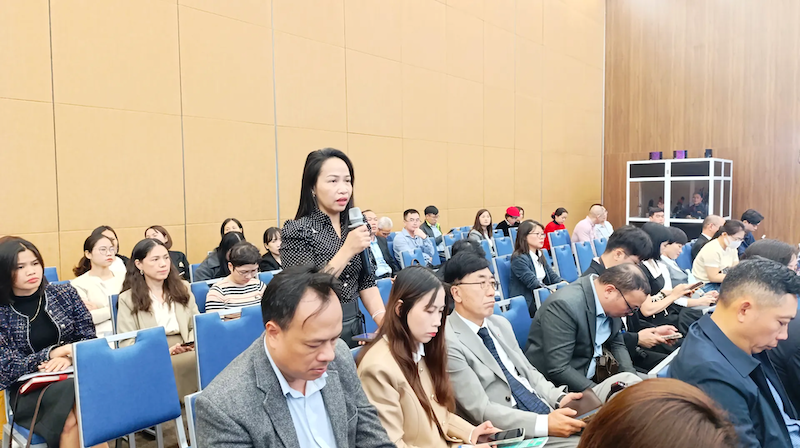
A business representative raises proposals at the dialogue. Photo: Kinh te & Do thi Newspaper
According to Minh, many investors at the Thang Long Industrial Park are seeking to upgrade factories and expand capacity to meet rising demand.
In this context, adjusting planning parameters, especially factory construction density, is an urgent issue, he said.
Minh noted that most enterprises currently operate at construction densities below 60%, while existing technical standards allow density to rise to 70%.
Dao Duy Vinh, Head of the Technical Department at Hanwha Aero Engines, urged the management board to soon complete the installation of standardized directional signage.
He said authorities asked enterprises in 2024 to remove self-installed signs to make way for a unified system, but the new signage network has yet to appear.
Vinh also proposed building dormitories for employees inside the Hoa Lac Hi-Tech Park to support workers from distant provinces.
“Adequate housing would stabilize the workforce and help retain highly skilled employees,” he said.
Responding to these proposals, Dinh Tran Quan, Deputy Head of the Hanoi Hi-Tech and Industrial Park Management Board, confirmed that current regulations allow construction density of up to 70% in hi-tech parks and industrial zones.
He said recent regulatory adjustments provide investors with greater flexibility while maintaining planning discipline.
Quan added that enterprises must submit comprehensive review and adjustment reports explaining whether higher density would reduce green space, increase workforce size, or place additional pressure on technical infrastructure designed under original planning schemes.
“Environmental impacts require careful assessment and official approval to ensure clean, green and sustainable industrial park development,” the deputy head said.
Regarding signage issues, the hi-tech and industrial park management board said the removal of unregulated signs was necessary to establish a consistent and modern navigation system.
The board plans to complete the signage network and develop digital navigation solutions aligned with the city’s digital transformation strategy. These tools will improve connectivity, location search and guidance through mobile applications.
On employee accommodation, the Management Board encouraged enterprises to seek direct guidance and offered to connect businesses with existing housing projects within the parks.
For companies planning to invest in their own housing facilities, the board pledged support throughout the process, from investment approval to land allocation and construction permits, ensuring compliance and timely implementation.
Administrative reform
Hoang Tuan Huy, a representative of the Vietnam Association of Functional Foods, said investors currently must submit multiple monthly online reports to different agencies covering investment, statistics and environmental compliance.
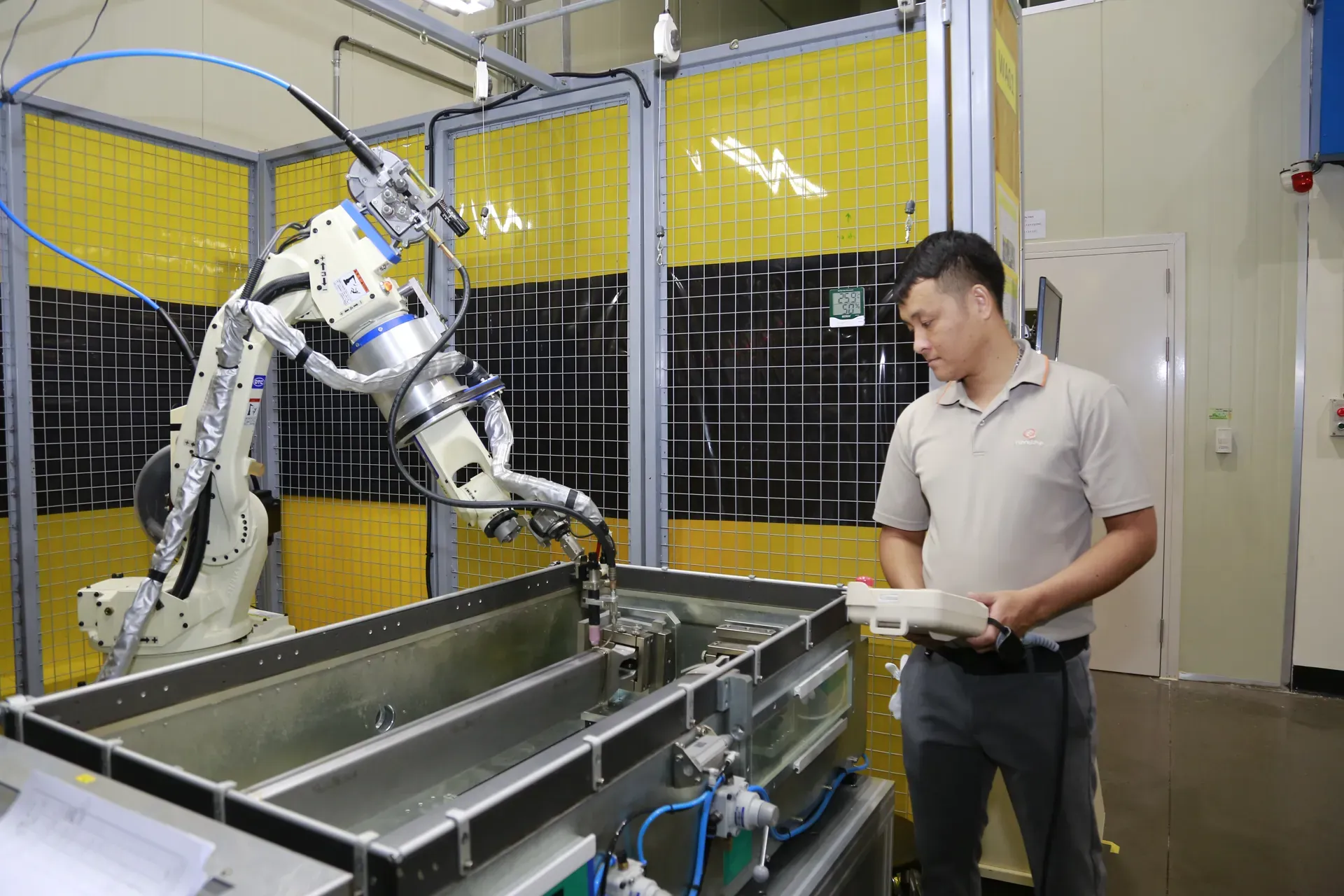
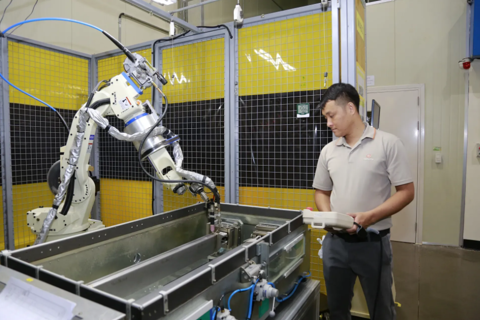
Robot used in the production line by Hanwha Aero Engines at the Hoa Lac Hi-Tech Park. Photo: Thanh Hai/The Hanoi Times
He proposed a unified reporting system to share data among companies, departments and agencies to reduce administrative workload for enterprises.
According to Sumitomo Heavy Industries, procedures for foreign work permits remain challenging. Slow responses from authorities risk delaying subsequent processes such as visa issuance, extensions and temporary residence registration.
On tax administration, Truong Quoc Cu, General Director of Minh Hoa JSC, said companies have faced difficulties with tax refunds after July 1 due to new regulations.
The policy requires enterprises to declare the origin of suppliers’ input materials. Inconsistent guidance has forced some firms to wait up to five months for refunds, he said.
Regarding administrative obstacles, Vu Xuan Hung, Head of the Hanoi Hi-Tech and Industrial Park Management Board, said the board has been the single contact for enterprises operating in hi-tech parks and industrial zones since early September.
He said the board has held delegated authority over labor-related procedures, including work permit certification. These procedures are now processed online to improve convenience and transparency.
Regarding proposals to integrate reporting systems and share data among agencies, Hung said the board acknowledged the recommendations and would study feasible solutions.
According to Hung, Hanoi has had several breakthrough measures to reform administrative procedures and adopted special incentive mechanisms to attract talent, including priority access to housing, a 50% personal income tax reduction and full subsidies for monthly bus passes during the first three years for employees working in hi-tech parks.
Authorities have also prioritized research, development and technology transfer activities through preferential land leasing and legal consulting support. Innovative startups receive tax exemptions for their first five years, along with support for workspace and equipment.
Management board commits to supporting enterprises
Hung emphasized the city’s consistent commitment to placing businesses and investors at the center of public service, viewing enterprise success as a core measure of effective governance.
"The Management Board will continue to modernize governance practices, improve administrative efficiency and coordinate closely with relevant agencies to remove bottlenecks while building a clearer legal framework for new policies and mechanisms," said Hung.
In 2025, total revenue from Hanoi’s hi-tech parks and industrial zones is estimated at about $12.1 billion, accounting for 19% of the city’s GRDP. Hanoi’s overall GRDP is projected at around $63.5 billion.
State budget contributions from these zones are estimated at nearly $450 million, while export turnover reached $7.4 billion. Total investment attraction stood at about $660 million, exceeding the annual target by 24.5%.
These figures underscore the leading role of Hanoi’s hi-tech parks and industrial zones in driving economic growth, advancing a modern high-tech industrial structure and creating stable employment for more than 180,000 workers.
|
Major enterprises receive cerfiticates for operation expansion On the same day, the Hanoi Hi-Tech and Industrial Park Management Board handed over investment policy approvals and investment certificates to major enterprises. Viettel Group increased capital for its research, design and manufacturing complex for telecommunications electronics and high-tech products by nearly $110 million, raising total investment to about $228 million. CMC Group added $46 million to its research and innovation complex, focusing on high-tech R&D and lifting total investment to more than $114 million. Sunhouse plans to invest nearly $50 million in a factory producing autonomous robots and AI-powered equipment, while GenPharma will inject an additional $103 million into a high-tech biopharmaceutical manufacturing plant. |