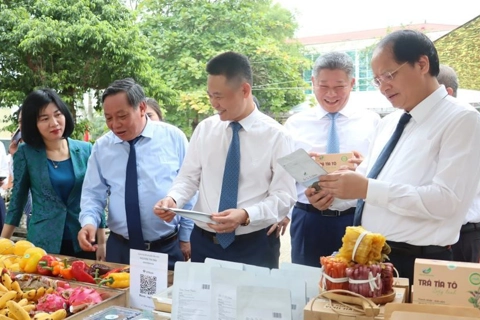
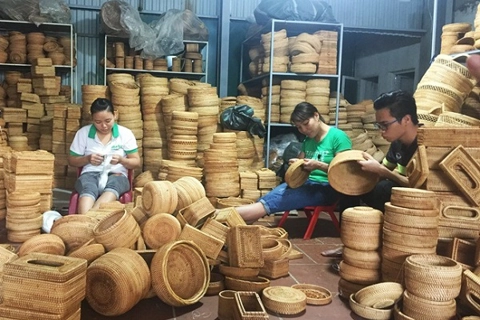
Hanoi targets recognition of at least 2,000 more OCOP products
Most OCOP products are agricultural and processed from specialized cultivation areas.
Hanoi has set a target of recognizing at least 2,000 more products evaluated under the One Commune One Product (OCOP) Program to make a positive contribution to economic restructuring, said Nguyen Xuan Dai, Director of Hanoi's Department of Agriculture and Rural Development.
Dai said Hanoi needs to invest more in the development of agricultural products from OCOP, to enhance the strengths of the city's agricultural sector in the long term, improve the productivity and quality of agricultural products, and increase farmers' incomes.
According to the Hanoi Department of Agriculture and Rural Development, the city currently has an annual cultivated area of about 224,500 hectares and an estimated grain production of 1 million tons/year. The total area of perennial crops is about 24,027 hectares, of which 20,350 hectares are fruit trees, 2,000 hectares are tea, and the rest are other perennial trees.
The grapefruit products of Nguyen Tien Luyen's household in Hanoi's Chuong My district are OCOP certified. Photo: Hanoimoi |

Nguyen Tien Luyen, a farmer in Chuong My District, has 20 hectares under 100 Phuc Trach grapefruit trees and 300 Dien grapefruit trees. His family's grapefruit garden is 22 years old, with a total output of about 32,000 fruits per year.
"My family's Phuc Trach grapefruit was classified as three-star OCOP in 2021 and will be further evaluated and reclassified in 2024 to confirm the brand and quality of the product. Currently, all 100 Phuc Trach grapefruit trees have been harvested and sold at an average price of VND40,000 (US$1.58) per fruit," Luyen told Hanoimoi.
Moreover, Director Dai added that the city has 406 high-tech agricultural production models. Among them, 262 models are in the field of cultivation, concentrated in Hoai Duc, Me Linh, Gia Lam, Thuong Tin, Dong Anh, Thanh Oai, Dan Phuong, and other districts.
High-tech agricultural approaches have improved economic efficiency and are appropriate for Hanoi's current circumstances. In addition, the city has set up and maintained 159 chains for safe agricultural production and consumption, including 106 chains for plant products and 53 chains for animal products. Numerous enterprises, cooperatives, and rural households have joined the networks, Dai said.
He emphasized that Hanoi aims to further restructure the agricultural sector by 2030, building environmentally friendly commodity agriculture in response to climate change and international integration.
Hanoi is also promoting agricultural production in line with specialized areas to feed about 10 million people living in the capital, partly to supply other localities and for export, the official said.
Gia Lam, Me Linh and Dong Anh districts are the traditional vegetable and fruit growing areas in Hanoi. The average area in these localities is from 10 to 15 hectares, even over 100 hectares.
"At present, these specialized areas are all applying science and technology to cultivation, such as using high-quality varieties, mechanization, greenhouse systems and net houses. As a result, the quality of the products is getting better and better," Dai said.
Dinh Thi Luyen, Deputy Director of Van Duc Agricultural Production and Service Cooperative in Gia Lam District, said that Van Duc commune has 285 hectares of farmland, of which nearly 200 hectares are under vegetable production.
"Every year, the Van Duc vegetable area supplies about 35,000 tons of green vegetables to supermarkets and wholesale markets in Hanoi. Since 2019, 17 agricultural products have been certified by OCOP. In 2024, the cooperative has prepared a complete dossier to evaluate and reclassify products whose recognition has expired," Luyen said.
According to the Hanoi New Rural Development Program Coordination Office, Hanoi has evaluated and classified 2,924 products under the OCOP program so far. Most of the OCOP products are agricultural and processed from specialized cultivation areas.