Hanoi tipped as emerging rail industry hub
The rail industry complex is expected to serve as the central pillar of a new era for the sector, marked by the emergence of high-speed rail and expanded urban rail networks.
THE HANOI TIMES — The government is reviewing a proposal to build a 250-hectare rail industry complex in Chuyen My and Ung Hoa on the outskirts of Hanoi, aimed at positioning the capital as the core hub of a new phase in rail development.
New opportunities
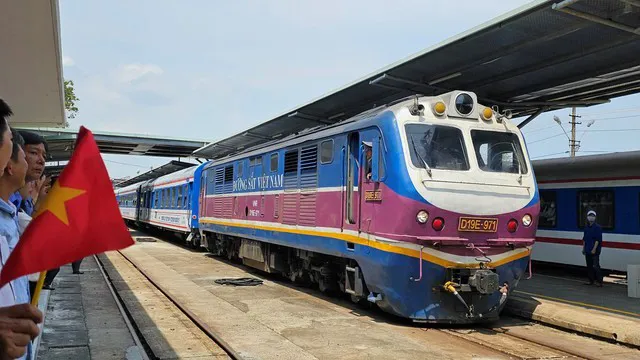
Train operated by Vietnam Railway. Photo: VGP
Vietnam Railways (VNR) has proposed investing VND17.3 trillion (US$705 million) to build a rail industry complex covering around 250 hectares in Chuyen My and Ung Hoa communes of Hanoi.
A VNR representative said the project is finalizing its pre-feasibility study report and is expected to be approved in mid-2026, break ground later in 2026 and be completed by 2028 to meet demand from the Lao Cai – Hanoi – Haiphong rail corridor.
The complex is designed to go beyond manufacturing to build domestic capacity to produce equipment and components for new projects while integrating a testing center, an operations hub and specialized workforce training facilities for the rail sector.
It is seen as a critical nucleus for gradually strengthening industrial and technological self-reliance, reducing dependence on foreign suppliers and improving economic efficiency, stated VNR.
In reality, Vietnam’s railways have a development history spanning more than a century, but still lag far behind regional and global standards.
The national rail network continues to rely on outdated technology, with no electrified trains or high-speed rail, while urban rail systems remain at an early stage and depend almost entirely on foreign technology.
Transport expert Vu Tuan Linh noted that despite its significant potential, rail accounts for only a small share of passenger and freight transport due to a lack of modernization, coherent planning and capacity to meet rising demand in both scale and quality.
“Railways operate on dedicated infrastructure and offer high carrying capacity, giving them the potential to serve as a backbone of the transport system. But years of underinvestment have left the sector outdated and the rail industry underdeveloped,” he said.
Facing these realities, the government has signaled its determination to build a high-capacity rail industry focused on self-reliance and localization to meet future development needs.
The rail industry complex is expected to serve as the central pillar of a new era for the sector, marked by the emergence of high-speed rail and expanded urban rail networks.
According to VNR, the project will be implemented as a public investment with the goal of gradually mastering operations, maintenance and the production of selected components for high-speed rail.
Plans include technology transfer, equipment investment to manufacture locomotives and carriages for conventional rail below 200 km per hour and the purchase of designs to produce urban rail trainsets.
From 2029 to 2031, the complex is expected to assemble electric and clean energy locomotives, produce passenger carriages below 160 km per hour, assemble urban metro trains and manufacture freight wagons for the Lao Cai - Hanoi - Haiphong line.
From 2032 to 2035, it aims to master carriage production and assemble electric locomotives with a localization rate of around 30% while producing materials and spare parts for infrastructure and signaling systems.
For the North-South high-speed railway, the complex would participate in train assembly under technology transfer contracts with a target localization rate of 20% by 2035. From 2040 to 2050, the project targets localization of about 80% for trainsets and the production of materials and components for high-speed rail operations.
Meeting expectation
North - South railway. Photo: Tuan Anh/The Hanoi Times
Economic management expert Hoang Thi Thu Phuong said locating the complex in Hanoi would help form a new industrial growth area and deliver significant socio-economic benefits for the capital.
“Beyond manufacturing locomotives, carriages and components, the complex would also support training and technology research, attracting a large workforce,” Phuong added.
Phuong added that building a rail industry complex of this scale is an ambitious plan and, if successful, would mark a qualitative turning point for Vietnam’s rail sector while elevating Hanoi into a major national industrial hub.
With its geographic position, resources and human capital, the capital is seen as well placed to meet expectations for an internationally scaled modern rail industry complex,
However, modern rail systems require highly complex and rapidly evolving technologies, particularly in signaling, control and advanced materials.
Transport expert Le Trung Hieu suggested that keeping pace with these advances demands substantial resources and mismatches between transport development and industrial capacity could pose challenges.
As a result, Vietnam should integrate more deeply into global supply chains and focus on segments where it holds competitive advantages and higher value added, he noted.
“In the short term, priority should be given to localizing operations, maintenance and repair. Mastering these processes, from routine locomotive and carriage maintenance to major repairs of signaling systems and track infrastructure, would significantly reduce operating costs, enhance autonomy and ensure network safety," said Hieu.
These areas require large workforces and are more suitable for training and technology transfer."
He said for more complex systems such as signaling, train control and high-speed rolling stock manufacturing, cooperation with leading global corporations would allow Vietnam to access advanced technologies without excessive upfront investment.
The goal is to participate in around 50% to 70% of the high-speed rail supply chain by focusing on feasible and economically efficient stages.
Experts also stress the need to accelerate technology transfer and international cooperation with top global partners. With the formation of the rail industry complex, they agreed that Vietnam would be better positioned to train high-quality human resources, test, develop and apply information technology in rail management, operations and maintenance.