Hanoi
Hanoi to ban motorbike by 2030
According to the plan, Hanoi will gradually restrict motorbike in some districts in the period of 2017-2030 and by 2030 to ban the motorbike in all districts.
Hanoi People’s Committee has issued Decision No.5953/QD-UBDN approving the plan of “Increasing management of road vehicles in order to reduce traffic jam and environmental pollution in Hanoi in the 2017-2020 period, and vision to 2030”.

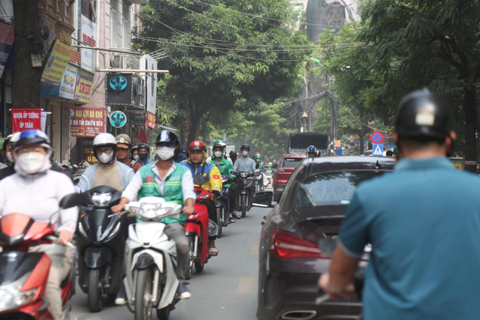
Hanoi is famed for legions of motorbikes - sometimes stacked with entire families or overloaded with deliveries - that clog roads in a fast-growing city with limited public transportation.There are five million motorbikes among a population of about seven million, compared with half a million cars on the road. Critics blame the emissions-heavy motorbikes for Hanoi's deteriorating air quality and worsening traffic congestion.
As such, the increasing management of road vehicles is aimed to reduce traffic jam and environmental pollution, with a view to meet the public’s transport demand and improve citizen’s living environment. With this regard, Hanoi will focus on public transport development in consistent with the plan. Specifically, by 2020, the public transport will meet the transport demand in city central from 30 - 35%, and by 2030 is from 50 - 55%; in terms of satellite urban areas, by 2020 the rate is expected to be 15%, and by 2030 is approx. 40%.
Developing a network of transport infrastructure in consistent with other master plans, especially the transportation master plan approved by the Prime Minister, so that by 2030 the rate of transportation area over urban construction area is from 20 - 26% for central area; 18 - 23% for satellite urban areas and 16 - 20% for villages and towns, in which land fund reserved for static traffic network is expected from 3 - 4%.
In order to achieve these objectives, Hanoi has conducted many consistent measures, including the management of transport vehicles; the quality of transport vehicles; the operational area of transport vehicles; developing and increasing efficiency in public transport services; applying IT in management; the city will increase its management in transportation.
Specifically, the solutions are divided into 3 phases. In the period of 2017-2018, Hanoi will focus on implementing measures on transport vehicles management and state management on transportation. From 2017 to 2020, Hanoi will carry out measures with regard to the quantity and quality of transport vehicles, as well as the development of public transport services.
Private transport vehicles will be restricted based on odd and even day plan for heavy congested streets and areas. For period of 2017-2030, gradually restricting motorbikes in some districts, at the same time preparing necessary conditions to ban motorbikes operating in districts by 2030.
At a meeting in July, Hanoi City Council has approved the plan on increasing management of transport vehilces to reduce traffic jam and environmental pollution in Hanoi for the period of 2017 – 2020, with vision to 2030; the decision was approved by more than 91% of city councillors at the meeting.
The number of registered motorbikes in Vietnam is among the highest in South-east Asia, and Hanoi officials have long mulled over banning the bikes in an effort to modernise the city. Experts have blamed Hanoi's poor air quality in part on harmful emissions from cars and motorbikes, especially in major cities. Hanoi is forecast to have six million motorcycles on its roads in the next three years, according to the city government.
Hanoi is famed for legions of motorbikes - sometimes stacked with entire families or overloaded with deliveries - that clog roads in a fast-growing city with limited public transportation.There are five million motorbikes among a population of about seven million, compared with half a million cars on the road. Critics blame the emissions-heavy motorbikes for Hanoi's deteriorating air quality and worsening traffic congestion.
As such, the increasing management of road vehicles is aimed to reduce traffic jam and environmental pollution, with a view to meet the public’s transport demand and improve citizen’s living environment. With this regard, Hanoi will focus on public transport development in consistent with the plan. Specifically, by 2020, the public transport will meet the transport demand in city central from 30 - 35%, and by 2030 is from 50 - 55%; in terms of satellite urban areas, by 2020 the rate is expected to be 15%, and by 2030 is approx. 40%.
Developing a network of transport infrastructure in consistent with other master plans, especially the transportation master plan approved by the Prime Minister, so that by 2030 the rate of transportation area over urban construction area is from 20 - 26% for central area; 18 - 23% for satellite urban areas and 16 - 20% for villages and towns, in which land fund reserved for static traffic network is expected from 3 - 4%.
In order to achieve these objectives, Hanoi has conducted many consistent measures, including the management of transport vehicles; the quality of transport vehicles; the operational area of transport vehicles; developing and increasing efficiency in public transport services; applying IT in management; the city will increase its management in transportation.
Specifically, the solutions are divided into 3 phases. In the period of 2017-2018, Hanoi will focus on implementing measures on transport vehicles management and state management on transportation. From 2017 to 2020, Hanoi will carry out measures with regard to the quantity and quality of transport vehicles, as well as the development of public transport services.
Private transport vehicles will be restricted based on odd and even day plan for heavy congested streets and areas. For period of 2017-2030, gradually restricting motorbikes in some districts, at the same time preparing necessary conditions to ban motorbikes operating in districts by 2030.
At a meeting in July, Hanoi City Council has approved the plan on increasing management of transport vehilces to reduce traffic jam and environmental pollution in Hanoi for the period of 2017 – 2020, with vision to 2030; the decision was approved by more than 91% of city councillors at the meeting.
The number of registered motorbikes in Vietnam is among the highest in South-east Asia, and Hanoi officials have long mulled over banning the bikes in an effort to modernise the city. Experts have blamed Hanoi's poor air quality in part on harmful emissions from cars and motorbikes, especially in major cities. Hanoi is forecast to have six million motorcycles on its roads in the next three years, according to the city government.