Hanoi launches two-wheel electric vehicles to expand green urban mobility
Hanoi has introduced two-wheel electric vehicles for the first time in its transport network, offering residents a new green mobility option and marking a key step in the city’s smart-transport development.
THE HANOI TIMES — Hanoi has launched two-wheel electric vehicles at the Hanoi Opera House area, marking the first time the city has brought this model into its urban transport system.
Starting in December, operators placed around 10–15 vehicles near the Opera House for residents to test for free.
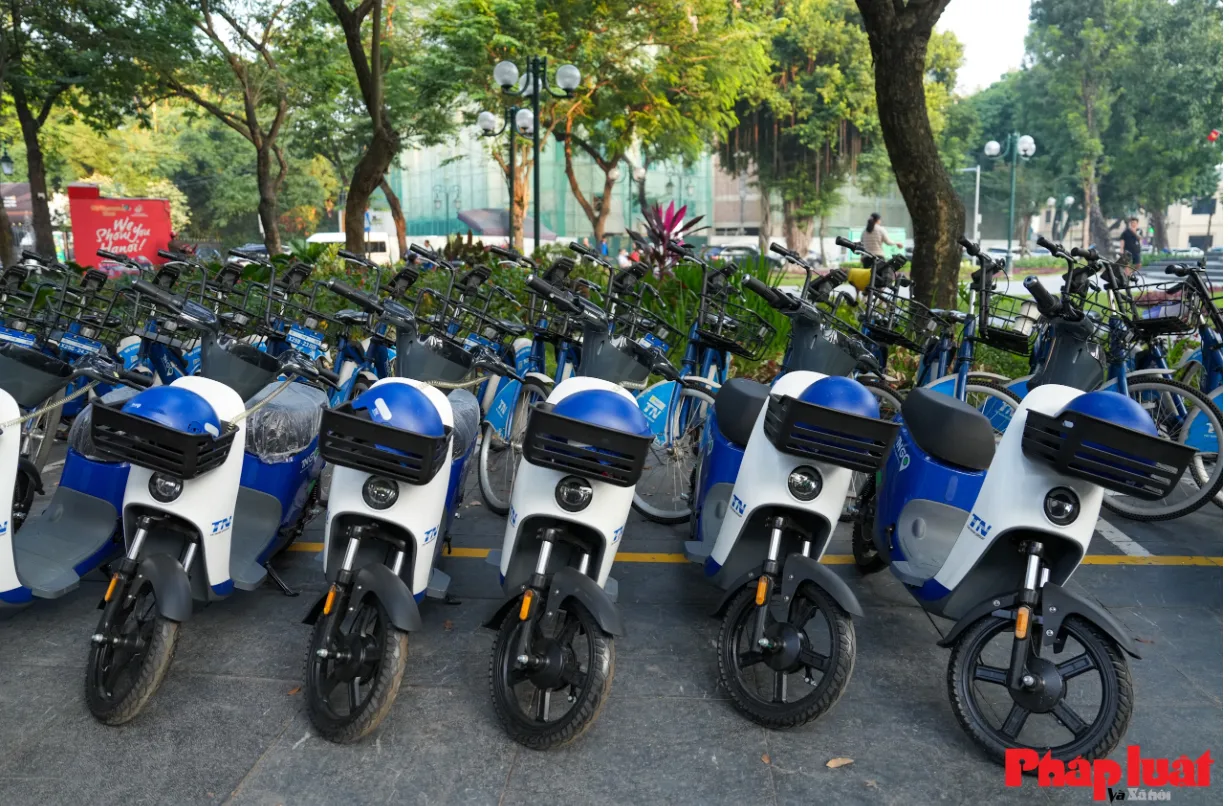
The first two-wheel electric vehicle model appeared in Hanoi on December 1, placed at a public bicycle station next to the Hanoi Opera House. Photo: Phap Luat & Xa Hoi Newspaper
Users can access the service through a mobile application by downloading the app, registering an account, adding credit, and scanning a QR code to unlock the vehicle. The operator will announce service fees later.
In the initial phase, the service operator Tri Nam Group (TNG) will deploy 500 vehicles across 130 approved stations within Ring Road 1. It plans to expand the system to Ring Roads 2 and 3.
The vehicles feature a compact design, carry up to 130 kg and reach a top speed of 25 km/h.
A fully replaced battery allows up to 90 km of travel, and riders can use the vehicle like a regular bicycle if the battery runs out.
For typical urban travel, most users replace the battery about once a week. Early users said the vehicles feel lightweight, quiet and comfortable.
They considered them especially suitable for women and older users because they require little physical effort. Some users suggested adding electric turn signals for more convenience.
TNG plans to introduce virtual stations at restaurants, cafés and other public venues to give users more flexibility.
TNG Chairman Do Ba Quan said the company will add more than 5,000 vehicles in the first quarter of 2026 across the urban core.
Dinh Van Hung, Director of the Center for Geo-Environment and Territorial Organization under the Vietnam Association for the Conservation of Nature and Environment, said public bicycle and e-bike services diversify the urban transportation network, encourage green-mobility habits, and support efforts to ease congestion and reduce air pollution.
He said the model serves as a “last-mile connector” linking residents to bus and urban-rail lines, helping the city move toward its goal of raising the share of public passenger transport to 30–35% in the coming years.
The rollout of two-wheel electric vehicles marks a significant step in Hanoi’s smart-transport system, giving residents a safer, greener and more modern travel option.
The program expands on the public bicycle service the city launched in August 2023.