Hanoi urged to train 100,000 digital engineers through online academy
The Capital Strategic Technology Development Forum gathered a wide range of proposals from businesses, experts and investors on how Hanoi should shape its deep-tech development agenda in the coming decades with a long-term vision to 2045.
THE HANOI TIMES — Hanoi should develop an online academy focused on digital technology development to train 100,000 high-quality engineers during 2030-2035, said Le Khac Hiep of ADT Group at the Capital Strategic Technology Development Forum.
The academy, named the Capital Digital Technology Academy, would include exchange programs to engage Vietnamese technology experts living and working overseas, helping reconnect global talent with the capital’s innovation goals, he said.
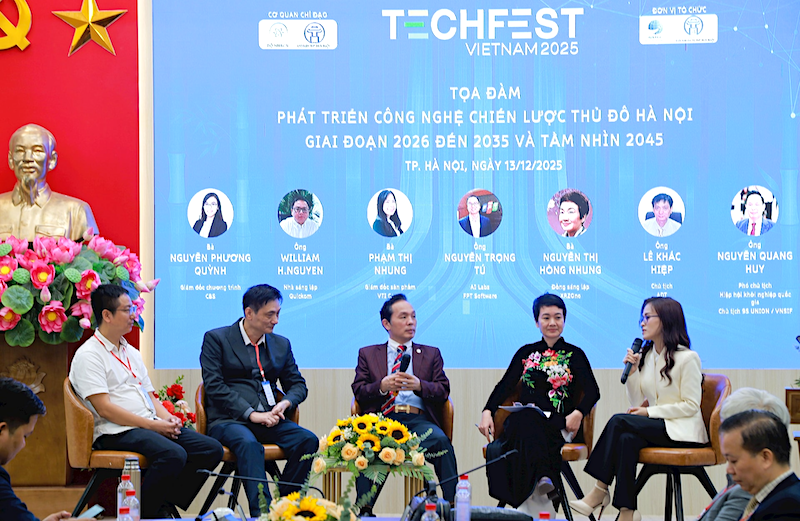
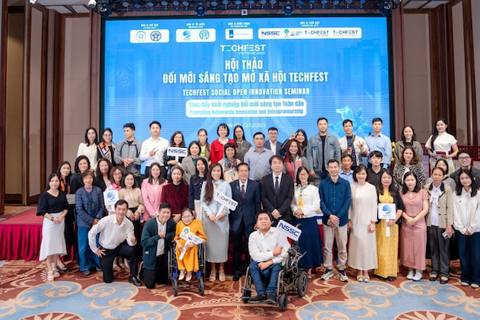
Delegates at the Capital Strategic Technology Development Forum. Photo: Hanoimoi Newspaper
“Such efforts would reconnect global talent with the capital’s innovation ambitions and strengthen Hanoi’s links with the global innovation ecosystem to compete in high-value technologies,” Hiep told the forum held last week as part of TECHFEST Vietnam 2025.
From a financial and startup perspective, Nguyen Quang Huy, chairman of 9S Union and VNSIF, said deep-tech startups cannot emerge without tailored venture capital mechanisms and faster pathways for technology testing.
He proposed that the city allocate land and infrastructure for privately operated innovation centers, authorize pilot venture capital funds under international standards and introduce targeted policies to attract talent, technology and financial resources from the overseas Vietnamese community.
Addressing the semiconductor sector, Tan Teong Wei, a representative of Infineon Technologies, said Hanoi has strong potential to integrate more deeply into the global semiconductor value chain.
Other speakers highlighted practical priorities across emerging technology fields.
Nguyen Trong Tu of AI Labs at FPT Software said data serves as a strategic asset and warned that a truly smart city cannot exist without a clear and coherent data strategy.
He proposed building a shared citywide data platform and piloting artificial intelligence applications in traffic management, public administration, construction permitting and urban feedback systems.
Pham Thi Nhung from VTI Group said smart factories will play a decisive role if Hanoi seeks leadership in next-generation industrial development.
She stressed the need to develop industrial AI infrastructure, support enterprises in digitizing production lines and establish pilot smart-factory clusters to speed up technology adoption across manufacturing sectors.
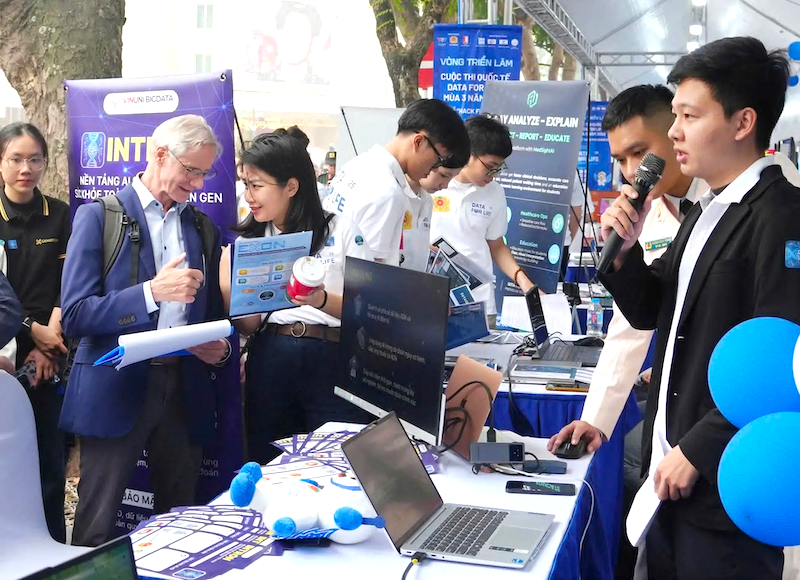
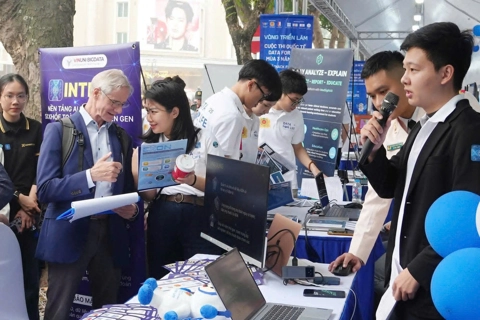
Foreign and local visitors explore Vietnam's pioneering AI technology at the Sphinx JSC booth near Hoan Kiem Lake in Hanoi
In cultural industries and creative technology, Nguyen Hong Nhung of XRZone highlighted the economic potential of virtual and extended reality.
She said immersive technologies could create a new growth engine for Hanoi if authorities allow startups to test applications in tourism, education and heritage preservation.
Her proposals included government procurement of creative technologies and dedicated funds to support the commercialization of cultural and technology-based products.
The forum also delivered concrete outcomes, with participants signing five memoranda of understanding between startups, investment funds and innovation support organizations, signaling stronger collaboration within Hanoi’s innovation ecosystem.
Based on global technology trends and Hanoi’s strengths, participants proposed seven priority technology groups for 2026–2035, with a vision to 2045, including artificial intelligence, semiconductors, robotics, smart cities, clean energy and immersive digital technologies.
Forum participants said these fields align well with Hanoi’s high-quality human resources, offer strong potential for high value-added growth and support Vietnam’s long-term goal of building a digital, knowledge-based and green economy.
Beyond technology priorities, experts proposed three experimental policy mechanisms for Hanoi. These include a deep-tech sandbox allowing new technologies to operate for 36–48 months in areas such as Hoa Lac, Dong Anh and the Red River corridor; a public–private Hanoi technology venture capital fund targeting US$300–500 million by 2030; and a partnership model allowing firms to invest in public research infrastructure in exchange for priority rights to commercialize research outcomes.
|
TECHFEST Vietnam 2025, co-organized by the Ministry of Science and Technology and the Hanoi People’s Committee, took place from December 12 to December 14 under the theme “Nationwide Entrepreneurship – A New Growth Driver” at Hoan Kiem Pedestrian Street. In its ninth edition, the event attracted about 60,000 participants online and offline, along with 1,200 investment funds and incubators and 1,700 domestic and international startups. |