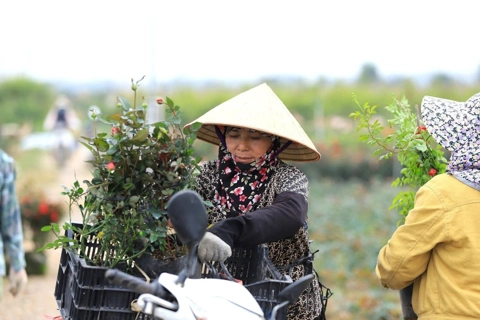
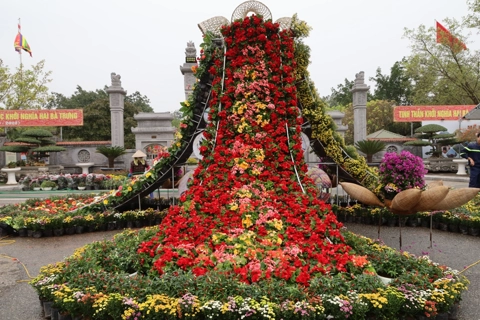
High-tech flower farming transforms Hanoi's agricultural landscape
Hanoi plans to develop nearly 8,000 hectares of various flower species, focusing on sustainable growth and environmental protection.
According to insiders, technology-driven flower farming has become a viable option as Hanoi's agricultural land is rapidly being converted to urban areas, allowing higher yield and boosting market competitiveness.
Fruitful investment
| High-tech orchid cultivation model at Me Linh F-Farm. Photo: Pham Hung/The Hanoi Times |
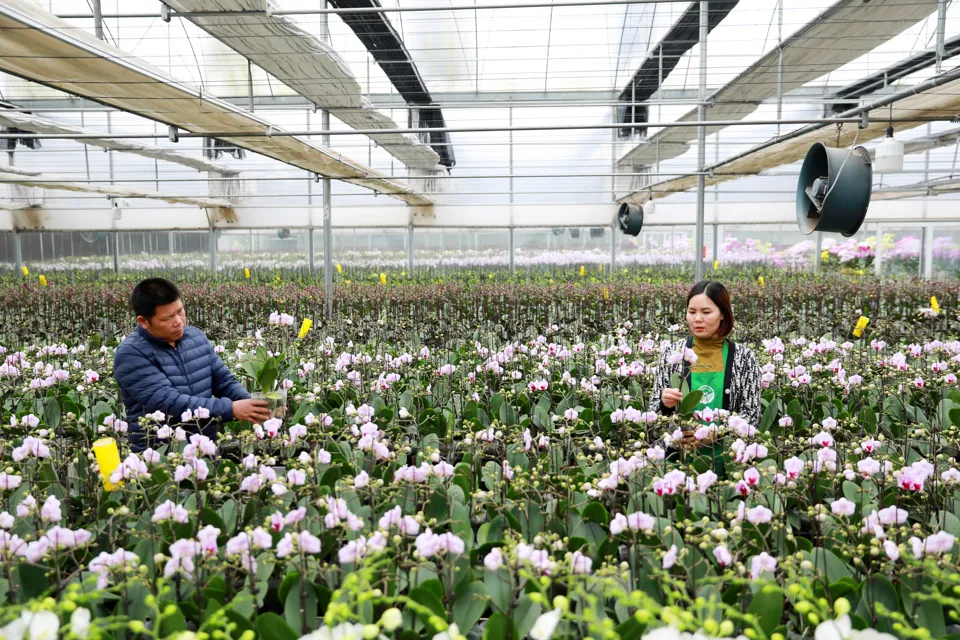
Bui Huong Vich, Director of Dang Hai Co-op, said that the co-op has invested in advanced technology, including net houses, hothouses, and automatic irrigation systems for the production of orchids.
Growing orchids in greenhouses provides an ideal growing environment, allowing a consistent production schedule and year-round supply. As a result, the cooperative produces nearly 250,000 flower plants annually, generating almost VND10 billion (US$402,931) in revenue and employing about 40 workers, with an average monthly income of VND8 million (US$322) per person.
In addition, the cooperative has created the "Flora Vietnam" brand, which has been officially certified and protected by the Department of Intellectual Property under the Ministry of Science and Technology.
Nguyen Tien Dung, owner of Me Linh F-Farm in Me Linh District, has transformed a less productive rice-growing area in Dai Thinh Commune into a high-tech orchid farm. His farm uses a closed-loop care system that controls factors such as temperature and light for more than 50,000 orchid plants, making Me Linh F-Farm's Phalaenopsis orchids popular with consumers, earning more.
Hoang Thi Hoa, Director of the Hanoi Agricultural Development Center, said the city has 47 flower production zones covering more than 1,800 hectares in districts such as Bac Tu Liem, Tay Ho, Me Linh, Dan Phuong, Thuong Tin, and Gia Lam.
She added Hanoi is home to 61 facilities employing advanced technology in flower cultivation with more than half of the total area of 122 hectares growing greenhouse flowers.
Many of these high-tech flower cultivation models have revenues of VND500 million-VND1.5 billion ($20,324-$60,974) per hectare per year, with some models earning up to VND2.2 billion ($88,644)/hectare annually, the Director said.
Advanced technology allows farmers to streamline cultivation processes, adapt to weather conditions, and align planting schedules with market demand, ensuring premium pricing and consistent quality.
Challenges and future plans
| A flower garden in the village of Tay Tuu. Photo: Hanoimoi Newspaper |
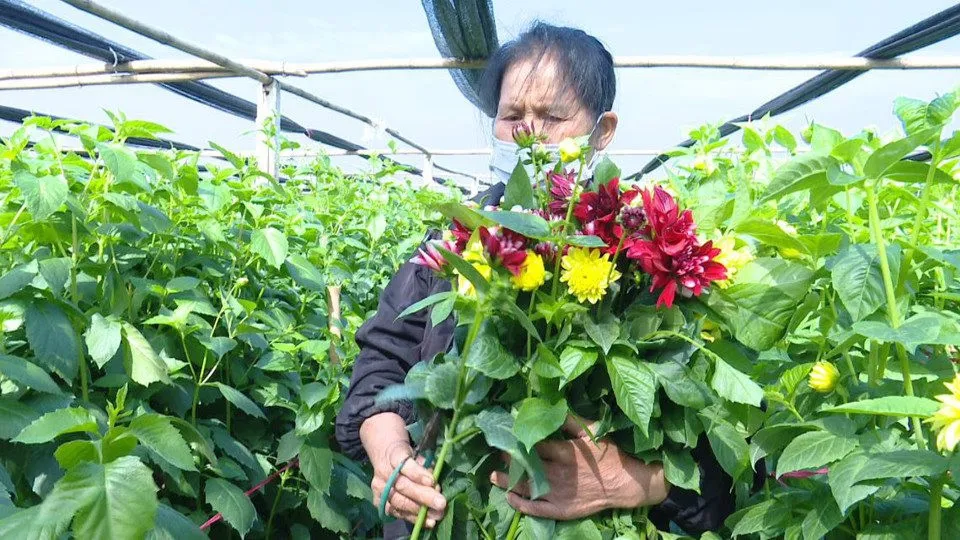
More concentrated flower production hubs using advanced technology include those in districts such as Dan Phuong and Thach That. However, these efforts remain fragmented and lack coordination among farmers, businesses, and research institutions. In addition, there is insufficient planning for specialized growing areas and poor market demand forecasting, resulting in a lack of clear production strategies.
Moreover, it requires more investment in production technology. Many companies and cooperatives face the challenge of synchronizing advanced equipment and technology throughout the production, harvesting, and storage processes.
To expand high-tech flower cultivation, Nguyen Huu Cuong from Dai Dong Commune in Thach That District has called for governmental support for greenhouse facilities and training on advanced cultivation techniques for cooperatives and farmers.
As part of its agricultural restructuring plan for 2025, Hanoi aims to develop nearly 8,000 hectares of various types of flowers with a focus on sustainable growth and environmental protection, including 500-700 hectares of high-tech flower cultivation.
The city also plans to gradually convert less productive rice fields into flower-growing areas, while utilizing riverbank land for livelihood opportunities and promoting flower growing in conjunction with experiential tourism.
Nguyen Manh Phuong, Deputy Director of the Hanoi Department of Agriculture and Rural Development, has called on districts and towns to strengthen their planning efforts and refine supportive policies. He stressed the need to position flower growing as a key economic sector that contributes to environmental improvement.
The agriculture sector will work with localities to provide training and technical support for greenhouse and net house flower production for better effectiveness. In addition, guidance on disaster prevention and climate change adaptation will be provided to flower growers. At the same time, new flower growers will be supported to access high-yielding and high-quality seeds to maximize land efficiency, said the Deputy Director.
Local authorities are urged to encourage high-tech agricultural enterprises to invest in quality flower regions to build strong brands, expand the domestic market, and target export opportunities, Phuong stressed.