Ho Chi Minh City, WEF advance smart manufacturing and green transition cooperation
Ho Chi Minh City and the World Economic Forum have launched a new partnership to promote smart manufacturing, responsible industrial transformation and Vietnam’s broader green and digital transition goals.
THE HANOI TIMES — Ho Chi Minh City and the World Economic Forum (WEF) issued a joint partnership today (November 26) at the 2025 Autumn Economic Forum, held on November 25-27 under the theme “Green Transformation in the Digital Era” to advance smart manufacturing and responsible industrial transformation.
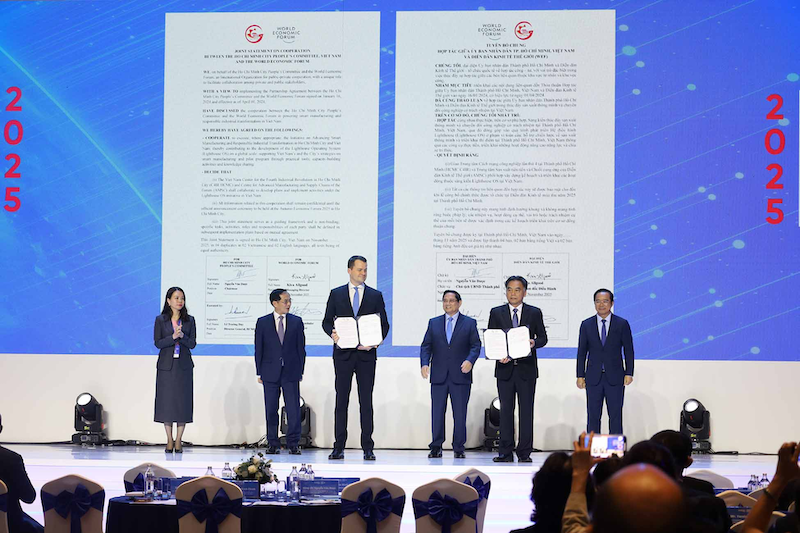
An overview of a Joint Statement on advancing smart manufacturing and responsible industrial transformation in Vietnam on November 26. Photos courtesy of the organizing board
Under the agreement, which defines Ho Chi Minh City and Vietnam as “co-creators” in WEF-led global initiatives, both sides will work together to promote smart manufacturing and responsible industrial transformation in the city, contributing to the development of the global Lighthouse Operating System (Lighthouse OS).
The cooperation includes strategic guidance for smart manufacturing and pilot implementation in Ho Chi Minh City through practical tools, capacity-building programs and knowledge sharing.
On the same day, Ho Chi Minh City and cryptocurrency trading platform Binance inked a Memorandum of Understanding (MoU) to help Vietnam develop the International Financial Center.
Under the agreement, both sides will coordinate efforts and introduce investors, financial institutions and investment funds to take part in business activities and operations at the Vietnam International Financial Center in Ho Chi Minh City.
Binance and international financial firms, fintech companies and investment funds will share practical experience in developing regulatory frameworks for digital assets, blockchain technology and payment infrastructure using digital assets.
Both sides will also develop, propose and test projects under a controlled sandbox mechanism for digital asset activities at the Vietnam International Financial Center once the legal framework is complete and approved by the authorities.
In addition, they will work together to build and support an innovation ecosystem for startups, small and medium-sized enterprises and companies applying digital technology, blockchain and financial technology.
Green transition in Ho Chi Minh City
According to a 10-year projection, Ho Chi Minh City will need around VND990 trillion (US$38 billion) to meet its green transition and digital transformation goals, equal to nearly $4 billion per year.
The estimate comes from a recently completed roadmap for the city’s green and digital transition, conducted by the Ho Chi Minh City Institute for Development Studies in collaboration with VinUni University.
Deputy Minister of Finance Do Thanh Trung said Vietnam may need a total of $28 billion for green transition efforts until 2030, based on the updated Nationally Determined Contribution (NDC).
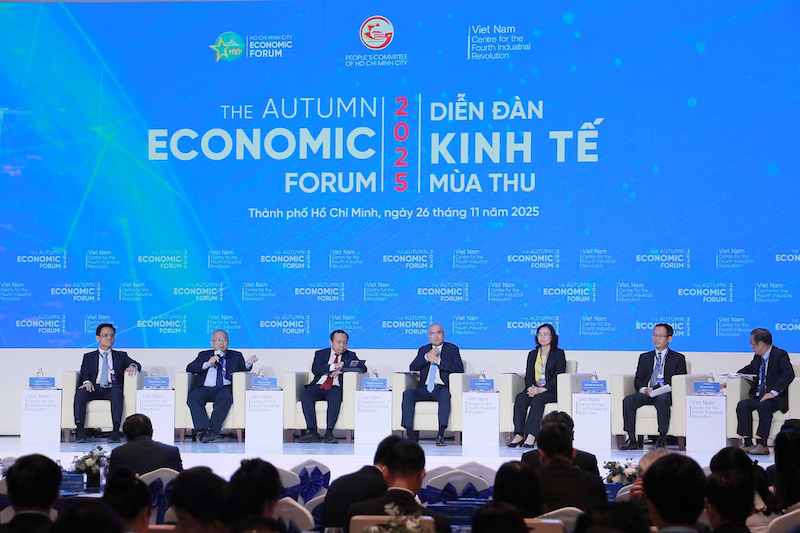
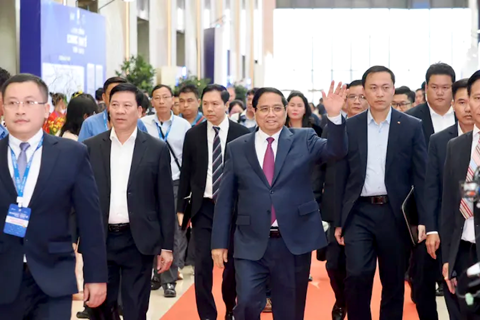
Delegates attend the high-level dialogue between city leaders and central ministries on digitalization strategies and national green-transition goals
He said green bonds could help address the financing challenge. By the end of 2024, corporate green bond issuance was estimated at $1.2 billion, while green lending rose 25% on-year to nearly VND700 trillion ($26.5 billion), accounting for almost 6% of total outstanding loans.
Additional funding will come from the state budget through mechanisms such as interest-rate support, direct investment and public–private partnerships.
“These are very encouraging figures,” Deputy Minister Trung said. “Both the green bond market and green credit are showing clear progress, supporting the government’s commitment to green economic growth.”
He added that the Ministry of Finance is preparing the 2026–2030 financial and budget plan worth more than VND8 quadrillion ($303.5 billion).
This estimate will support green growth priorities in Ho Chi Minh City and nationwide, including smart and sustainable urban transport, environmental infrastructure and climate resilience, Trung said.
He also said the ministry is seeking financing from international financial institutions to accelerate Vietnam’s green transition and help the government fulfill its climate commitments.
Another major task is to enhance transparency, expand stock listings, further develop the securities market and reduce transaction fees, he said.
At the event, Prime Minister Pham Minh Chinh urged Ho Chi Minh City to quickly develop a detailed action plan to implement the forum’s commitments.
“The city must be ready to take the lead as a ‘sandbox’ for green economic models, green finance, smart urban development and especially the upcoming international financial center,” he said.
He asked other localities to design green-transition roadmaps suited to their strengths, unique potential and competitive advantages, forming green economic corridors and digital economic linkages.
The prime minister said the business community, as the driving force of development, must continue to innovate, invest boldly in research and development, upgrade technology and apply new economic models.
“Enterprises need to improve governance capacity, prepare for green standards in global markets and work with the government in developing policy,” he said.
He also called for strong support from international partners and the World Economic Forum to help Vietnam become a regional “green–digital laboratory.”