Global CEOs propose bold strategies to make Ho Chi Minh City’s a global mega city
Leaders of major Vietnamese and international corporations have outlined ambitious plans to help Ho Chi Minh City accelerate its transformation into a global megacity, focusing on innovation and green finance.
THE HANOI TIMES — Lee Ark Boon, CEO of Sembcorp Development and VSIP Co-Chair, on November 25 proposed two collaboration models to strengthen Ho Chi Minh City’s position as a regional innovation and financial hub.
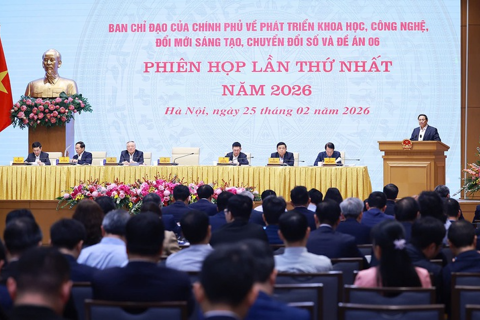
At the CEO 500 – Tea Connect program, part of the ongoing 2025 Autumn Economic Forum in Ho Chi Minh City, he suggested co-developing a next-generation urban zone for high-value industries.
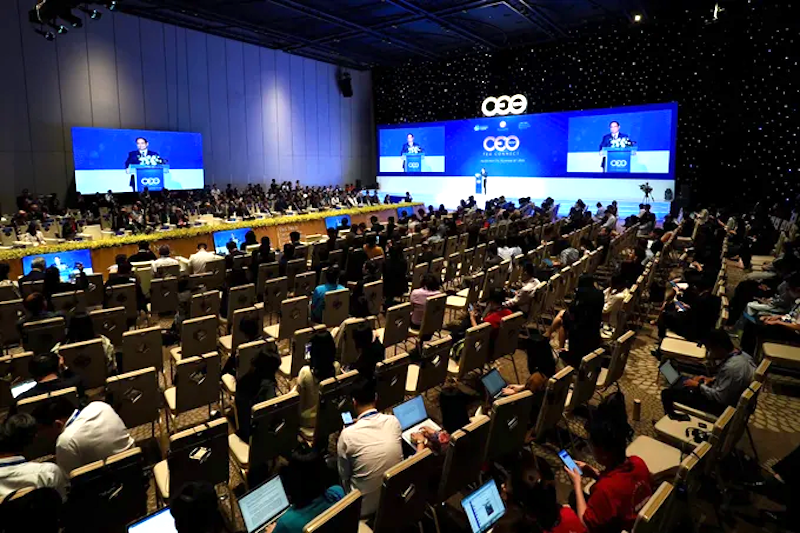
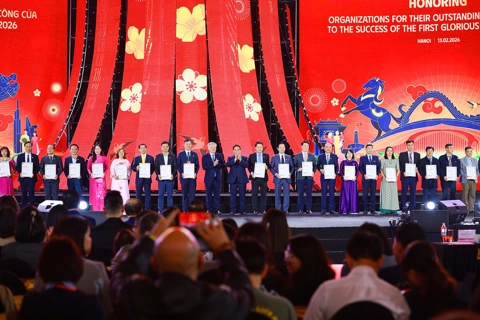
An overview of the CEO 500 – Tea Connect program on November 25 in Ho Chi Minh City. Photos: sggp.gov.vn
The zone includes renewable-powered data centers, semiconductor and precision manufacturing, low-emission industrial infrastructure, R&D hubs and integrated living amenities designed to attract global talent, Lee said.
He also recommended upgrading existing industrial parks into innovation ecosystems with high-tech zones, improved energy and water systems and sandbox models to pilot new technologies and business methods.
Lee’s ideas were among many recommendations from CEOs of major Vietnamese and international corporations aimed at helping Ho Chi Minh City grow into a global megacity.
Highlighting the city’s potential as a regional innovation hub, Jesse Choi, Regional Director of Sunwah Group in ASEAN and CEO of Sunwah Innovations, emphasized the urgent need for skilled technical workers in high-tech manufacturing and electric vehicle (EV) production.
He recommended establishing international vocational training centers and major industrial training zones in the southern region.
These facilities, he said, will offer global-standard programs in semiconductors, automation, robotics and EV manufacturing. They will also connect students to jobs, reduce skills gaps and support industrial development, Choi added.
According to the Sunwah CEO, the company is developing a renewable-powered hyperscale data center.
He called for stable power supply, clear investment incentives, streamlined approval processes and a pilot shared e-bike parking program to support sustainable urban mobility.
Focusing on sustainable finance, Vo Hoang Hai, Deputy CEO of Nam A Bank, highlighted the potential of a future International Financial Center (IFC) to attract foreign green capital and advance Ho Chi Minh City’s sustainability goals.
He proposed three initiatives, including green supply-chain finance, carbon-credit trading and an environmental commodities platform.
“Together, these initiatives could help position Ho Chi Minh City as a leading regional hub for digital green finance,” he said.
Speaking at the dialogue, Ho Chi Minh City Party Secretary Tran Luu Quang emphasized the city’s new development phase and its ambition to become a modern, dynamic and globally competitive metropolis.
With more than 14 million residents contributing nearly 25% of national GDP, the city remains Vietnam’s economic engine, he said.
Quang added that economic size, growth quality, governance, connectivity, creativity and living standards define a true international financial hub.
He said the city is restructuring toward a multi-centered urban model guided by three growth zones and five strategic pillars: high-tech industries and innovation, logistics and free trade, international financial services, tourism and creative industries and education, healthcare and science and technology.
He emphasized that improving governance, infrastructure, talent development and competitiveness will require strong global partnerships and the attraction of international expertise.
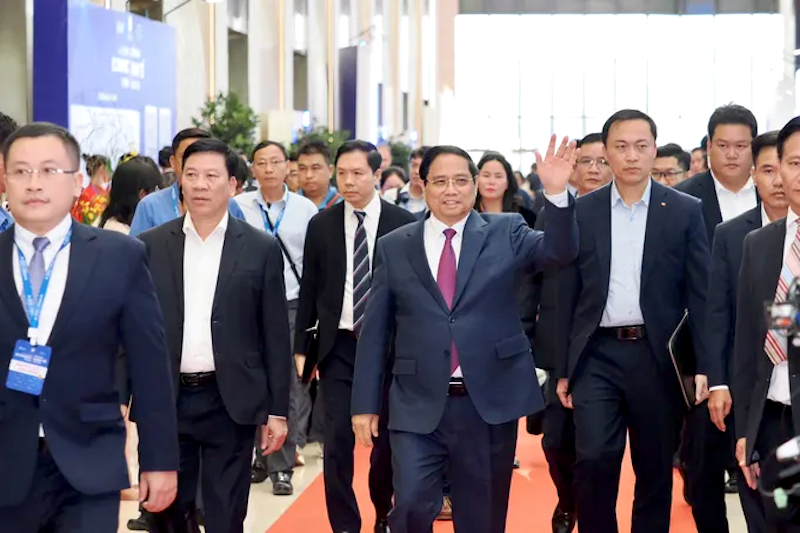
Prime Minister Pham Minh Chinh attends the CEO 500 – Tea Connect program.
Prime Minister Pham Minh Chinh said Ho Chi Minh City’s vision requires major capital, modern digital infrastructure, a skilled workforce, open institutions and international cooperation.
The city is pushing ahead with plans for an International Financial Center (IFC), advancing institutional and urban governance reforms and promoting innovation with businesses as a key driving force.
He said success depends on shared responsibility: a proactive state, pioneering enterprises, engaged citizens, supportive international partners and a fair balance of benefits and risks for everyone.
The prime minister expressed confidence that Ho Chi Minh City can compete with major regional and global cities, but emphasized that international cooperation, trust and contributions will be essential.
With a spirit of respect, efficiency and decisive action, he called on global partners to continue supporting Vietnam and Ho Chi Minh City.
“Our common goal is to work together, win together, grow together and share the results, contributing to peace, stability and prosperity in the region and the world and ensuring no one is left behind,” he said.
At the event, Ho Chi Minh City agencies and domestic and international partners announced eight cooperation programs and memoranda of understanding to demonstrate the city’s commitment to turning collaboration into action.