Incentives proposed to boost PPP in science and technology
The draft decree introduces a risk-sharing mechanism, which is crucial for attracting private investment.
THE HANOI TIMES — The Ministry of Finance has proposed policies in a new draft decree to promote public-private partnerships (PPPs) in science, technology, innovation, and digital transformation.
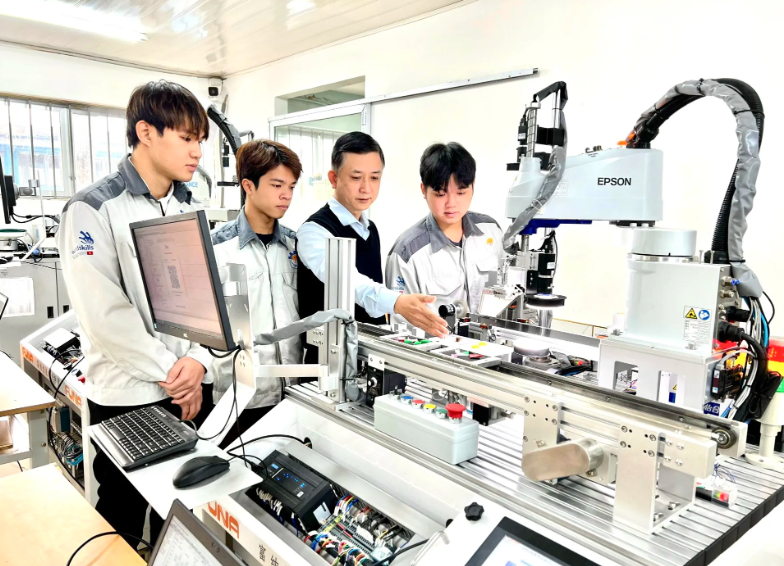
Students at Hanoi Industrial Vocational College learn robot programming. Photo: Tran Oanh/The Hanoi Times
This follows Politburo Resolution 57, issued on December 22, 2024, which outlines special mechanisms for the development of science, technology, innovation, and national digital transformation.
At a conference last week, Finance Minister Nguyen Van Thang said that although the PPP is defined in the Law on Public-Private Partnerships, it lacks the legal and procedural support needed for effective implementation in science and technology, citing rigid regulations, complex procedures, inadequate incentives, and limited investor confidence.
To implement Resolution 57, the Ministry of Finance has been tasked with drafting a new decree to address institutional bottlenecks, expand the scope for PPPs, and effectively mobilize resources to develop these strategic sectors.
"The Ministry of Finance considers this a critical and urgent task to ensure that science, technology, innovation, and digital transformation become the central drivers of economic growth and sustainable development," said the minister.
According to Pham Thi Hung, Deputy Director General of the Public Procurement Agency under the Ministry of Finance, the draft decree proposes several breakthrough mechanisms to foster sectoral development.
Specifically, the draft expands the definition of PPPs to include forms beyond those in the current PPP Law, adds stronger incentives, and enhances decentralization to ensure flexibility and alignment with sectoral needs.
Investor selection methods are also broadened to include direct appointment, open bidding, competitive negotiation, and special case selection. Notably, direct awarding of contracts is permitted for projects related to national defense and security.
The draft also introduces a risk-sharing mechanism, which is crucial for attracting private investment. During the first three years of operation, the state will compensate investors for 100% of the shortfall if their revenue falls below projections. If revenues drop by more than 50%, investors can terminate the contract and be reimbursed for all investment costs.
The decree streamlines procedures for better science and technology projects, shifting approval authority from ministers, heads of central agencies, and provincial chairpersons to heads of public service units under the Law on Management and Use of Public Assets while allowing state-owned enterprises (SOEs) to participate in PPPs.
Additional support and incentives are introduced. In line with the PPP Law, the state’s capital contribution to PPP projects may be raised to a maximum of 70%. Furthermore, budget support will be provided for science and technology development funds.
To address a major bottleneck in the process, the draft allows heads of public service units to independently determine asset values, while also reducing the time for proposal feedback and approval from 30 days to 15 days, cutting processing time by about 80%.
Regarding partner selection, if a suitable partner already exists, the unit may negotiate directly, bypassing complex investor selection procedures.
Public science and technology institutions, public service units, and SOEs will be exempt from the required minimum contribution of 2% of revenue for R&D or workforce training related to strategic technologies. This contribution is fully waived for science, technology, and innovation fields.
The draft decree also expands PPPs beyond existing laws, allowing tripartite partnerships among the state, academia, and businesses with the state providing infrastructure, funding, and coordination, while academia leads research and businesses offering expertise, data, and human resources.
Another model involves R&D partnerships among state agencies, science institutions, public service units, SOEs, and private enterprises. Ho Chi Minh City suggested that international organizations, such as the World Bank and the Asian Development Bank (ADB), could participate in financing R&D initiatives.
Innovation-focused PPPs are proposed for high-risk, long-term research programs with breakthrough potential and uncertain commercialization prospects. These are suitable for emerging technologies that could transform production and technological development.
Another model focuses on research sponsorship. With this approach, the state and the private sector can fund R&D activities, foster innovation ecosystems, support startups, and co-develop innovation hubs and shared research facilities.
Regarding financing, the draft outlines mechanisms for research funding in addition to the state budget and science and technology funds, encouraging private firms and international donors, such as the World Bank and the Asian Development Bank (ADB) for commercial projects.
The decree is expected to be issued in June and take effect on July 1.