Italian professor releases Vietnamese book on opera history
Professor Gianni Kriscak, the main author of the research book History of Italian Opera, wants Vietnamese artists and the public to better understand the early period of this art.
Aiming to bring more knowledge about opera history to Vietnamese audiences and artists, Italian music professor Gianni Kriscak and two lecturers/artists Nguyen Thi Hien (Hien Nguyen Soprano) and Trinh Thi Oanh presented the research book History of Italian Opera in Vietnamese.
Professor Gianni Kriscak studied violin and piano at the G. Tartini Conservatory in Trieste, Italy. He went on to study piano and conducting in Hamburg and Lübeck. In 1999 he became a professor and taught at the University and the Japan Opera Association. He currently teaches at the University of Music and Performing Arts in Graz, Austria.
During his visit to Vietnam for the launch of his book, he spoke to The Hanoi Times about his desire for more people to better understand the art of opera.
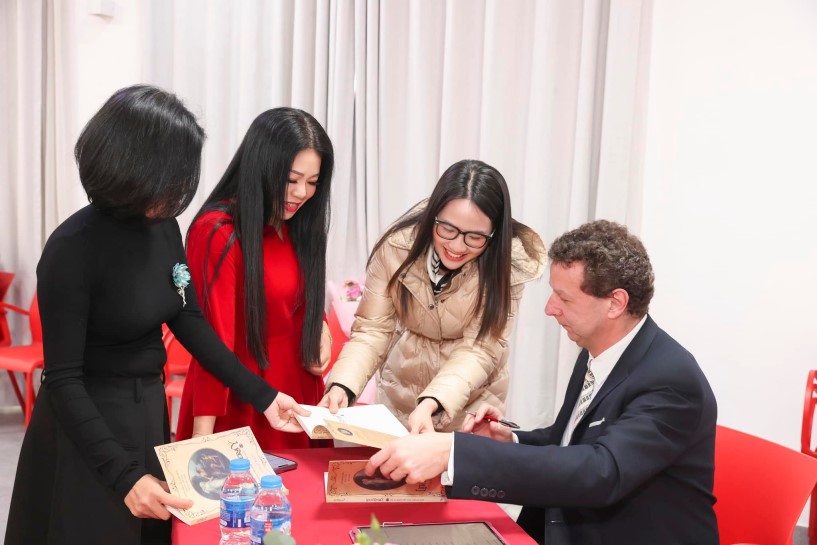
| Autographs for readers by Italian music professor Gianni Kriscak. Photo: The Hanoi Times |
Back to opera’s dawn
What made you choose Vietnam to publish this book series and why did you start working on it?
In my experience, many people who are singers, conductors, or musical theater directors, do not clearly understand the origin of opera. Especially in Vietnam, monographs on opera are very rare.
In 2016, I had the opportunity to go to Vietnam to teach. I met Hien Nguyen Soprano at the Vietnam National Academy of Music. I noticed that she is very interested in European culture, especially opera and Italian culture. I can communicate with her in English and Italian.
Two years ago, Hien shared with me the idea of writing a book about opera, focusing on the early stages of this art form.
Opera was born in Italy, not in Germany, France, or Russia. I think this art has its own foundation, historical and social context. Hien and I have the same desire to spread this knowledge to everyone, especially in places where information is lacking. That is why we decided to make this book in Vietnam. Hien Nguyen invited music teacher Trinh Thi Oanh to join the project. Hien Nguyen is responsible for translating all my parts into Vietnamese.
| The cover of the book is inspired by the classic opera "Orpheus and Eurydice". Photo: Ngo Minh/The Hanoi Times |
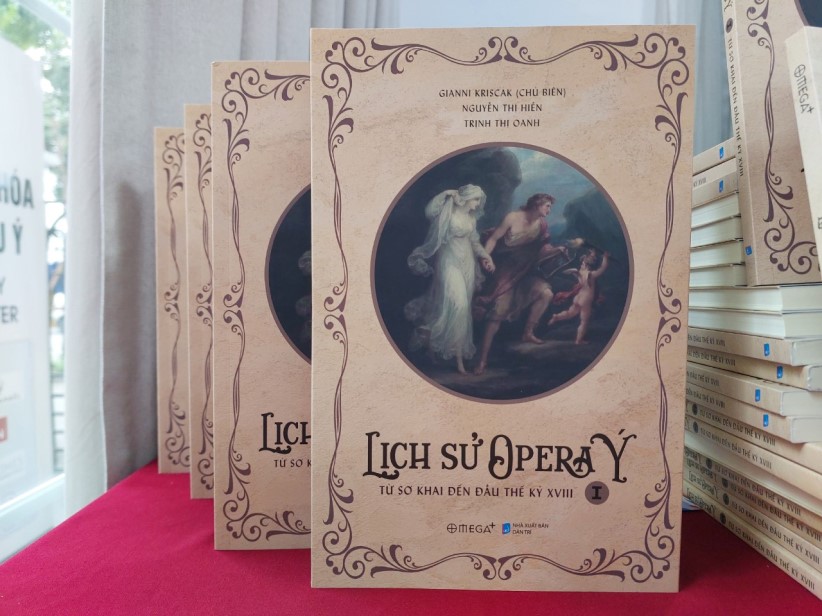
How do you choose to tell stories to bring this academic art to the readers?
With the first volume of 194 pages, we will talk about opera in the least boring way.
I tried to give brief but informative explanations about what was happening in society, about political development, and the role of the theater in Italian society. I am not greedy to mention too many names or details, because that would make the book heavy and complicated for Vietnamese readers, even for Italians.
I have tried to mention the most important and interesting moments in the first period of opera when the first form of opera was "liturgical drama", which played the role of conveying religious ideas. At that time, women were not allowed on stage, and the female roles were all played by men. Readers will also learn more about the different forms of opera and the vocal qualities of opera singers.
We planned to divide the book into two volumes. The first volume presents the history of musicals from the dawn (16th century) to about the mid-18th century, the least-known period not only in Vietnam but also in the world. The second volume will discuss the period after that until the moment of decline.
| Italian music professor Gianni Kriscak had a concert with soprano Hien Nguyen and bass-baritone Quoc Dat in Hanoi. Photo: The Hanoi Times |
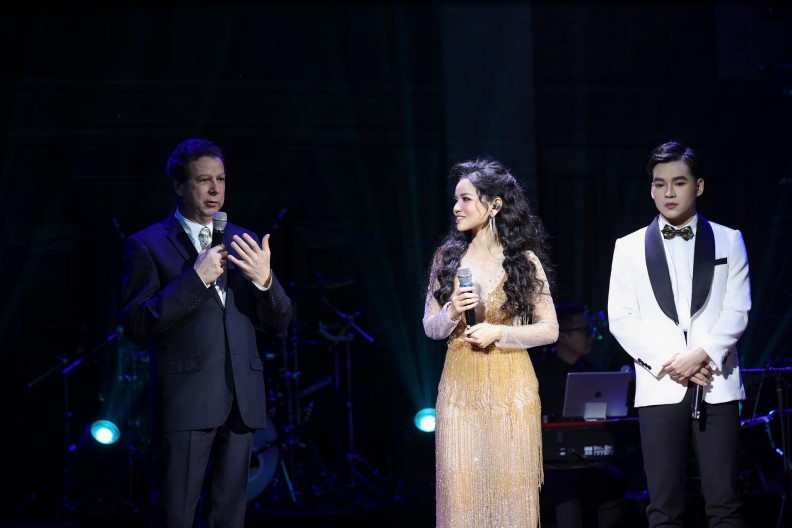
Opera understanding with Italian spirit
As a performer, conductor, and music professor with extensive experience all over the world, what is your opinion of Vietnamese opera today?
Throughout our years of research, we have appreciated the dedication and enthusiasm of Vietnamese music critics and artists in studying opera. However, they need to be supported by a vast knowledge of opera history. We hope that with our book, the authors can bring the spirit of Italy closer to Vietnamese musicians and the public who are passionate about opera music.
It is a fact that many young Vietnamese today are indifferent to opera and other academic arts. The same thing happened in Italy, so I understand very well.
I hope that this book, with very basic knowledge, will be popularized in society and in general education to bring opera closer to the Vietnamese audience.
How do you plan to learn more about Vietnamese opera and music during your trip to Vietnam this time?
Well, I had a book launch where I shared information with artists, journalists, and people who are interested in opera. This week I had a mini concert at the Vietnam National Academy of Music. I played piano with soprano Hien Nguyen and bass-baritone Quoc Dat. We performed classical and semi-classical music from Vietnam and the world, including Winter Lullaby by Dang Huu Phuc and Spring Arcade by Cao Viet Bach. The process of practicing with artists allowed me to understand more about Vietnamese music.
But this business trip was too short. I will return soon to learn more about Vietnamese opera. I also need to understand the readers' feedback and find the inspiration for the next volume of the book series.
Thanks for your time.