It's time to promote underground spaces for Hanoi of the future: experts
The slow pace of transportation area expansion compared to the growing number of vehicles has led to overloaded urban infrastructure, traffic congestion, and air pollution.
It is the right timing for Hanoi to promote underground spaces as rapid urbanization increases demand for the expansion of transportation areas in the capital city.
| Kim Lien Underpass. Photo: The Hanoi Times |
.png)
Vice President of the Vietnam Urban Planning and Development Association (VUPDA) Dao Ngoc Nghiem told The Hanoi Times as he discussed the city’s ongoing process of drafting overall planning for infrastructure development.
“Hanoi should push forward in underground planning for consistent urban development and avoid the lack of planning in the construction of such infrastructures,” Nghiem said.
As of July 2021, Hanoi’s population exceeded the eight-million-mark, or an addition of 200,000 people per year.
Meanwhile, statistics from the Police Traffic Department of the Hanoi Police revealed over 7.6 million vehicles hit the roads in the city every day, not to mention another 1.2 million from other provinces/cities commuting daily to the capital.
“The slow pace of expansion of transportation area compared to the growing number of vehicles has led to overloaded urban infrastructure, traffic congestion, and air pollution,” stated the Police Department.
In this context, an underground transportation system, or even underground urban areas would emerge as a viable solution for Hanoi to address current issues.
In fact, since 1996, a number of shopping malls or hotels in Hanoi had constructed two to four basement levels. Around the 2000s, the city has built several underpasses of Kim Lien, Thanh Xuan, or Trung Hoa to address traffic congestion, along with the underground technical infrastructure for water discharge, electricity, or water supply.
Director of the Hanoi Department of Planning and Architecture Nguyen Truc Anh noted as of present, there has not been specific mention on the scale or size of underground infrastructure in legal documents on the overall planning for Hanoi’s development, including the planning for Hanoi until 2030 and the transportation planning until 2030.
As the Government is in the process of amending the prime minister’s decision No.1259/QD-TTg on Hanoi’s overall planning, Anh expected there should be a specific proposal on the location and size of constructing underground spaces in Hanoi, as well as measures to utilize underground urban areas.
According to Anh, the Hanoi People’s Committee in 2015 had set the task of drafting the planning for the underground urban area in central Hanoi until 2030, with a vision to 2050.
“The Hanoi Urban Planning Institute has completed the proposal and submitted it to the city’s leaders for approval,” Anh told The Hanoi Times.
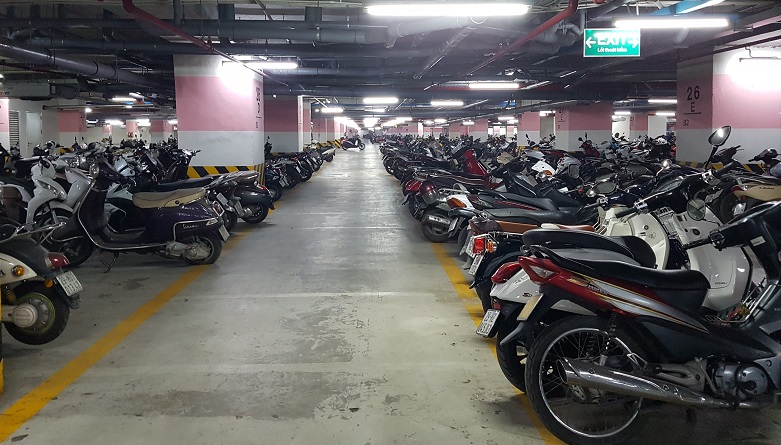
| A parking basement at Times City, Hai Ba Trung District. Photo: Vu Cuc |
Under the draft planning, underground walkways will be mainly built at interchanges or public squares (My Dinh stadium), national railway hub (Hanoi station, Ngoc Hoi station).
The network of underground urban networks including lines No.2, 3, 4, 5, and 8 for a total length of 68.5 kilometers and 61 underground stations will connect with other public transportation modes.
Anh added Hanoi would plan for the construction of 79 three- to four-floor level underground parking lots at nine downtown districts for an area of 107.03 hectares.
Regarding underground spaces, Anh said underground stations would serve as the core to form public underground spaces with a radius of 500 meters. “Under this basis, Hanoi has identified 39 potential locations to build public underground spaces in the area within the ring road No.3,” he added.
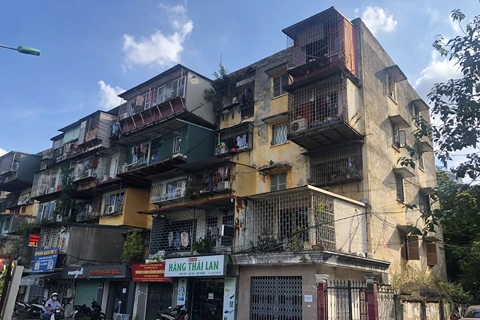
“Old apartment buildings and facilities subject to relocation out of Hanoi’s metropolitan areas would be encouraged to build underground floors for greater efficiency in land utilization,” Anh added, noting a total of 65 areas in question could build public underground spaces of 2,171 hectares.
| “The development of underground areas is in an early stage of development in Hanoi, and without early planning, the construction of underground transportation would face many difficulties. The first obstacle would be the basements of high-rise buildings or those currently under construction, without planning, they would make it impossible to plan underground transportation routes. The controversy surrounding the building of C9 station of an underground railway by the Hoan Kiem Lake is an example,” Lecturer Pham Hung Cuong at the Hanoi Construction University told The Hanoi Times. |
![[Longform] Renovation of old apartment buildings must keep social cohesion: experts](https://cdn-media.hanoitimes.vn/2022/07/30/rsz_ddffcover1.jpg?w=480&h=320&q=100)