JICA launches project on production of protein-free natural rubber in Vietnam
The project focuses on developing advanced technologies to establish a large-scale production process for protein-free natural rubber in Vietnam.
The Japan International Cooperation Agency (JICA) has launched the “Project for Innovation of Science and Technology on Natural Rubber for Global Carbon Process” in Hanoi to support Vietnam realize its net-zero emission commitment.
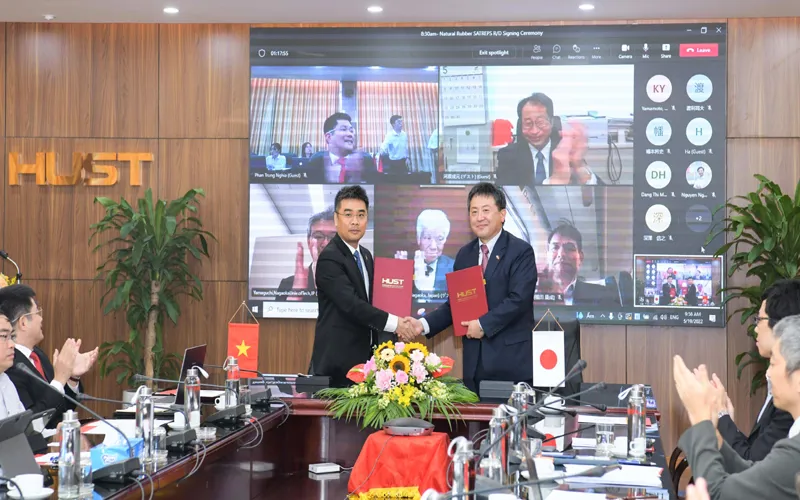
JICA and the Japan Science and Technology (JST), in cooperation with the Hanoi University of Science and Technology (HUST) and the Nagaoka University of Technology (NUT) of Japan, held a signing ceremony of the Record of Discussions for the project on May 19.
The project is funded by the Official Development Assistance (ODA) of the Government of Japan through the Science and Technology Research Partnership for Sustainable Development Program, which is co-financed by JICA and JST.
It will be implemented by HUST and NUT for five years, from 2022 to 2027, and considered the development of the previous JICA-JST joint project for the “Establishment of Carbon-Cycle-System with Natural Rubber”, which was completed in March 2016.
Chief Representative of JICA Vietnam Office Shimizu Akira (right) and Vice-President of HUST Huynh Dang Chinh sign the Record of Discussion for “Project for Innovation of Science and Technology on Natural Rubber for Global Carbon Process”. Photo: JICA |
The project focuses on developing advanced technologies to establish a large-scale production process for protein-free natural rubber in Vietnam. Besides, new technologies for the biodegradation of rubber products and a low greenhouse gas (GHG) emission and rubber production wastewater system with resource recovery will also be developed.
“The project aims at establishing an industrial base to increase the utilization of natural rubber as sustainable use of biological resources. With the innovation of science and technology, we hope that we will be able to contribute to building a foundation for the development of the natural rubber chemistry field and creating sustainable products from natural rubber, which can be a substitute for plastic,” said Professor Yamaguchi Takashi, team leader of the Japanese researcher groups.
The Vietnamese Government has already announced its strong commitment to achieving net-zero emissions by 2050. Prime Minister Pham Minh Chinh has called on stakeholders, including ministries, local governments, and businesses, to develop action plans on GHG reductions across all sectors aligned with the target of carbon neutrality by 2050.
“Technological innovation is the key for us to fight against the climate crisis and we believe that this project will set a good example of collaboration between Japanese and Vietnamese research institutes in pursuing breakthrough technologies for the development of sustainable products and contribution to GHG emission reduction,” said Shimizu Akira, chief representative of JICA Vietnam Office.
Thanking the Japanese Government for providing such valuable support to HUST, Associate Professor Huynh Dang Chinh, vice-president of HUST, said that this is an important international joint research project in which HUST has been participating.
“I strongly believe that working with leading Japanese scientists from the Nagaoka University of Technology will be a big opportunity for Vietnamese researchers to improve the capacity of innovation and creativity in scientific and technological research and natural rubber research, helping Vietnam overcome new challenges such as achieving net-zero emission target by 2050,” Chinh stressed.