Moody's upgrades Vietnam's rating to Ba2
The upgrade to Ba2 reflects Vietnam's growing economic strengths relative to peers and greater resilience to external macroeconomic shocks.
Moody's Investors Service on September 6 upgraded the Government of Vietnam's long-term issuer and senior unsecured ratings to Ba2 from Ba3 and changed the outlook to stable from positive.
| Moody's upgrade showcases the high regard of the international community for Vietnam's economic outlook. |
The upgrade to Ba2 reflects Vietnam's growing economic strengths relative to peers and greater resilience to external macroeconomic shocks that are indicative of improved policy effectiveness, and which Moody's expects to continue as the economy benefits from supply chain reconfiguration, export diversification, and continued inbound investment in manufacturing.
The rating also reflects a sounder fiscal footing backed by contained borrowing costs, a conservative approach to fiscal policy, and improved government liquidity, driven by the ongoing transition from external concessional borrowing toward longer-dated, low-cost domestic market financing.
The stable outlook reflects a balance of risks to the rating. On the positive front, Moody's expects continued improvements in economic competitiveness to support rising incomes and advancements in fiscal prudence demonstrated through the execution of a more systematic, long-term debt management strategy and an increasing emphasis in fiscal policy on long-term challenges, including improving worker productivity and mitigating against physical climate risks. On the downside, the relatively low capitalization levels of state-owned banks coupled with high domestic credit growth and potential risks from the real estate sector pose risks to the real economy in the event of a shock. Uncertainties relating to regional and global geopolitical tensions, higher imported input prices, and uncertain growth prospects in Vietnam's key trading partners may also pose limits to external surpluses for Vietnam's trade-reliant economy.
Concurrent to today's action, Vietnam's local- and foreign-currency ceilings are raised by one notch to Baa2 from Baa3 and Ba1 from Ba2, respectively. The Baa2 local currency ceiling, three notches above the sovereign rating, reflects relatively opaque government decision-making and the significant, though shrinking, government footprint in the economy, balanced by moderate political risks and low external imbalances. The foreign currency ceiling at Ba1, two notches below the local currency ceiling, reflects existing constraints to capital flows that point to possible transfer and convertibility restrictions being imposed at times of perceived need.
According to Moody’s, Vietnam’s increasing competitiveness and integration with global value chains support rising economic strength.
| Production at Sunhouse Group. Photo: Hai Linh |
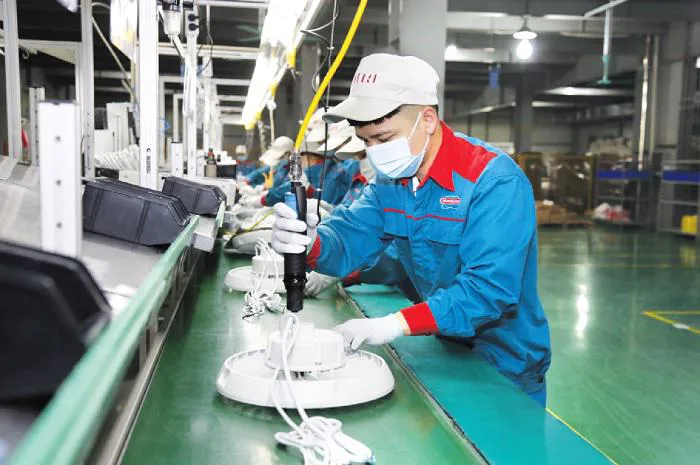
The increasing demand for Vietnamese exports through the coronavirus pandemic underpins the growing competitiveness of Vietnam's manufacturing sector, which has outperformed regional peers in the attraction of foreign direct investment (FDI) and has driven a rapid rise in per capita income. Trade tensions between the US and China, as well as the supply chain disruptions due to the waves of lockdowns within China, have accelerated manufacturing investment in Vietnam given the similarity of Vietnam's exports compared with China's among Asia-Pacific economies, along with an ample supply of relatively low-cost labor.
Moody's expects Vietnam's centrality to multiple regional and bilateral trade agreements to affirm its entrenched position in global value chains. Vietnam is a party to the Regional Comprehensive Economic Partnership (RCEP) and the Comprehensive and Progressive Agreement for Trans-Pacific Partnership (CPTPP) and bilateral Free Trade Agreements (FTAs) with Korea, and more recently, with the European Union and the United Kingdom. These trade agreements will strengthen Vietnam's competitive position in lower-value products such as footwear, garments, and agricultural goods while placing it firmly in higher-value-added regional tech supply chains for smartphones, computers, and other electronic products.
Structural risks to this economic trajectory may emerge over the next 5-10 years as the existing stock of port, airport, electricity, and railways infrastructure and the working age population, which will peak around 2035, may be insufficient to absorb large-scale shifts in supply chains to Vietnam from China and other higher-wage locations of production. Moody's expects the authorities to seek to address these challenges through investment in education and worker training to support higher productivity and employment in higher value-added activities while targeting inflows of FDI into sectors and activities that lead to greater direct spillovers to domestic suppliers.
Meanwhile, fiscal policy effectiveness has improved, including a greater emphasis on medium-term budget planning and the deepening of domestic, low-cost financing sources. The National Assembly has also lowered the statutory public debt ceiling to 60% of GDP from 65% to better anchor debt levels while preserving fiscal flexibility amid the ongoing economic recovery.
Stable fiscal performance
Despite below-potential growth in 2021, Vietnam's fiscal performance was stable, recording a 3.4% of GDP deficit with revenue collection exceeding its target by 16.8% - partially due to companies' lower-than-expected uptake of stimulus support measures such as corporate income tax deferrals. Vietnam's government debt burden registered a moderate rise to 39.1% of GDP in 2021, higher than previously forecast but comparable to levels in previous years and below the statutory public debt ceiling.
For 2022, Moody's expects the fiscal deficit to be marginally higher at around 3.8%, in line with the Ba-rated median, as the authorities implement the Socio-Economic Recovery and Development Program, valued at VND350 trillion ($14.9 billion, or 4.1% of 2021 estimated GDP). The program cuts the value-added tax for most sectors, provides interest rate subsidies on loans to businesses, and allocates additional expenditure toward public investment in transport, IT infrastructure, prevention of riverbank and coastal erosion, and other climate change adaptation projects. Moody's expects Vietnam's fiscal deficit to consolidate to around 2.7% by 2025, with the government debt burden set to decline to around 37%.
Vietnam’s Ministry of Finance (MoF) noted that Moody’s decision to upgrade Vietnam’s sovereign rating amid rising global uncertainties showcases the high regard of the international community for the efforts of the Government in stabilizing the macro-economy and promoting socio-economic development.
“The negative economic environment led to 30 rating downgrades for countries around the world during the first eight months of 2022, while Vietnam was the only country in the Asia-Pacific, and among four worldwide having seen their ratings upgraded by Moody’s,” stated the MoF.