No electricity shortage in Vietnam: PM
Prime Minister Pham Minh Chinh has assured foreign investors that Vietnam will not face electricity shortages, thanks to comprehensive solutions in generating, transmission, distribution, and pricing.
Vietnam will not face electricity shortages this year, despite an expected 15% increase in consumption.
| Prime Minister Pham Minh Chinh speaks at the World Economic Forum on June 26. Photos: Duong Giang/VNA |
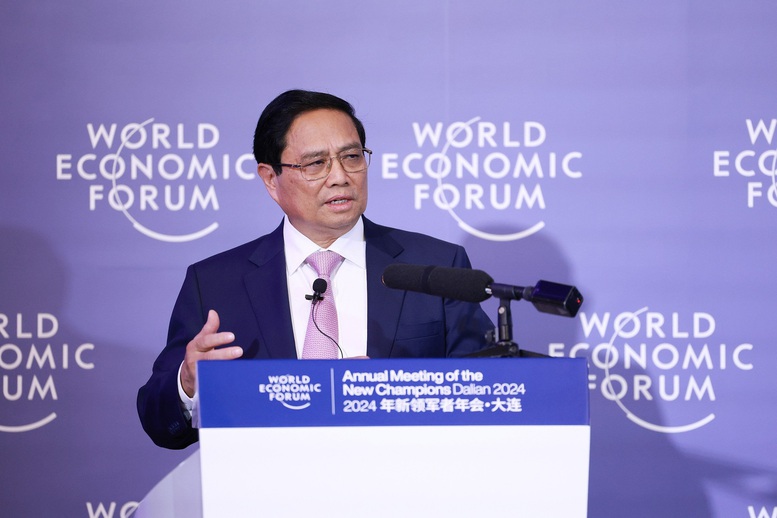
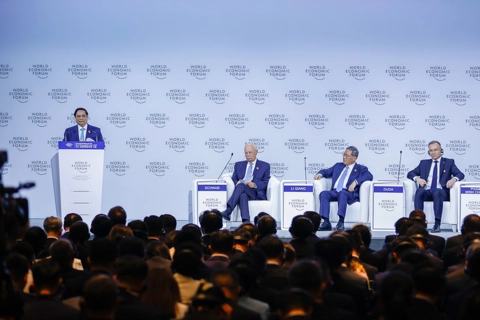
Prime Minister Pham Minh Chinh made this statement while co-chairing a discussion with Professor Klaus Schwab, Founder and Executive Chairman of the World Economic Forum (WEF), and about 20 leaders of major corporations on June 26 in Dalian, China.
Some investors raised concerns about electricity supply, financing for renewable energy, and incentives for high-tech and green transition sectors in Vietnam. In response, the Prime Minister noted that while there was a local power shortage in 2023, the situation has been resolved this year.
Electricity consumption in Vietnam is forecasted to grow by 15% this year. Specifically, residential consumption is expected to increase by over 18%, industrial consumption by more than 12%, and commercial services by 18%. On June 14, national electricity consumption exceeded 1 billion kWh in a single day, a historic high, yet the Prime Minister assured that supply remains secure.
"Vietnam will not face electricity shortages, thanks to comprehensive solutions in sourcing, transmission, distribution, and pricing," said Chinh.
He highlighted efforts being made to secure the power supply, pointing out that it now takes about six months to build a 500 kV transmission line, as opposed to the two to four years it used to require. By the end of June, this project will be operational, adding nearly 2,500 MW of power transmission from the South to the North.
Vietnam is also committed to the transition to clean energy, he noted. Chinh said the Government is refining policy frameworks and is set to issue regulations on direct power purchase agreements (DPPAs), incentives for rooftop solar, and the development of natural gas and LNG power projects, creating opportunities for investors in the energy sector.
Additionally, the government is preparing to introduce regulations related to global minimum tax and shifting investment incentives from fiscal to financial, cost-, and land incentives for priority projects.
“Vietnam's investment attraction strategy focuses on emerging fields, high-tech, high-value-added, and networked projects, which are seen as new growth drivers, boosting digital and green transformation and advancing breakthrough areas like semiconductors and artificial intelligence (AI),” Chinh added.
| Overview of the discussion. |
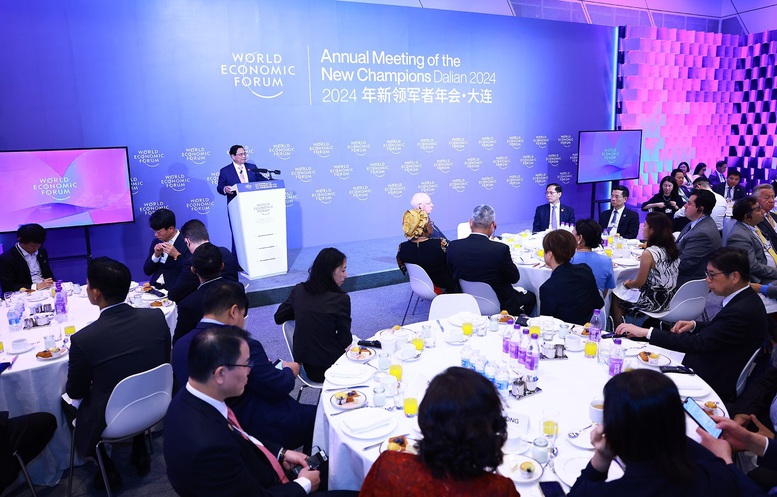
During the discussion, investors praised Vietnam's growth rate and improving business environment. Brand Cheng, Chairman and CEO of Foxconn, recalled that during a meeting last January, he discussed setting up a new factory in Vietnam, which has been operational since April.
"This demonstrates Vietnam's determination in economic development. Vietnam is making rapid progress," said Brand Cheng.
Foxconn now has factories in five provinces employing 80,000 people and has invested around $4 billion in Vietnam.
Meanwhile, a representative from Pepsico said after 30 years, the company has invested about $850 million in Vietnam. He also mentioned ongoing investments in agriculture, food processing, support for small businesses, and plastic recycling.
Prime Minister Chinh emphasized that Vietnam prioritizes growth, controlling inflation, and maintaining macroeconomic stability.
In 2023, GDP grew by 5.5%, and in the first quarter of this year, it reached 5.66%. It is estimated that second-quarter growth will surpass the first quarter, with a higher trend in the second half of the year. Public debt, government debt, and foreign debt are well below the permissible limits, and the VND is one of the least depreciated currencies in the region, Chinh noted.
To achieve these goals, Vietnam focuses on three strategic breakthroughs: the regulatory environment, infrastructure, and human resources.
He stated that the regulatory environment is also a resource and a driver for development. The government will soon establish a committee to review and resolve regulatory issues, led by the Prime Minister himself, with ministers directly overseeing the review and development of the institutional framework.
"Vietnam will continue to prioritize growth, with flexible policies, revitalizing traditional growth drivers, and vigorously promoting new areas like the digital, green, and sharing economies," he said, urging investors to partner with Vietnam based on "harmonized interests and shared risks."
He also requested WEF and its partners to strengthen cooperation with Vietnam in policy consultation and development and to allow Vietnam to participate in WEF initiatives and ecosystems.
In a meeting with Prime Minister Chinh on the same day, Professor Klaus Schwab praised Vietnam as a model of strong economic growth and effective utilization of Industry 4.0 opportunities. He noted that Vietnam’s participation in WEF’s 4th Industrial Revolution Network is an opportunity to share technological knowledge and boost cooperation in science, technology, and innovation.
Both sides agreed to promote the Industrial Revolution 4.0 Center in Ho Chi Minh City as a leading regional hub.