Vietnam seeks China’s expertise for major railway projects
Vietnam expects to cooperate with China in personnel training, management, control, and design of railway projects.
Vietnam seeks China's support and expertise for major railway projects, including the highly anticipated 1,500-kilometer North-South high-speed railway project, scheduled for the 2026-2027 period.
| Prime Minister Pham Minh Chinh and CRSC Chairman Lou Qiliang. Photos: Nhat Bac |
.jpg)
Minister of Transport Nguyen Van Thang shared the view during a meeting between Prime Minister Pham Minh Chinh and Chairman and Director of General China Railway Signal Information Corporation (CRSC) Lou Qiliang on June 25 in Dalian, China.
CRSC, under the supervision of China's State-owned Assets Supervision and Administration Commission (SASAC), is the world's largest provider of railway traffic control systems. It is the authoritative agency in China for technical standards and product standards of railway traffic control systems.
During the discussions, Thang mentioned that Vietnam plans to develop the 1,500-kilometer North-South high-speed railway system, with work expected to start by 2026-2027. Vietnam seeks cooperation with China in railway infrastructure, rolling stock, and signaling.
"These are three critical components that determine the safety of railway lines, including high-speed and urban railways," Thang emphasized, noting that China possesses advanced railway development technologies at reasonable costs. This presents an excellent opportunity for bilateral cooperation through mechanisms such as ODA loans and export credits, he noted.
Vietnam aims to have 3,000 kilometers of expressways by 2025, increasing to 5,000 kilometers by 2030. Railway infrastructure, particularly the North-South high-speed railway investment project, will enhance the nation's multimodal transport network and improve national competitiveness.
In late November 2023, the Ministry of Transport solicited feedback on three scenarios for the North-South railway, including two scenarios for 350 km/h passenger trains at speeds with and without freight.
At the meeting, Prime Minister Pham Minh Chinh acknowledged China's strength in developing high-speed and urban railways. He expressed interest in Chinese assistance in the design, construction, technology transfer, and development of railway projects, including the Yunnan- Lao Cai -Haiphong, Lang Son - Hanoi, and Dongxing - Mong Cai, - Haiphong lines. These railways, totaling over 700 kilometers, play a crucial role in boosting trade between the two countries.
CRSC is currently China's leading railway signaling enterprise, holding a 45% market share in the metro sector. The corporation has established a comprehensive industrial chain from design and R&D to equipment manufacturing and technical services for railway control systems.
CRSC Chairman Lou Qiliang expressed the corporation's desire to cooperate with Vietnam. He highlighted CRSC's strengths in designing and manufacturing railway signaling control systems, including software and digitalization of equipment, forming an integrated supply chain that ensures competitive pricing, safety, and quality.
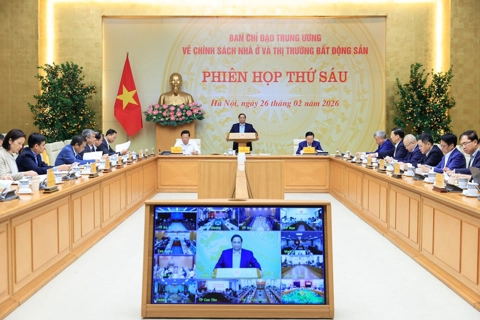
| Overview of the meeting. |
.jpg)
Qiliang also emphasized the critical role of human resources in railway development projects. CRSC is eager to collaborate with Vietnam in research, development (R&D), and railway signaling, which are essential elements for the advancement of railway systems.
Echoing this viewpoint, Chinh mentioned the challenges in training human resources for Vietnam's railway projects.
That is why Vietnam seeks collaboration with China in personnel training, management, control, and design for railway projects, he said.
"Human resources must come before technology transfer. If product costs and logistics remain high, it will be challenging to compete in the market. Therefore, we hope the corporation will participate," Chinh added, urging CRSC's leadership to visit Vietnam for detailed discussions with ministries and sectors to advance these projects.
According to Minister Nguyen Van Thang, the governments of Vietnam and China are directing the implementation of three railway projects connecting the two countries, with the first project, Lao Cai - Hanoi - Hai Phong, expected to commence around 2025.
The Minister of Transport also hinted at potential cooperation in standard gauge railway projects linking seaports to economic zones, industrial parks, airports, and border gates. He emphasized these projects' high economic efficiency, and urged the participation not only of state-funded projects but also of the private sector through Public-Private Partnerships (PPP).
CRSC operates in over 20 countries and regions, including projects such as the Jakarta-Bandung HSR in Indonesia, the Hungary-Serbia Railway, and the China-Laos Railway.