Remembering Merle Ratner: A cherished advocate for peace in Vietnam
Merle Ratner's lifelong love for Vietnam has led her to dedicate herself to the country's independence movement and the restoration of diplomatic ties between the US and Vietnam.
A ceremony was held in the northern city of Haiphong on August 10 to scatter the ashes of Merle Ratner, an American leftist and anti-war activist – a friend of Vietnam.
| Merle Ratner, a leftist and anti-war American activist, a friend of Vietnam. Photo: VNA |
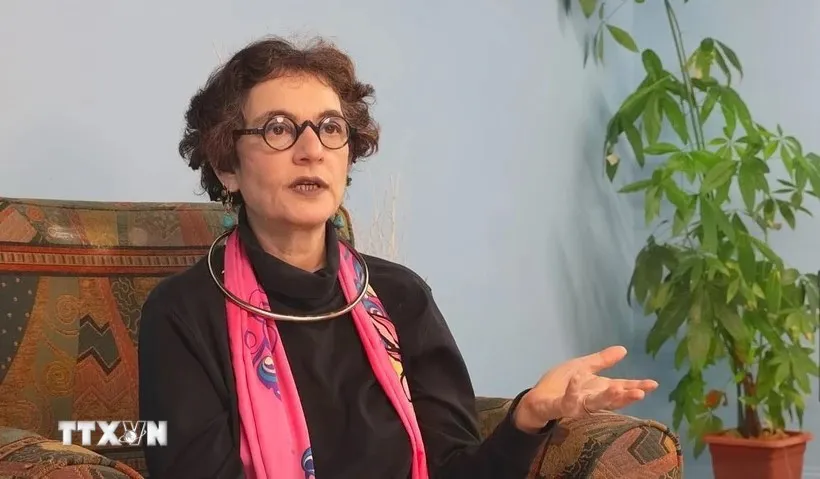
The ceremony coincided with the Day for Vietnamese Victims of Agent Orange/dioxin, for whom Merle Ratner was an active campaigner.
Vietnamese officials and people offered their condolences to Merle Ratner’s family, who died suddenly in a car accident in the US on February 5, 2024, at the age of 67.
To honor Merle Ratner for her support of Vietnam, her advocacy for Vietnamese victims of Agent Orange/Dioxin, and her contributions to the country's struggle for freedom, her ashes were scattered at the Do Son Sea in Haiphong, Vietnam, her second motherland.
For Vietnamese and Americans as well as friends of the global leftist movement, Merle Ratner's legacy serves as an endless source of inspiration and a fire that ignites the belief in amicable relations based on mutual understanding and respect for peace, cooperation, and development.
Prof. Ngo Thanh Nhan at New York University, Merle Ratner’s husband, expressed his gratitude to Vietnam for Vietnam's outpouring of emotion for her and her wish to rest in peace in the country she loved.
On August 8 in New York, the Permanent Mission of Vietnam to the United Nations held a somber farewell ceremony to send Merle Ratner’s ashes to Vietnam. Vietnamese Permanent Representative to the UN Dang Hoang Giang said that although Merle Ratner was born in the United States, she has dedicated her entire life to Vietnam, which became her second home.
He said that the people and leaders of Vietnam would never forget her fondness and her commitment to the cause of national development, reunification, and liberation. Merle Ratner is welcomed by the Party and the State of Vietnam as a long-lost relative.
At the ceremony in New York, Prof. Ngo Thanh Nhan, Merle Ratner’s husband, and her American friends recalled the significant years of her vibrant and passionate life spent championing the independence, peace, and prosperity of the Vietnamese people.
Born in New York in 1956, she took to the streets at the age of 13 to protest against the American war in Vietnam and became known for hanging anti-war signs on the Statue of Liberty. She was a co-founder and coordinator of the Vietnam Agent Orange Relief & Responsibility Campaign (VAORRC) in the New York area.
Since the late 1960s, Ratner had been active in anti-war demonstrations in Vietnam, the anti-imperialist movement in the 1970s and 1980s, and current anti-racism campaigns in the United States.
Ratner fought for the normalization of Vietnam-US relations after 1975 and supported Vietnam’s foreign relations activities out of a profound love for her country. She made many trips to Vietnam and cand maintained close cooperation with Vietnamese mass organizations, the Vietnam Fatherland Front, and the Ho Chi Minh National Academy of Politics.
She was awarded the “For Vietnam Agent Orange Victims” and the “For the Development of Vietnamese Women” insignias in 2010 and 2013, among other honors from Vietnam.
When she was alive, had close friends in the capital city of Vietnam - the place she loved for its cultural riches, ancient architecture, and historical relics. Merle Ratner had long been connected to Hanoi and Vietnam through her work in advocating for human rights, social justice, and solidarity with Vietnam. She has been actively involved in several key areas that have deepened her attachment to Hanoi: One of the things is her support for victims of Agent Orange: Ratner worked closely with Vietnamese organizations to advocate for the victims of Agent Orange, a toxic chemical used during the war. She helped bring international attention to the suffering of those affected by Agent Orange, many of whom live in and around Hanoi. In addition, she increased engagement with Vietnamese communities. Ratner was involved in efforts to support the development of human rights and social justice in Vietnam, including projects focused on improving living conditions for marginalized communities. This has brought her to Hanoi frequently for collaboration with local organizations and NGOs. In terms of cultural and educational exchanges, she fostered US-Vietnam relations by facilitating cultural and educational exchanges between Vietnam and the US, aimed at fostering mutual understanding and cooperation. Through these initiatives, she has cultivated strong ties with institutions in Hanoi, promoting dialogue and learning opportunities. At the same time, she worked with veterans. She worked closely with US veterans who served in Vietnam, many of whom have returned to Hanoi to participate in reconciliation efforts. Her role in facilitating these interactions has reinforced her connection to the city. Through her advocacy and solidarity efforts, Merle Ratner’s attachment to Hanoi has been rooted in her commitment to addressing the consequences of war, promoting peace, and fostering collaboration between Vietnam and the international community. |