Removal of business conditions to help change state management mindset in Vietnam
Business conditions should be for the sake of public interests, not for government agencies to fulfill their state management responsibilities, said an expert.
Removal of business conditions, not just simplification, would help change the current mindset in state management and speed up the establishment of e-government, according to Nguyen Dinh Cung, former director of the Central Institute for Economic Management (CIEM).
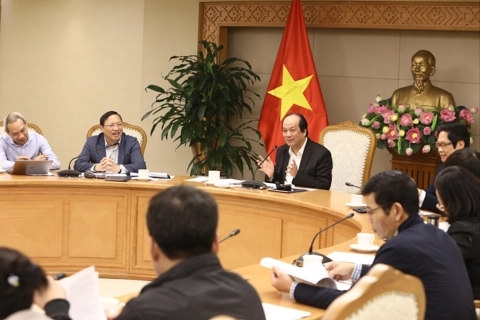
| Overview of the workshop. Nguyen Tung. |
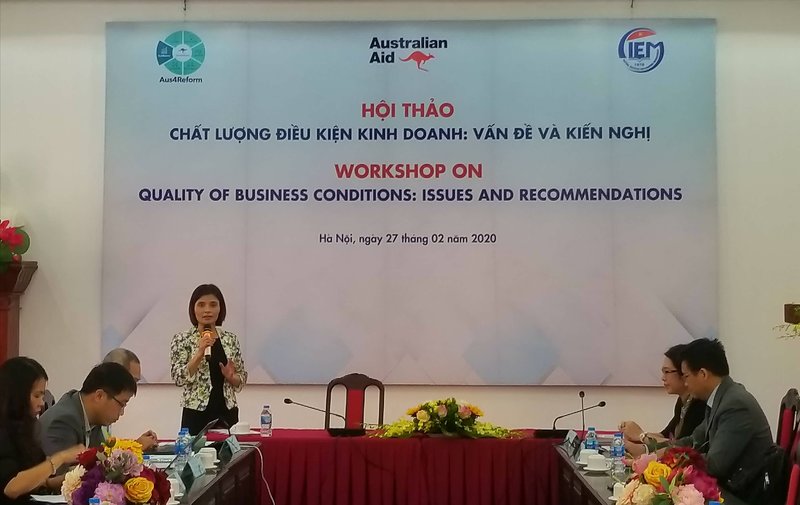
“For the government, they are instruments for economic management, but for the business community, business conditions are restrictions and barriers to market entry,” said Cung at a workshop discussing the quality of business conditions in Vietnam on February 27.
Business conditions should only be considered means for the state to safeguard national security and public interests, other than that, they are poised to cause unnecessary costs for enterprises, disrupt the market and reduce competitiveness, stressed Cung.
The removal of nonessential business conditions, therefore, would force government agencies to look for other ways of state management, Cung said, adding this is feasible in the current Industry 4.0 era when “technologies could come in handy in collecting information, evaluation and searching for solutions, and the model of e-government naturally becomes the next step forward.”
Meanwhile, the simplification of business conditions means there is no change in the existing mindset, and when the urge for reform cools down, all barriers and restriction would come back in full, Cung raised concern.
Nguyen Minh Thao, head of CIEM’s Business Environment and Competitiveness Department, said with 40 directives on reforming business conditions during the 2017 – 2019 period, the government is giving high priority to this matter.
“In 2018, the government requested the removal of 50% of total business conditions, but the actual figure may only be around 30%,” Thao said. "Some reforms are still limited to simplification of business conditions in form of numerical reductions, meaning almost no substantial changes for the business environment as the business conditions still remain."
Director of the Legal Department under the Vietnam Chamber of Commerce and Industry (VCCI) Dau Anh Tuan attributed the slow reform process to a lack of a clear definition on business conditions.
“Business conditions should be for the sake of public interests, not for government agencies to fulfill their state management responsibilities,” Tuan added.
Unless the government has clear instructions on setting up business conditions, government agencies would continue to take advantage of such a loophole to protect their interests, Tuan continued.
As the drafting process for the new Law on Enterprises is underway, Tuan suggested the drafters incorporate incentives for market entry and freedom of doing business.
Additionally, during every process of policy making, policymakers should take into account economic benefits of these policies and potential damages to businesses.
Tuan noted there have been signs of major corporations lobbying the government to tighten market entry regulations as a way to maintain their market shares.
“The government must ensure competitiveness of the market and lower requirements for market entry,” Tuan said.
Small and medium enterprises are fully capable of making high quality products and services, in turn bringing great value for customers and society, Tuan asserted.
More importantly, there should be a clear line between policymakers and those enforcing policies afterwards, Tuan stressed.
“This is the only way to ensure the efficiency and fairness of laws. Otherwise, reform efforts would not be sustainable and remain a formality,” Tuan concluded.