Tech giant CMC Group advises Hanoi to build an innovation center
According to CMC Group's CEO and Chairman Nguyen Trung Chinh, the establishment of an innovation center at the Hoa Lac Hi-Tech Park would reinforce Hanoi's commitment to advancing science, technology, and innovation.
THE HANOI TIMES — Hanoi should establish an Innovation Center at the Hoa Lac Hi-Tech Park through a public–private partnership, according to CMC Group Chairman and CEO Nguyen Trung Chinh.

The Hoa Lac Hi-Tech Park in Hanoi's Thach That District. Photo: Chien Cong/The Hanoi Times
At a workshop on June 19 focused on promoting science, technology, and innovation, he proposed operating the center as a dedicated legal entity that combines public assets, private governance, and social resources.
Chinh said the center should serve as a strategic hub that links R&D efforts, trains human resources, facilitates technology transfer, supports startups, operates a technology exchange platform, and provides an open space for developing and commercializing "Make in Vietnam" products.
“In today’s increasingly fierce global competition, Hanoi must offer attractive policies, and be willing and open to experiment with new models and institutional breakthroughs that transform both thinking and operations,” he said.
The business executive said the center would facilitate "three-party" cooperation between the state, scientists, and businesses within Hoa Lac.
This ecosystem would place businesses at the heart of innovation, scientists as drivers of knowledge, and the government as a policy enabler and leader.
“If this tripartite model is successful, it will provide Hanoi with a sustainable foundation to attract and retain talent while generating new growth momentum for the city and beyond,” Chinh said.
Bui Thi Minh Hong, Director of Education at VinUniversity, said that attracting talent also depends on whether institutions have bold visions and significant challenges to overcome.
She highlighted a modern work culture and policies to support the return of Vietnamese professionals.
Professor Nguyen Van Minh of Hanoi National University of Education said it is necessary to create unique living and working environments to maximize the potential of scientists and intellectuals.
He recommended prioritizing talent development through stronger higher education, core science and technologies, overseas study, and funding mechanisms for science and innovation.
“Hanoi must be selective when attracting international expertise to avoid becoming a dumping ground for outdated technologies,” Minh added.
Do Tien Thinh, Deputy Director of the National Innovation Center (NIC), emphasized the importance of investing in technological infrastructure first.
He also proposed tax and land incentives for large corporations, as well as support programs to foster international business cooperation.
According to CMC Chairman Nguyen Trung Chinh, many small tech companies and startups in Hoa Lac face high costs for servers, data storage, high-bandwidth internet, and high-performance computing, which are typically affordable only by large corporations.
He called on the city to build a shared digital infrastructure system for businesses, research institutes, and universities.
Such a system would conserve social resources and accelerate technology testing, product deployment, and commercialization.
He noted that administrative procedures and land use policies remain too rigid, citing prolonged permitting times, complex paperwork, and a lack of clear incentives.
He urged the city to issue a special policy framework for Hoa Lac that includes flexible land allocation, streamlined administrative procedures, and fully digitalized permitting processes.
Regarding workforce development, Chinh urged the city to adopt clear, accessible policies to attract various expert groups.
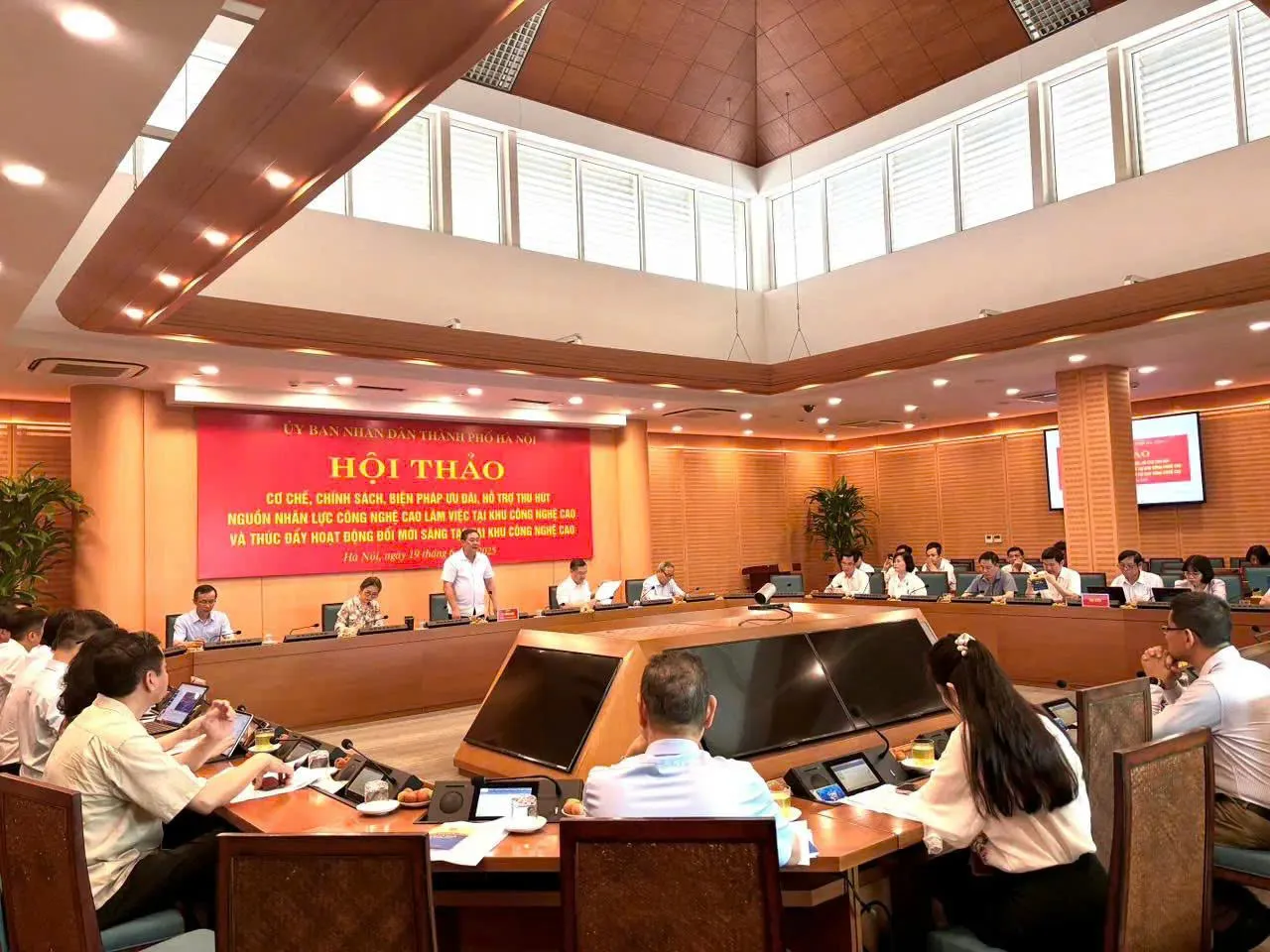
Overview of the meeting on June 19. Photo: Kinh te & Do Thi Newspaper
“CMC is ready to collaborate with Hanoi University of Science and Technology and the Hoa Lac Hi-Tech Park Management Board to pilot this model, demonstrating the feasibility and effectiveness of the ‘three-party’ approach,” he said.
Le Hong Son, Vice Chairman of the Hanoi People's Committee, stated that the city will soon issue resolutions on science, technology, and innovation, prioritizing top domestic and international technology experts, scientists, engineers, and professors; Vietnamese professionals abroad; and award-winning young innovators.
Son added that the policy packages should be tailored to each group and include both tangible and intangible incentives, including performance-based salaries, favorable visa and residency policies, personal income tax exemption, talent incubation programs, legal protection for experts, and startup–investor connections.
These resolutions must align with the capital's development objectives and establish a collaborative mechanism between the government, businesses, universities, and investment funds.
Son also suggested more support for the public-private partnership (PPP) governance model in which the government focuses on policymaking and oversight while businesses lead market operations.