The US helps Vietnam close tuberculosis detection and treatment gaps
The donation, including drugs to treat 15,000 patients with latent tuberculosis infection for three months, will be distributed nationwide.
The US Agency for International Development (USAID) on February 16 delivered new tuberculosis (TB) detection tools and treatment medications valued at roughly US$3 million to the National Lung Hospital of Vietnam in support of the country's goal to end TB by 2030.
The donation includes 38 rapid diagnostic machines with 90,000 test kits and 10 digital X-ray devices to be distributed to district health facilities across the country, including those in the remote areas of provinces of Nghe An, Lai Chau, An Giang, and Dong Thap, which have a high burden of TB and multidrug-resistant TB.
Director of Vietnam National Lung Hospital Nguyen Viet Nhung said that both the rapid diagnostic machines and the X-ray devices are designed to operate in hard-to-reach areas.
USAID Vietnam Mission Director Ann Marie Yastishock and Director of Vietnam National Lung Hospital Nguyen Viet Nhung in the aid delivery ceremony held at the hospital. Photo: USAID Vietnam |
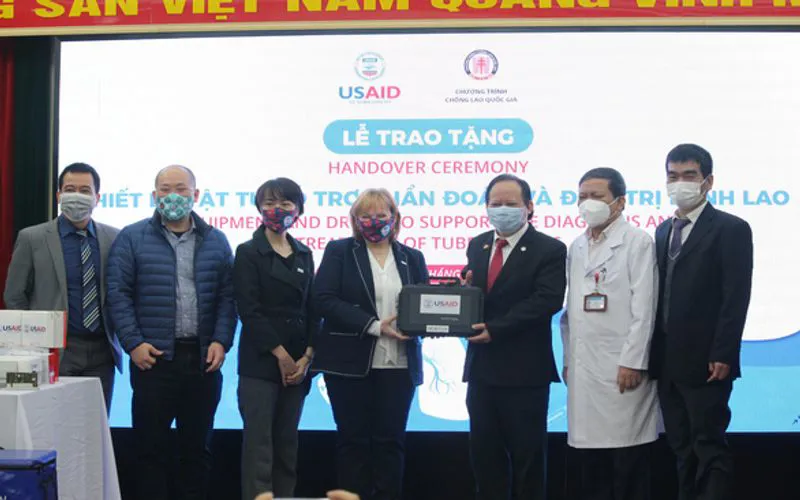
“The rapid diagnostic machines, called Truenat, can perform on-the-spot detection of TB and drug-resistant TB in less than two hours and are battery-powered. The digital X-ray devices are ultra-portable, with computer-aided TB detection software to assist in areas where radiologists may not be present,” Nhung said.
He added that the donation also includes drugs to treat 15,000 patients with latent TB infection for three months, to be distributed nationwide.
Besides, USAID is funding a tailored package of training curricula and technical support to the National Tuberculosis Program, health facility staff and local partners. This will help ensure greater sustainability of efforts to enhance Vietnam’s active case detection, ensure accurate and timely diagnosis, and support linkages to the treatment of active and latent TB.
“In Vietnam, approximately 40% of new TB cases go undetected and untreated every year. The new diagnostic equipment and treatment medications delivered today directly support Vietnam’s National Tuberculosis Program’s “Double X” strategy to improve TB case detection and increase uptake of TB preventive therapy in our joint effort to end TB in the country,” Nhung stressed.
He noted that the impacts of Covid-19 have severely reduced TB care and services, with TB detection in Vietnam decreasing by 23.5% in the first 10 months of 2021.
To address this, USAID Vietnam Mission Director Ann Marie Yastishock said that the agency is also supporting the integration of TB screening in the Vietnamese Government's Covid-19 vaccination campaigns.
Since 2018, USAID has provided Vietnam with over US$16 million in TB health assistance. In continued partnership with the Government of Vietnam, today’s donation demonstrates USAID’s steadfast support to achieve the End TB goals by 2030.
“USAID will continue to support the introduction of the latest high impact TB technologies and treatment medications as part of the ongoing partnership and solidarity between the United States and Vietnam,” Ann Marie Yastishock affirmed.
TB is preventable and curable. Yet every year in Vietnam, 172,000 people develop TB and more than 10,000 people die from TB, placing Vietnam among the top 30 countries with the highest TB burden in the world.