Hanoi maintains public service discipline as Tet holiday nears
Hanoi keeps administrative services running through Tet while advancing digital reform, AI applications and mobile public service teams to improve efficiency and citizen satisfaction.
THE HANOI TIMES — With the 2026 Tet (Lunar New Year) approaching, government offices and public service centers across Hanoi have maintained strict discipline, showing no signs of slowing down.
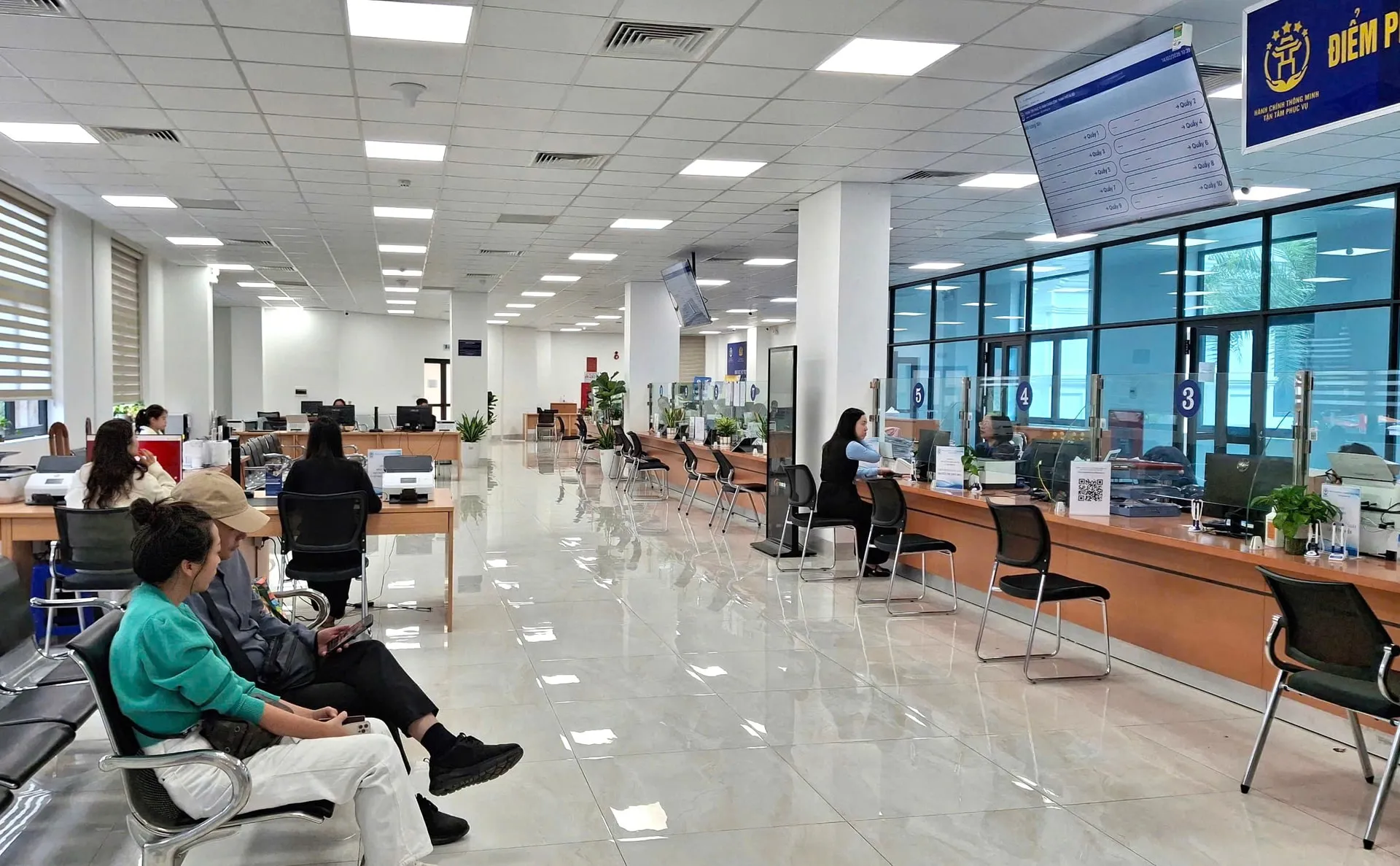
The Hanoi Administrative Service Center's Branch No. 2 on the last working day before Tet. Photos: Hanoimoi Newspaper
For residents, the final working days of the year often mean rushing to complete pending paperwork before the holiday. Many aim to settle procedures and start the new year without backlogs.
On February 14, the final working day before Tet, most visitors handled civil status and land-related matters. Staff processed applications promptly, whether submitted in person or online.
Nguyen Thi Ha arrived at the Hanoi Public Administrative Service Center’s Branch No. 2 in Cau Giay Ward to register a birth certificate.
Ha said she felt unsure about filing online. With staff guidance, she completed her submission and will receive the result after Tet.
Do Tien Viet, from Hong Ha Ward, arrived early at Branch No. 1 on Vo Chi Cong Road in Tay Ho Ward to finalize his business documents. Staff processed his application in accordance with regulations, ensuring it was completed before the new year.
“Finishing before Tet helps us start fresh after the holiday,” Viet said.
Staff regard citizen satisfaction as both a responsibility and a source of motivation. Full staffing was maintained and procedures strictly observed through the final working day.
Before the Tet break, employees reviewed, sorted and sealed files, cleaned offices and shut down electrical systems to ensure safety. The center also scheduled on-duty staff during the holiday to handle urgent cases.
Nguyen Thi Thuy Nhung, an administrative employee in Cau Giay Ward, said many elderly residents struggle with online applications.
“We guide them carefully and contact applicants if information is missing. About 90% of files are processed ahead of schedule,” she said.
Nguyen Thi Thuy Hoa, who oversees land procedures at the center’s Branch No. 2, said the office typically receives 300–400 in-person visitors per day, though only a few dozen arrived on the final morning.
All staff worked through the last day, ensuring full attendance and attentive service to reduce repeat visits, she said.
The branch’s Director Nguyen Hoang Thang said all 29 staff members across 25 counters are present at work despite lighter foot traffic. Specialists also focused on clearing online applications.
He added that affiliated support points operated normally, with duty schedules in place for Tet to address urgent needs.
Nguyen Thi Viet Ha, Deputy Director of Branch No. 1 in Tay Ho Ward, said administrative procedures continue as long as residents and businesses arrive.
“From February 15 to February 20, we assigned staff to remain on duty at all five service points to resolve unexpected issues,” she said.
Administrative reform and digital transformation as core task
Hanoi has identified administrative reform as a core political task and a central growth driver, targeting at least 11% GRDP growth in 2026.
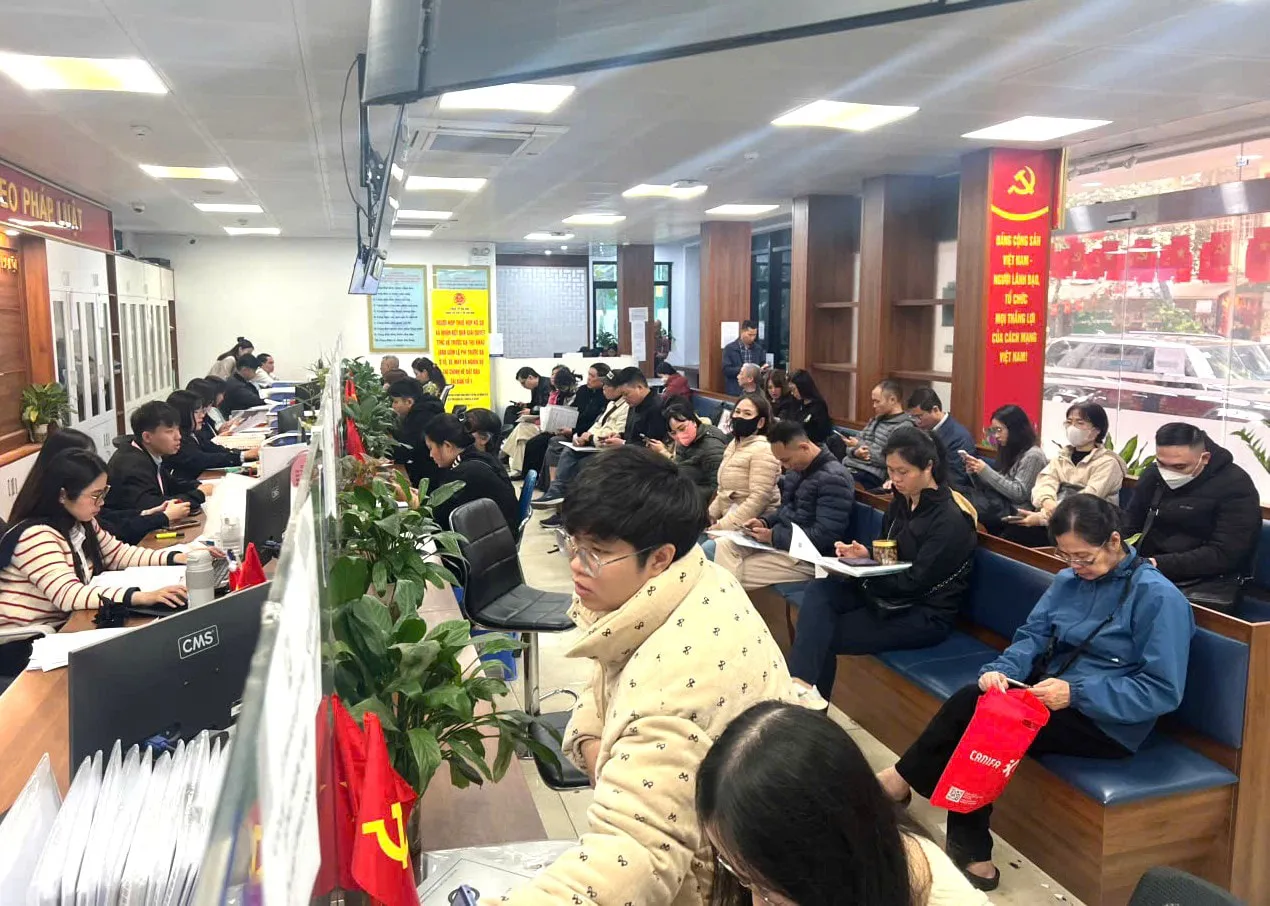
Many residents gather at the Hanoi Administrative Service Center's Branch No. 3 to complete their applications.
The city aims to remain among the country’s leaders in the Public Administration Reform Index and to achieve at least 86% satisfaction in the Public Administration Satisfaction Index, including 90% satisfaction for online services.
A key element of the 2026 reform plan involves modernizing governance through digital platforms and artificial intelligence.
Hanoi aims to conduct all leadership and internal management activities on digital systems, applying AI within its document management platform. Authorities plan to process all work files electronically at city and commune levels, except classified documents.
The city also seeks to remove dependence on local administrative boundaries for public services and to ensure all applications are resolved on or before deadlines, with land and investment sectors reaching at least 99% on-time processing.
Hanoi continues streamlining its apparatus under the principle of lean and effective governance and plans to reduce at least 20% of state-funded staffing in line with central directives.
Officials will review the restructured Public Administrative Service Center after one year, following the transfer of commune-level service points to centralized management.
To strengthen transparency, the city requires agencies to process and publicly disclose all citizen feedback on the iHanoi application. Leaders must hold dialogues with residents and businesses at least twice a year.
Under guidance from the city’s steering committee on science, technology and digital transformation, Hanoi has restructured 293 administrative procedures.
The move saves more than VND1.65 trillion (US$65.5 million) in social costs annually and cuts millions of travel hours, marking a shift from paper-based to data-driven governance.
Hanoi leads in applying AI to public services through its AI Callbot.
Previously, hotlines often became overloaded. The AI Callbot now operates around the clock, checking application status, guiding procedures and answering basic legal questions.
Officials estimate the system reduces 30% to 40% of repetitive inquiries handled by front-desk staff and standardizes responses.
The AI Callbot integrates with the iHanoi app and uses generative AI to convert speech to text and back with natural Vietnamese intonation. The system handles thousands of calls simultaneously without congestion.
Technology firms have also developed specialized virtual assistants for government agencies.
A legal assistant can draft documents and detect regulatory conflicts within seconds, replacing manual work that once took weeks. Meeting assistants can record, summarize and assign tasks automatically.
|
Hanoi launches Mobile Public Service Teams Vice Chairman of the Hanoi People’s Committee Nguyen Manh Quyen on February 13 signed a plan to deploy Mobile Public Service Teams citywide. Authorities describe the initiative as a breakthrough that brings services closer to residents, especially priority groups, without administrative barriers. The Hanoi Public Administrative Service Center and its branches will coordinate with local authorities to form teams that visit villages and residential areas. These teams will assist revolution contributors, policy beneficiary families, elderly residents, people with disabilities, low-income households and others unable to visit service centers. Teams will visit homes or community centers to guide procedures, explain documentation, assist with online submissions and support cashless payments and result delivery, focusing on complex areas such as land and social welfare. Members will also guide residents in using digital platforms such as iHanoi, VNeID and the National Public Service Portal. The city will expand remote support through the AI hotline 19001009, hotline 1022 (extension 7) and the iHanoi application, creating a multi-channel service ecosystem. The municipal People’s Committee assigned the Hanoi Public Administrative Service Center to lead implementation to ensure consistent and professional operations. Officials expect the Mobile Public Service Teams to raise satisfaction levels, strengthen community-based support networks and advance digital transformation across the capital. |