Universities, enterprises partner to close Hanoi’s workforce skills gap
Hanoi’s universities, vocational schools and key industrial enterprises have joined together to enhance workforce quality, bridge training gaps and drive the city’s industrial development.
THE HANOI TIMES — Universities, vocational schools and key industrial producers across Hanoi on September 11 agreed to enhance human resources training and meet the evolving needs of core industries.

Son Ha Group showcases its products at the 2024 Hanoi Key Industrial Products Fair. Photo: Hoai Nam/The Hanoi Times
The signing was part of a conference connecting the Hanoi Association of Main Industrial Products (HAMI) with domestic universities and vocational schools, organized by the Hanoi Department of Industry and Trade, marking an encouraging step for companies in the sector.
Tran Nam Hai, Deputy General Director of Thanh Giong Computer and Communication JSC, said that recruitment demand is currently high, driven by the Industry 4.0 and rapid growth of artificial intelligence (AI).
“We need people with technological background and business management skills to expand markets and sales," he said.
"Graduates are an important source of candidates, but they need additional training to meet real job requirements,” he added.
According to Hai, the quality of manpower is one of the decisive factors to drive the company's growth by 30%-50% in 2026. Economic challenges have kept its 2025 targets below expectations.
Thanh Giong Computer and Communication plans to expand its market coverage to 30-40 provinces and cities from the existing number of 10-15, the executive said.
Hai’s company is just one among many in Hanoi facing a pressing demand for skilled workers. ETEK Automation Solutions JSC have struggled to find suitable talents despite its strong needs.
"It can take us three to four months to hire a qualified engineer," said Chairman Nguyen Quoc Dat.
“With many foreign enterprises investing in Vietnam, the labor market now becomes intense, especially for those in need of high-quality human resources,” he noted.
Viet-Tiep Lock JSC at times has employed up to 1,000 people. The company is now employing 600 persons, therefore, its demand for quality labor is high.
However, ongoing challenges have still persisted.
General Director Le Duc Phuong said that the company is always in need of highly skilled technical workers. He said that Viet-Tiep Lock welcomes graduates into their workforce.
“To be operative, they need proper training," he said. "Passion for work and quick adaptability are also important."
Partnerships drive workforce quality growth
According to HAMI Vice Chairman Nguyen Cong Cuong, the need for talents across information technology and digital transformation roles continues to rise.
Demand is getting higher in specific fields such as application development, technology innovation, digital management, data analytics, marketing and online business, he said.
“Many graduates are short of practical skills, foreign language ability and familiarity with modern production lines," Cuong said.
"That is why new recruits must take re-training as it is the foundation to shape their mindset and skills for the job," he said.
"The gap between education and real-world needs is something we must work together to narrow."
Cuong noted that human resources are about operations and a strategic driver of competitiveness, creativity and global integration.
Key industrial enterprises want their specialized personnel ready to join production lines as soon as they are contracted, master new technologies and adapt quickly to shifts in the digital labor market, he added.
“This is essential for businesses to raise productivity, improve product quality and move closer to international standards,” Cuong said.

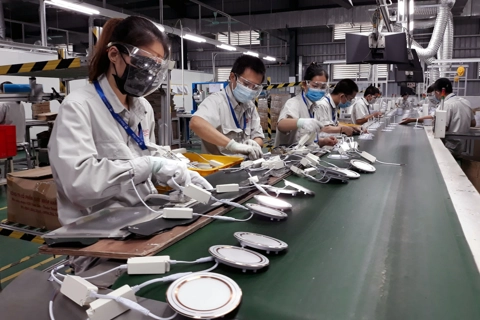
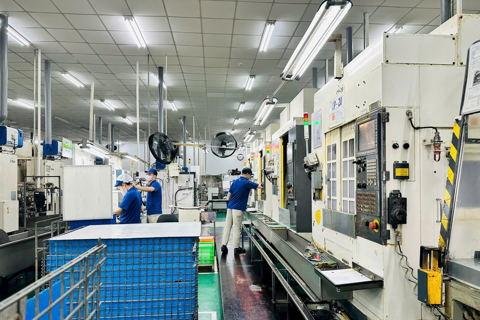
Electronics production at Katolec Vietnam in Quang Minh Industrial Park, Hanoi. Photo: Pham Hung/The Hanoi Times
He pointed to the fact that enterprises are already working with universities and vocational schools to design curricula, focusing on the creation of “order-based training” programs to deliver exact skills required by employers.
Alongside this, a sustainable cooperation mechanism is being developed under the “three-party model”, in which the State shapes policies, schools handle training and businesses employ and co-train the workforce.
“The ‘three-party’ model will provide a solid foundation for building a high-quality human resources ecosystem to support the growth of key industries,” Cuong said.
Nguyen Duc Thang, Vice Rector of East Asia University of Technology, said that the institution trains hundreds of skilled engineers each year with solid foundations and the ability to master new technologies.
Given the rising demand for high-quality talent in key industries, the facility is eager to deepen cooperation with businesses through internships, graduate recruitment, joint scientific research and tailored training programs, he said.
Thang hoped that stronger ties between academia and industry will open new opportunities for collaboration, contributing to the development of a highly qualified workforce to support Vietnam’s industrialization and modernization.
According to the Hanoi Department of Industry and Trade, the city currently has 104 enterprises with 156 products recognized as key industrial products across sectors from semiconductors and IT to mechanical engineering, textiles and processed food.
Each year, these enterprises generate nearly VND200 trillion (US$7.6 billion) in revenue, accounting for almost 35% of the city’s industrial production value, with export turnover reaching close to $2 billion.
According to Vuong Dinh Thanh, Deputy Director of the department's Industrial Promotion and Development Consulting Center, Hanoi is among the leading localities nationwide in terms of trained labor, with more than 70% of its workforce having undergone training. Half of those are graduates from universities, colleges and vocational schools.
Compared to global standards, both the structure and volume of high-quality labor remain insufficient, highlighting persistent challenges in talent development, he said.
For this reason, the city views stronger connections between manufacturers and training institutions as a strategic breakthrough, equally important as capital, resources and technology in building a high-quality workforce, Thanh said.
“This is key for Hanoi to achieve industrialization, modernization, and sustainable international economic integration,” the official said.